Persona Non Grata
by Jamie Bell
A Crimson Stain
The morning after, the campus hums with a different kind of energy, one that bristles with judgment. Kakeru navigates the halls, a target in plain sight, culminating in a confrontation with a defaced locker and a silent, damning encounter in a crowded corridor.
The air in the hallway felt like a freshly scrubbed floor – cold, clean, and entirely too reflective. Kakeru could practically see his own looming misfortune mirrored in the polished linoleum, distorted and wavering as if through a sheet of cheap plastic. Usually, the morning rush at Northwood Academy was a blur of backpack straps and half-finished conversations, but today, it was a deliberate, slow-motion ballet of avoidance. Shoulders dipped, gazes slid away, and conversations stuttered into whispers that seemed to follow him like a pack of particularly well-groomed ghouls.
He tightened his grip on his history textbook, the spine digging into his palm. It was the kind of pain that felt almost welcome, a small, honest anchor in a sea of abstract discomfort. He passed a group of sophomores, their heads bowed conspiratorially, then one of them, a girl with hair the color of over-steeped tea, risked a glance. Her eyes, wide and assessing, were exactly the same shade of disgust he’d seen on Mrs. Albright’s face when she’d found a rogue gum wrapper stuck to the underside of her desk. It was the look of someone judging a pest, not a person.
Kakeru felt a heat prickle behind his ears. This was it, then. The fallout. He’d known it was coming, of course. Trusting blindly, the previous context had whispered, leaves you vulnerable. But knowing and feeling were two wildly different beasts. The vulnerability wasn't just a wound; it was a gaping maw in his chest, exposed for everyone to see. He just hadn’t expected the whole school to arrive with popcorn and binoculars.
He rounded the corner, pushing through the invisible wall of social static, and there it was. His locker. Or what used to be his locker. A violent, angry crimson streaked across the pale green paint, dripping sluggishly down the small metal vents. The word, stark and unambiguous, screamed: 'RAT.'
And there they were. Naomi, flanked by two of her usual sycophants, stood back a few feet, admiring their handiwork. Naomi, with her perfectly straightened hair and a smirk that could curdle milk, held a can of cherry-red spray paint like a trophy. The smell of aerosol, sickly sweet and metallic, bit at the back of Kakeru’s throat. It was the scent of manufactured rebellion, of shallow malice.
“Oh, look,” Naomi purred, her voice dripping with mock surprise. “It’s the man of the hour. Come to admire our art, Kakeru?” Her friends snickered, a high-pitched, reedy sound that grated on his already frayed nerves. One of them, a boy with too much gel in his hair, elbowed the other, clearly delighted by the spectacle.
Kakeru just stared at the word. 'RAT.' It wasn’t even clever. It was primal, childish, and brutally effective. It felt less like an accusation and more like a brand, seared onto his public persona. His knuckles went white against the history book. He wanted to shout, to demand, to explain, but what would be the point? They weren’t looking for answers. They were looking for a show.
“What is this, Naomi?” Kakeru’s voice came out raspy, thinner than he intended. He hated the tremor in it, the obvious crack in his composure. He hated that she could see it.
Naomi tilted her head, her smirk widening. “Just a little public service announcement. You know, to warn everyone about… certain types. People who can’t keep their mouths shut. People who sell out their friends.” She glanced pointedly at his locker. “Figured a visual aid would be most effective. Northwood loves a good visual aid, don’t they?”
She was practically glowing with self-satisfaction. Her eyes, usually darting with insecurity, held a smug, vindicated gleam. It made Kakeru’s stomach clench. He thought of all the whispered conversations, the casual confidences, the shared anxieties over upcoming exams. All of it, now twisted into this ugly, public declaration.
“I didn’t—” he started, but she cut him off with a dismissive wave of the paint can. A thin, red line trailed off the nozzle, leaving a tiny, irrelevant streak on the polished floor.
“Oh, please,” she scoffed. “Everyone knows, Kakeru. Don’t bother with the dramatics. You gave up the goods. You threw your friends under the bus to save your own skin. Typical.” She blew a bubble with her gum, then popped it with a loud, obnoxious snap. It sounded like a gunshot in the suddenly quiet hall. Other students had started to gather, not openly staring, but definitely lingering, their peripheral vision trained on the scene.
Kakeru felt the weight of their collective judgment, a suffocating blanket woven from whispers and sidelong glances. He swallowed hard, his throat tight. He wanted to fight, to rage, but his limbs felt heavy, anchored by a sudden, profound weariness. What was the truth, anyway, in a place like this? It was whatever the loudest voice declared it to be. And right now, Naomi’s voice, amplified by a can of cheap red paint, was echoing across the entire institution.
He watched as Naomi and her entourage sauntered off, leaving him alone with the crimson accusation. The lingering smell of paint clung to his clothes, a scarlet badge of shame. He reached out, his fingers brushing the wet, tacky surface of the word. It was still soft, still vulnerable, like a fresh wound. He tried to scrape at it with his fingernail, but it only smeared, spreading the accusation further, deeper into the metal pores of the locker.
The bell shrieked then, an electric, nerve-jarring sound that signaled the start of first period. Students, who had been loitering with polite interest, suddenly dispersed, a torrent of backpacks and hurried footsteps. Kakeru was left in the suddenly emptying corridor, feeling utterly exposed. He was a piece of street art, a public declaration, but one without the artist’s consent. He was the subject of an installation, not a person.
He snatched his backpack from the floor, his movements clumsy. His history book slid from his grip and hit the linoleum with a dull thud. He didn’t bother picking it up immediately. The sudden urge to disappear, to simply evaporate into the chemical tang of the paint, was overwhelming. He looked up, his gaze sweeping the now sparse hallway, and that’s when he saw him.
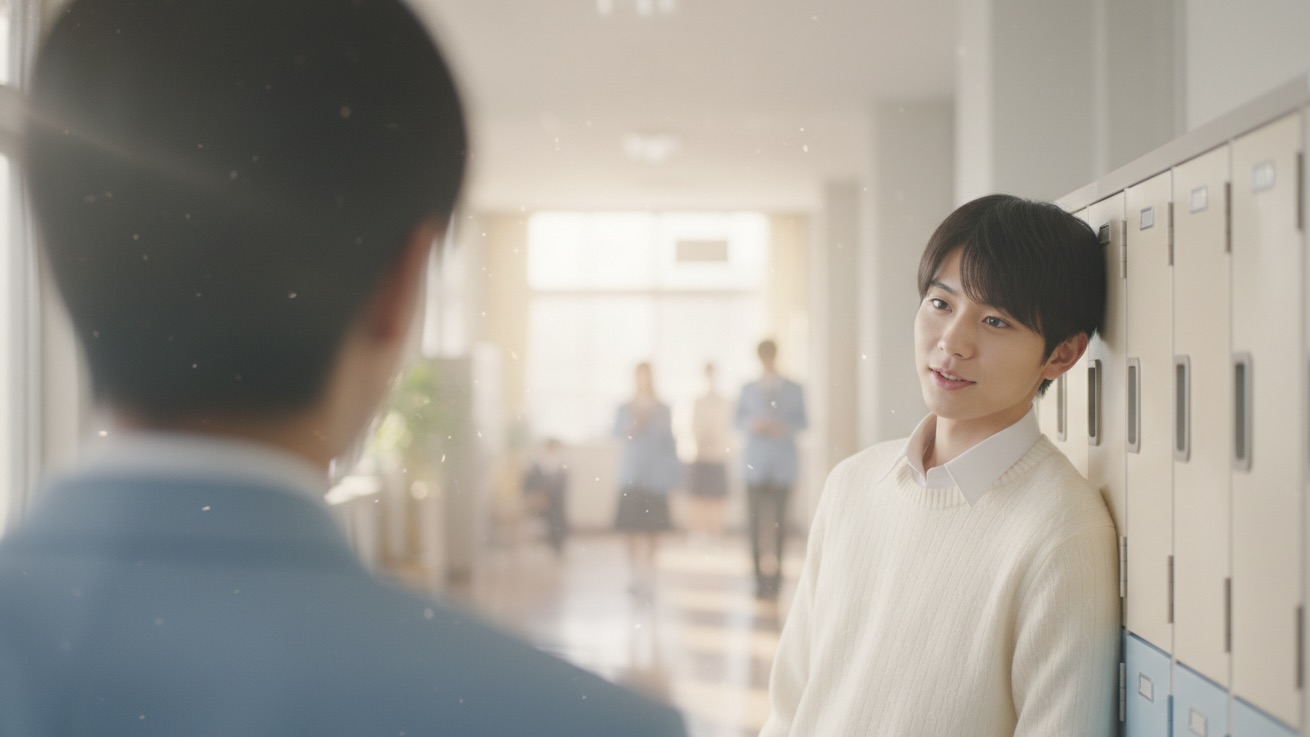
Asahi. He was further down the corridor, leaning against a row of lockers, talking to another student. His dark hair fell casually over his forehead, and a faint smile played on his lips. He looked effortless, composed, entirely untouched by the vulgar drama unfolding just meters away. Kakeru felt a jolt, an involuntary clench in his stomach that had nothing to do with anger and everything to do with the lingering, electric pull that had always existed between them. Even now, amidst the wreckage, Asahi’s presence was a physical force.
Their eyes met. Across the expanse of polished floor and fluorescent lights, Asahi’s smile faltered, just for a millisecond. His gaze, usually so sharp and direct, seemed to pass over Kakeru, then flicker towards the defaced locker. There was no surprise, no shock, no concern. Not a flicker of recognition for the boy he’d shared a late-night coffee with, the boy he’d exchanged secrets with, the boy whose trust he'd—
Asahi’s eyes met Kakeru’s again, but this time, they were cold. Impassive. A thin, almost imperceptible line formed between his eyebrows, a micro-expression Kakeru had learned to read as annoyance, or perhaps, simply, indifference. Then, Asahi turned his head, completing his conversation with the other student, as if Kakeru, and the screaming red 'RAT' on his locker, simply didn’t exist. As if they were just… background noise.
A cold dread, sharp and absolute, settled over Kakeru. It wasn’t just the public shunning, the cruel word, or Naomi’s vindictive grin. It was this. Asahi, standing there, perfectly still, perfectly calm, and doing absolutely nothing. Not a word. Not a step. Not even a sympathetic glance. He wasn't just not defending Kakeru; he was actively, silently endorsing the verdict. The unspoken message resonated louder than any spray paint.
The electrical spark that usually jolted between them, even in silent moments, was gone, replaced by a hollow echo. Kakeru felt a sharp, burning sensation behind his eyes. Not tears, exactly, but the hot, tight squeeze of profound disappointment. He had, stupidly, foolishly, perhaps even pathetically, held onto a sliver of hope. That Asahi, of all people, would somehow… explain. Or at least, acknowledge. But there was nothing. Just the chilling, casual turn of his head.
Kakeru snatched his fallen history book, the cover now smudged with a faint red mark he hadn’t noticed before. He clutched it to his chest, feeling the solid, unforgiving weight of it. The cold war had begun, not with a bang, but with a silent, devastating glance. It wasn’t just a war between him and the rest of Northwood. It was a war between him and Asahi. Or, more accurately, a war that Asahi had already won, sacrificing Kakeru on the altar of his own meticulously crafted reputation.
He dragged himself to class, the scent of fresh paint and betrayal sticking to him like a second skin. The classroom was an ocean of averted eyes. The seat next to him remained conspicuously empty, a wide, desolate expanse of desk that seemed to mock his new status. His backpack, usually nudged by a neighboring elbow, sat alone, an island of social leprosy. The teacher, Mr. Harrison, a man whose preferred method of discipline involved passive-aggressive eye contact, pretended not to notice Kakeru’s late arrival, nor the red stain on his textbook. This feigned blindness was, in its own way, another nail in the coffin.
Throughout the morning, the isolation became a physical thing, a growing pressure in his chest. He felt every shifted foot, every hushed whisper that died on the approach of his ears. In the cafeteria, the vast, echoing space suddenly felt infinitely larger. He found an empty table in a forgotten corner, near the back exit, and sat down. His lunch tray, with its sad-looking chicken nuggets and congealed peas, seemed to mirror his own internal state. No one approached him. No one even glanced his way directly. He was a ghost, visible only in the accusatory red on his locker, a pariah in the polished halls of Northwood Academy.
He chewed slowly, tasting nothing but the bitter tang of his own humiliation. He saw Naomi and her friends at their usual table, laughing, pointing, occasionally casting veiled looks in his direction. And then, he saw Asahi. Asahi was at a different table, surrounded by his own group, talking animatedly, his profile etched against the bright cafeteria window. He was smiling, genuinely, easily. The ease of it, the sheer normalcy of his existence, twisted something deep inside Kakeru.
It wasn’t just that Asahi hadn't defended him. It was that he clearly didn’t feel the need to. He was thriving, untouched, while Kakeru was crumbling. It solidified the gnawing suspicion that had taken root hours ago: Asahi had used him. He had extracted the information, whatever it was, and then discarded him, a convenient scapegoat in a game Kakeru hadn’t even known he was playing. The thought was a sharp, cold jab, cutting through the dull ache of his previous hurt.
The afternoon classes dragged, each minute an eternity of solitude. He could feel the eyes on his back, even when he couldn’t see them, like tiny, invisible barbs. He scribbled aimlessly in his notebook during biology, drawing geometric patterns instead of cellular structures. His mind replayed Asahi’s cold glance, Naomi’s triumphant smirk, the ugly word. Each memory was a brick in a wall, building higher and higher around him, sealing him off.
When the final bell rang, Kakeru was the first one out of the classroom, almost sprinting down the deserted halls. He wanted to escape, to breathe air that didn’t smell of linoleum cleaner and judgment. He walked past his locker again. Someone had tried to wipe away the 'RAT,' but only managed to smear it further, turning the sharp, angry letters into a blurry, crimson splotch. It looked even worse, a testament to the futility of trying to erase public condemnation. He just wanted to go home.
He pushed open the heavy main doors, stepping out into the late afternoon light. The sun, usually a cheerful burst, now felt weak, filtered through a haze of distant exhaust fumes and the dull gray of the urban sky. The campus, usually buzzing with after-school activity, felt emptier, quieter, as if everyone else had already vanished into the comfort of their own lives. He walked towards the bus stop, his shoulders hunched, the weight of the day pressing down on him. The chill of the air was a welcome sensation against the internal heat of his shame. He was alone, truly alone, and the knowledge settled deep in his bones, cold and sharp. This was the price of trust, he thought. This was what happened when you dared to believe in someone else's sincerity, someone else's secret, especially in a world that thrived on performance. He swore, silently, that he wouldn't make that mistake again.
He closed his eyes for a moment, the image of Asahi’s impassive face burned into his memory. The way the light had caught his dark hair, the casual grace of his posture, the utterly blank expression when their eyes had met. It wasn't just indifference. It was a calculated distance, a strategic retreat. It was the confirmation that Asahi, the grounded, the pursued, had made a choice. And that choice had been to let Kakeru drown. The betrayal wasn't just emotional; it felt like a tactical maneuver in a covert operation, a clean, precise cut. The thought left a bitter taste, metallic and raw, far stronger than the lingering scent of red paint.
To the Reader
“The sting of betrayal often carves a path for resilience, forcing us to redefine strength not in trust, but in self-reliance. Just as Kakeru learned that even perceived betrayals reveal hidden truths about ourselves and others, remember that your capacity to heal and grow, even from the deepest wounds, is a testament to your unshakeable worth.”
Share This Story


