A Crack in the Glass
by Jamie F. Bell
A Shared Reach in the Quiet
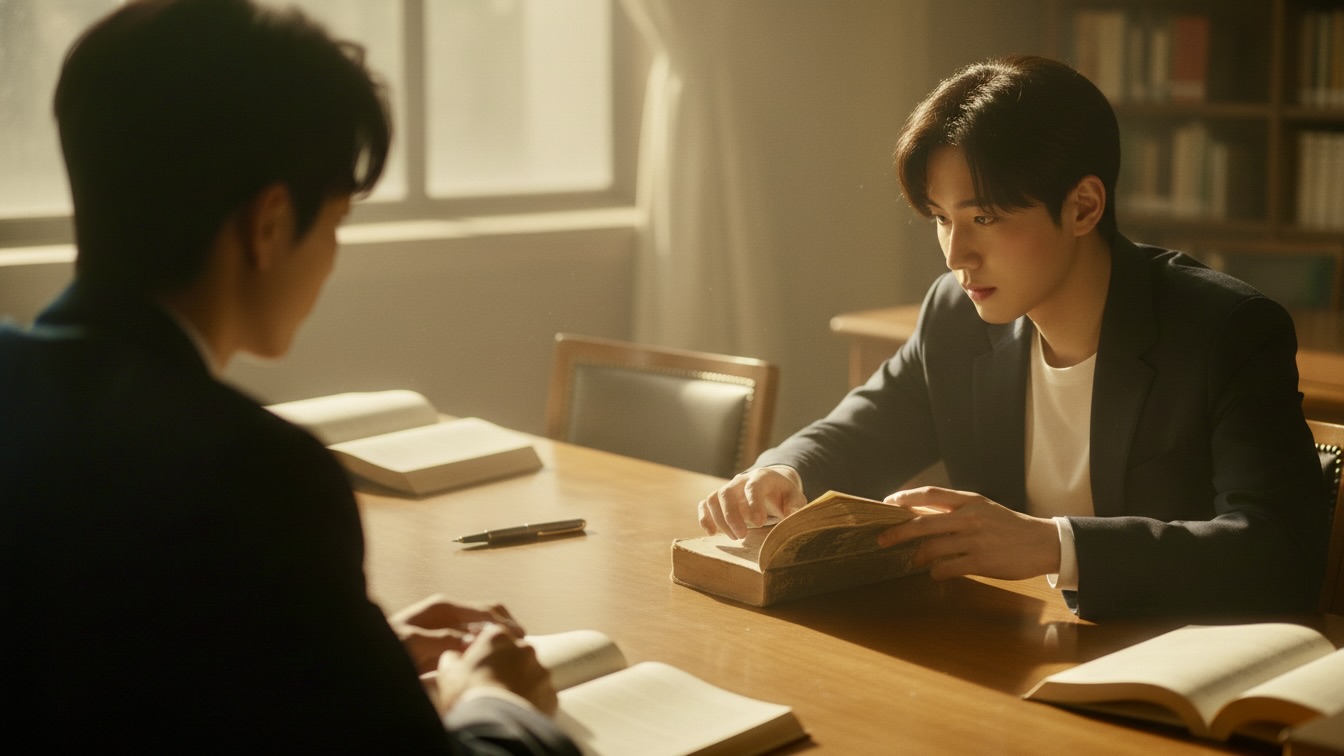
In the hushed, book-lined expanse of the school library's study room, a late afternoon sun filters through tall windows, casting long, dusty rectangles across worn wooden tables. Books are stacked haphazardly, reflecting the chaotic order of a group study session. Two boys, Daichi and Hiroki, are seated across from each other, the air thick with an unspoken tension that buzzes just beneath the surface of their focused work. Friends Maya and Ricky are nearby, their presence adding another layer to the intricate social dynamics.
The air in the study room, usually a low hum of hushed whispers and turning pages, seemed to thicken, pressing in on Daichi’s ears. It wasn’t the heat, though the late afternoon sun was slanting mercilessly through the high windows, warming his left cheek. It was something else. A static charge. He needed the textbook, the one on European history—the faded, slightly warped copy sitting squarely between him and Hiroki. His fingers twitched, a nervous tic he’d picked up somewhere, probably from endless hours hunched over homework, ignoring the world. He reached, a quick, almost involuntary motion, intending to snag the book before anyone else could lay claim to its brittle pages.
At precisely the same micro-second, Hiroki reached too. Their hands met over the cheap, textured cover—not a forceful clash, not even a firm grip, just the barest brush of skin. Daichi’s fingertips, cool from gripping his pencil, registered the unexpected warmth of Hiroki’s knuckles, the slight rough texture of a calloused joint. It was a jolt, sharp and unwelcome, like touching a live wire. He snatched his hand back as if burned, a reflex, his chair scraping loudly against the linoleum floor, a sound that felt deafening in the library’s quiet reverence. His breath hitched, a small, involuntary gasp. The heat from Hiroki’s hand seemed to follow him, pooling in his cheeks, then rushing through his neck and up into his ears until they felt fit to burst.
He didn’t look up. Couldn’t. His gaze was glued to the scuffed, worn toe of his sneaker, one lace already threatening to come undone. The sudden flush, he knew, was a betrayer. He could feel the fire crawling up his face, a vivid, inescapable crimson that announced his panic to the entire room, to the entire world, probably. God, you’re an idiot, he thought, a familiar, harsh voice echoing in his head. Why can’t you just be normal? It was just a hand. Just a book. You’re making it into a whole… thing. He clenched his jaw, the muscle there popping. His throat felt tight, a knot of embarrassment and something else, something he refused to name, refusing to acknowledge the weird, fluttery beat of his heart.
From across the table, Hiroki watched. His hand, the one that had brushed Daichi’s, remained on the textbook for a fraction of a second longer before he slowly, deliberately, picked it up. His eyes, dark and unreadable, tracked the fierce blush spreading across Daichi’s face, the way Daichi’s shoulders hunched inward, the sudden rigid set of his spine. It was a stark contrast to the sprawling, sometimes achingly vulnerable sentences that filled the margins of his own notebook. The boy in those letters… he was quiet, yes, introspective, but there'd been an almost reckless honesty in his words, a desperate yearning beneath the carefully crafted cynicism. This boy, hunched over his notebook like a cornered animal, was all sharp edges and desperate self-preservation. Hiroki’s brow furrowed, a faint, almost imperceptible line of curiosity and something akin to… concern.
The silence stretched, thick and awkward, punctuated only by the occasional rustle of paper from another table. Daichi could feel Hiroki’s gaze, a weight on his skin, even with his head down. He tried to focus on the diagram of the Treaty of Versailles in front of him, but the lines blurred, a meaningless tangle of ink. He wished the floor would just open up and swallow him whole, or that he could just… disappear. This was exactly why he preferred writing. Pages didn’t blush. Words didn’t stutter. You could craft them, hone them, make them say exactly what you wanted, or what you thought you wanted, without the messy, unpredictable reality of a human interaction.
Maya, perched precariously on the edge of her chair a few feet away, her brightly colored gel pen tapping a nervous rhythm against her teeth, picked up on the tension immediately. She was good at that, Daichi noted cynically, the social lubricant of their friend group. Always sensing the impending social implosion. “So, this project,” she began, her voice a little too bright, a little too loud. “The amount of reading is insane, right? I swear, Professor Ito thinks we’re all going for PhDs in ‘Ancient Roman Bathhouse Etiquette.’” She laughed, a light, airy sound that didn’t quite reach Daichi’s ears, bouncing off the wall of his embarrassment instead.
Daichi managed a grunt, a noncommittal sound that he hoped passed for engagement. He finally risked a quick glance up, not at Maya, but at his own notes, then swiftly back down. He could feel Hiroki’s eyes still on him, a subtle pressure. He wanted to scream. Or bolt. Or maybe just crawl under the table and wait for the bell. “It’s fine,” he mumbled, his voice rougher than he intended. He didn’t want to talk about the project. He didn’t want to talk about anything. He just wanted to be invisible.
“‘Fine’?” Ricky, leaning back precariously on two legs of his chair, piped up, a mischievous glint in his eye. He was oblivious, or perhaps willfully ignorant, to the finer points of social discomfort. “Daichi, that sounds less ‘fine’ and more ‘I want to set this textbook on fire and watch it burn in the administrative office’ fine.” He winked at Hiroki, then at Maya. “Looks like we need a mediator for this intense study session. Any volunteers to bridge the chasm of… academic despair?” Ricky’s usual brand of humor, designed to disarm, only made Daichi feel even more like a raw nerve exposed to the harsh light of judgment.
A nervous, high-pitched laugh escaped Daichi’s throat before he could clamp down on it, a sound that was far too loud and entirely too fake. It felt like a betrayal, a physical manifestation of his internal turmoil. He hated that laugh. Hated the way it made his throat ache, the way it solidified his own perception of himself as fundamentally inadequate, always on the verge of some social misstep. He could feel the eyes of their small group, even Maya’s, lingering on him. Just play it cool, he told himself, a futile instruction. Just act like you’re not about to combust. He pushed his glasses up his nose, a desperate attempt to create a barrier, a shield against the scrutiny he felt.
Hiroki, however, didn’t join in Ricky’s laughter. He merely observed, his gaze calm, steady. There was no judgment in his expression, only a quiet, almost forensic interest. He saw the nervous laugh, the sudden twitch in Daichi's shoulders, the way his fingers now gripped the edge of the table, knuckles white. The contrast was startling: the boy who wrote about the crushing weight of expectations, about the desperate hope for connection in a world that felt indifferent, was now visibly crumbling under the mildest social pressure. It was intriguing, to say the least. A puzzle. And Hiroki, despite himself, found he liked puzzles.
The study session, an agonizing stretch of time, eventually ground to a halt. Daichi practically bolted from his chair the moment Professor Ito’s voice boomed from the front, dismissing them. He mumbled a hurried farewell, avoiding eye contact with everyone, especially Hiroki. He walked the crowded hallway to the cafeteria, his backpack strap digging into his shoulder, a small, dull ache forming behind his temples. The conversation from moments ago replayed in his mind, Ricky’s words, his own pathetic laugh. He hated how easily he spiraled, how quickly a small, accidental touch could unravel his carefully constructed composure.
At the lunch table, the usual chaos reigned—clatter of trays, excited chatter, the distant, indistinguishable din of hundreds of conversations. Daichi picked at his chicken katsu, the breading too greasy, the chicken too dry. He could feel the familiar weight of cynicism settling over him, a comfortable, if somewhat bleak, blanket. He wasn’t hungry. Not really. But he had to eat, had to appear normal. He took a sip of lukewarm green tea, trying to drown out the lingering sense of unease. He felt the phantom warmth of Hiroki's hand on his fingertips still, a ghost that refused to dissipate.
Then, Maya, ever the instigator, leaned forward, her eyes wide with a dramatic flair. “Honestly, though,” she said, her voice dropping conspiratorially, but still loud enough to carry across their small table, “this whole ‘secret pen pal’ project is actually kind of… intense, right? Like, who thought pouring your soul out to a stranger was a good idea for a class assignment?” She gestured vaguely with her fork, bits of salad flying through the air.
Her words hung in the air, a bell ringing in Daichi’s chest. He felt a sudden, sharp surge of panic, cold and swift. He swallowed hard, the chicken katsu turning to sawdust in his mouth. Intense. Yes, intense. Too intense. He’d poured out more than just his soul. He’d written about his anxieties, his quiet frustrations, the loneliness he rarely admitted to anyone, not even to himself most days. He’d cloaked it in metaphor and cynical observations, thinking it was safe, anonymous. But now, Maya’s words, echoing Ricky’s earlier joke about mediators, made it feel glaringly, terrifyingly exposed.
A ripple of whispers spread through their friend group, like a wave through tall grass. “Mine was just about homework,” someone mumbled. “Mine was a rant about my little brother,” another added. “Yeah, but like, some people really got deep, right?” Maya insisted, her gaze, for a fleeting second, resting on Daichi, then glancing quickly towards Hiroki. It was just a glance, probably meaningless, but Daichi felt it like a physical prod. He pushed his plate away, a metallic scrape on the table. The thought of his written words—words that felt so intimate, so vulnerable—being scrutinized, possibly even laughed at, made his stomach churn.
Hiroki, seated directly across from Daichi, seemed outwardly composed. He was slowly, methodically, eating his own lunch, a bento box he’d brought from home. But his eyes, though seemingly focused on his food, were still. He’d heard Maya’s comment, heard the ripple of conversation, and watched the sudden, subtle shift in Daichi. The way Daichi’s shoulders tensed, the swift withdrawal, the slight tremor in his hand as he set down his chopsticks. It was another piece of the puzzle, slotting into place. The vulnerable boy in the letters, the guarded boy in person, and now, this overwhelming sense of being exposed. Hiroki's mind raced, connecting the dots of Daichi’s unusual reactions, his quiet observations hardening into a deeper resolve.
Daichi slumped in his chair, trying to make himself smaller, trying to blend into the general cafeteria noise. He felt a cold sweat prickle his hairline. Every word he’d painstakingly crafted, every raw emotion he’d tried to articulate, suddenly felt less like a carefully constructed piece of himself and more like a poorly drawn map to his deepest insecurities. The intimacy he’d found in the anonymity of the letters now felt like a terrifying precursor to a public dissection. He wanted to snatch back every single sentence, every unguarded thought. He wanted to go back to the moment his hand had brushed Hiroki’s, to do it differently, to not recoil, to not blush, to not be… him.
The simple angle of his chair, turned slightly away from the table, felt like a desperate attempt to physically disconnect. He saw Ricky still joking, Maya still chattering, but it was all distant, muffled. He felt Hiroki's presence across the table like a physical heat, a quiet, unwavering anchor in the maelstrom of his own anxiety. He wanted to look up, to meet those calm, dark eyes, to see if there was any flicker of recognition, any hint of judgment. But he couldn't. He was a tightly wound spring, on the verge of snapping. The gap between the words on paper and the awkward, breathing reality of him felt like an unbridgeable chasm. He squeezed his eyes shut for a second too long, the cafeteria fading to black. When he opened them, the world was still there, loud and terrifyingly real, and his vulnerability felt like a beacon, glowing for everyone to see.
To the Reader
“Navigating vulnerability in a world that constantly demands a polished facade is a quiet bravery. You have permission to feel exposed, to be messy, and to guard your heart until it finds a space where it feels safe to bloom.”
Share This Story


