Translating the Words
by Jamie Bell
A Different Kind of Confession
Jun and Souta spend their days together, moving from a bustling café to the quiet of the library, and then walking home. Their unspoken affections grow through shared glances, nervous laughter, and the simple, profound weight of physical proximity, all while being quietly observed by their friends.
Jun picked at a loose thread on his sleeve, his gaze fixed on the steam rising from his lukewarm coffee. He’d arrived early, because of course he had. His brain, a perpetual overachiever in the anxiety department, had calculated every possible delay, every worst-case scenario. Now he was just… waiting. In a coffee shop that smelled faintly of burnt sugar and old cleaning products. His cynical side, a constant companion, whispered that this whole 'meeting in person' thing, after weeks of pouring his soul into letters, was probably a terrible idea.
He watched the door, the bell above it jingling with every entrance. Each time, his chest did a ridiculous little flutter, an internal tic he despised. He was a grown man, or at least, technically, a legal adult. He shouldn't be acting like some lovesick pigeon. And yet, here he was, hunched over a chipped ceramic mug, feeling like he’d forgotten how to breathe normally. It was absurd. Everything was absurd.
Then Souta walked in. No grand entrance, no dramatic pause. Just a quiet glide, his eyes already sweeping the room, finding Jun with an unnerving precision. Souta wore a dark, oversized hoodie that looked impossibly soft, and jeans that were faded in all the right places. His hair, a slightly disheveled dark cloud, framed a face that was, even to Jun's jaded assessment, unfairly composed. Too calm. Too collected. It was almost irritating.
A spark, a weird, almost painful jolt, shot through Jun. He’d known it would happen, had even braced for it, but the actual impact was still a surprise. His cheeks, traitorous things, warmed immediately. He hated that. He hated how visible he felt, how easily he reacted. Souta, on the other hand, just offered a small, almost imperceptible smile. A smile that managed to be both reserved and… warm. It was infuriating.
“Hey,” Souta said, his voice a low hum that somehow cut through the café chatter. He slid into the opposite seat, the plastic groan of the chair the only break in his smooth movement. He didn’t fumble with his bag, didn't awkwardly adjust his jacket. He simply was. Jun, meanwhile, nearly knocked over his coffee reaching for the sugar that wasn’t there. He’d already added it.
“Hey,” Jun managed, the word thin and reedy. He cleared his throat, feeling a blush creep down his neck. He wished he had a script. He’d written so many words to Souta, long, meandering paragraphs, but in person, his brain seemed to have short-circuited. All that carefully constructed vulnerability from the letters felt miles away, replaced by a sudden, intense desire to appear vaguely competent.
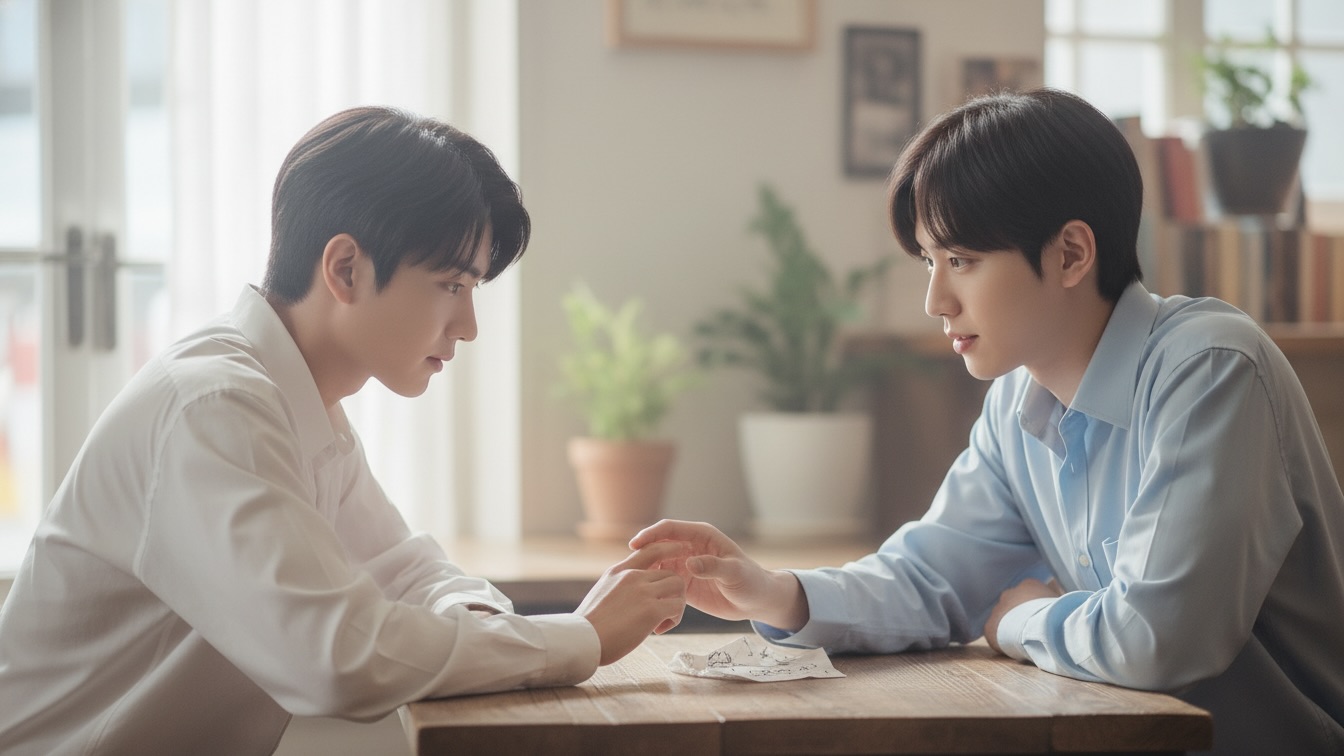
Souta ordered a black coffee, no fuss. While the barista scribbled his name, Souta pulled a tiny notebook from his pocket, along with a mechanical pencil, and almost immediately started sketching on a discarded napkin. His brow furrowed in concentration, completely oblivious to Jun’s internal meltdown. Or pretending to be. Jun watched, mesmerized, as Souta’s fingers moved, quick and precise, forming abstract shapes and delicate lines.
“You… do that a lot?” Jun asked, finally finding his voice. It still sounded slightly strangled.
Souta looked up, his gaze soft. “Hmm? Oh, yeah. Sometimes. Helps me think.” He paused, then offered the napkin across the table. “Just… nothing, really.”
Jun took it, his fingers brushing against Souta’s, a quick, almost imperceptible contact that still sent a shiver through him. The napkin was covered in intricate, swirling patterns, tiny eyes peering out from unexpected places, and what looked like a miniature, angry cloud. It wasn’t nothing. It was surprisingly detailed, almost a reflection of the quiet depth Jun had come to appreciate in his letters. He traced one of the lines with his thumb, a stupid, involuntary gesture.
“It’s… really good,” Jun murmured, feeling his face heat up again. He felt like an idiot. Really good? That was the best he could do? His internal cynic rolled its eyes. He stuffed the napkin into his pocket, a sudden, almost desperate urge to keep it washing over him.
They talked. Or rather, they spoke in fits and starts, punctuated by long stretches of silence that, surprisingly, didn't feel entirely awkward. Souta asked about Jun’s classes, about his part-time job at the bookstore. Jun found himself answering, more candidly than he’d expected, even sharing a minor complaint about a particularly rude customer. Souta just listened, head tilted slightly, a small, encouraging hum escaping him now and then. It was disarming.
Jun, in turn, tried to ask Souta about his day, stumbling over the questions, feeling like he was interrogating him. Souta, unruffled, mentioned a new project in his architecture class, something about sustainable urban planning. He spoke with a quiet passion, his eyes lighting up in a way Jun hadn’t seen before. It made him wonder, briefly, what else lay beneath Souta's perpetually calm exterior. He felt a weird, complicated mix of fascination and resentment for how effortlessly genuine Souta seemed to be.
Mid-conversation, Maya and Ricky ambled in, their laughter preceding them like a clumsy warning. Maya, with her bright pink scarf and even brighter smile, spotted them immediately. “Look who it is! The silent poets, finally out in the wild!” she teased, but her eyes held a soft, knowing warmth. Ricky just offered a half-wave, a small, approving smirk playing on his lips.
They didn’t linger, just grabbed their own coffees and found a table in the corner, offering a discreet, quiet support. Jun felt a flicker of gratitude, tempered by his usual suspicion. Even good intentions felt like a trap sometimes. But having them there, a familiar, non-judgmental presence, did make the air feel a little lighter, less charged with unspoken expectations.
As the afternoon wore on, the coffee shop emptied slightly. Jun and Souta lingered, their conversation slowly gaining a more natural rhythm. Souta’s knee, under the table, accidentally brushed against Jun’s. It was a fleeting contact, easily dismissed, but Jun’s entire body tensed. A static charge, a quiet hum. He held his breath, waiting for Souta to pull away, but he didn’t. The gentle pressure remained, a constant, low-level thrum against his jeans. Jun’s heart rate picked up, a frantic drum against his ribs. He stole a glance at Souta, who was still talking about his class, seemingly unaware. Or exceptionally good at faking it.
Later, the sun, a pale, anemic thing, began to dip, casting long, tired shadows across the café floor. Souta suggested they head to the library. “Got some readings I need to catch up on,” he said, pushing his empty mug away. Jun nodded, relief washing over him. The idea of ending the interaction now, of just walking away, felt… incomplete. His cynical brain tried to remind him that this was probably just procrastination, but his gut ignored it, pulling him forward.
The library was a different kind of quiet. Not the bustling hum of the cafe, but a hushed, reverent silence broken only by the rustle of turning pages and the soft coughs of diligent students. The air smelled of old paper and dust, a comforting, familiar scent to Jun. They found a table tucked away in a quiet corner, near a tall window that overlooked a small, grey courtyard.
They spread out their books, an unspoken agreement passing between them. Souta pulled out a thick textbook on urban design, while Jun wrestled with a philosophy essay he’d been putting off for days. The clatter of their pens, the soft thud of books being opened—these small sounds filled the space between them. It was a strange kind of intimacy, this shared silence, this parallel work. Jun had never really studied with anyone before, preferring the solitary pursuit of knowledge, but with Souta beside him, it felt… natural.
Jun struggled with a particularly dense paragraph, his brow furrowing. He chewed on the end of his pen, a bad habit he’d never managed to break. He could feel Souta’s presence beside him, a steady anchor. Every now and then, he’d glance up, catching Souta’s eye. Those brief, fleeting connections were like tiny sparks, igniting something warm and unfamiliar in his chest. His cynic tried to argue it was just a trick of the light, a figment of his overactive imagination, but the feeling persisted.
At one point, Jun reached for a reference book, his hand stretching across the table. At the exact same moment, Souta reached for his own notebook, their fingers brushing. It was just a touch, a quick graze of skin, but it was enough to make Jun's entire arm prickle. He pulled his hand back as if burned, a silent gasp escaping him. Souta, for his part, paused, his hand hovering for a second, his gaze meeting Jun’s. There was a question in his eyes, a soft, unblinking inquiry.
Jun felt his face flush again, the heat spreading to his ears. He mumbled an apology, something about being clumsy, and snatched the book. He could feel Souta’s gaze on him, a gentle pressure that made his skin hum. He kept his eyes glued to the page, pretending to read, but the words blurred into an incomprehensible mess. His heart thumped, a frantic drum against his ribs. It was ridiculous, this visceral reaction to a simple touch. He was, quite frankly, pathetic.
Souta didn't comment. He just returned to his own work, the rhythmic scratch of his pencil a soothing counterpoint to Jun's internal chaos. After a while, a student in the next aisle accidentally knocked over a stack of books, sending them crashing to the floor with a loud thud. Both Jun and Souta startled, their heads snapping up. Souta offered a small, shared smile that felt like an inside joke. Jun, against his better judgment, returned it, a genuine, unforced smile that surprised even himself.
The hours melted away. Jun found that he was actually getting work done, the subtle focus of Souta next to him a strange kind of motivation. There was a quiet hum of understanding, a shared commitment to the task at hand. It was different from the letters, where he could carefully curate every word, every emotion. Here, it was raw, unedited presence. And it was, he grudgingly admitted, better. His cynicism dulled, just a fraction, under the weight of this unexpected comfort.
When Souta finally stretched, a long, languid movement that pulled the fabric of his hoodie tight across his back, he suggested they head out. “It’s getting late,” he said, his voice soft. Jun looked at the clock. He hadn’t even noticed the time. The sky outside the window was now a deep, bruised purple, the first stars beginning to prick through the gloom. He packed his bag, a sense of lingering contentment settling over him, despite his best efforts to resist it.
They walked home side by side, the city lights beginning to assert themselves against the fading twilight. The air was cool, carrying the faint scent of wet asphalt and something vaguely metallic. Souta walked with a quiet, steady stride, his hands tucked into his pockets. Jun found himself matching his pace, their steps falling into an easy, comfortable rhythm. There was no need for constant conversation, no desperate urge to fill the silence. It simply existed, a shared, comfortable space between them.
A small shopfront they passed buzzed with a low, electrical hum, the neon sign flickering a tired red. Jun noticed a crumpled candy wrapper caught by a gust of wind against a lamppost, a small, irrelevant detail that somehow grounded him in the moment. He became hyper-aware of Souta’s shoulder, close enough that he could feel its warmth through his jacket. It was a faint heat, almost imperceptible, but it anchored him. He kept his own hands shoved deep in his pockets, resisting the urge to reach out, to confirm that the warmth was real, that Souta was truly there.
“The project… for architecture,” Jun began, surprising himself. He hadn’t meant to speak. “Sounds… complicated.” He tried to sound detached, intellectual, but his voice came out softer than he intended.
Souta turned his head slightly, his eyes catching the light from a passing car. “It is. A lot of variables. Trying to balance practicality with… something meaningful.” He paused, then added, almost as an afterthought, “But it’s interesting. To think about how people actually live. How space affects them.”
Jun mulled that over. How space affects them. He thought of the small, cramped cafe, the hushed expanse of the library, and now, this quiet stretch of pavement. Each space had felt different with Souta beside him. The letters had been a boundless, abstract space, full of carefully chosen words. But these physical spaces, shared in silence, felt… heavier. More real. And, against his cynical nature, more meaningful.
Their elbows brushed, then their shoulders, a gentle, repeated contact as they navigated a slightly uneven patch of sidewalk. Jun didn’t pull away this time. He just let the sensation settle, a soft, persistent pressure that warmed him from the inside out. His brain was screaming at him to find something wrong with it, some flaw, some hidden agenda. But all he felt was a strange, quiet contentment. It was irritating, how easily Souta managed to dismantle his carefully constructed walls.
As they approached Jun’s street, a sense of melancholy settled over him. The day was ending. The shared presence would soon dissipate. He wanted to prolong it, to stretch out the quiet comfort, but he couldn’t think of a single plausible excuse. He considered suggesting another round of studying, but the thought felt forced, too transparent. He was, after all, Jun, the king of overthinking and subtle social sabotage.
“Well,” Jun said, stopping at the corner that marked his turn-off. The word felt clunky, inadequate. “Thanks… for today. The coffee, the… studying.” He gestured vaguely, his hand movements as awkward as his words.
Souta met his gaze, his expression unreadable. But then, a small smile, just for Jun, softened the edges of his face. “Yeah. Thanks. I… liked it.” The sincerity in his voice was like a punch to Jun’s gut. Souta shifted his weight, and for a terrifying second, Jun thought he might lean in, might do something that would shatter the fragile peace between them. But he didn’t.
He just nodded, a small, almost imperceptible gesture, and then, slowly, turned to walk away. Jun stood there, watching Souta’s retreating back, the dark hoodie a silhouette against the streetlights. The warmth from Souta’s shoulder still lingered on his own, a phantom touch. He hated how much he wanted to call him back, how much he wanted to just… exist in that shared space a little longer. He hated how un-cynical he felt, how thoroughly disarmed. He sighed, the sound a small, defeated puff of air. This was going to be a problem. A sweet, infuriating problem.
To the Reader
“Allowing yourself to be truly present, even when your mind wants to overthink everything, can open you to unexpected warmth. What small, everyday moments are you ready to just simply experience?”
Share This Story


