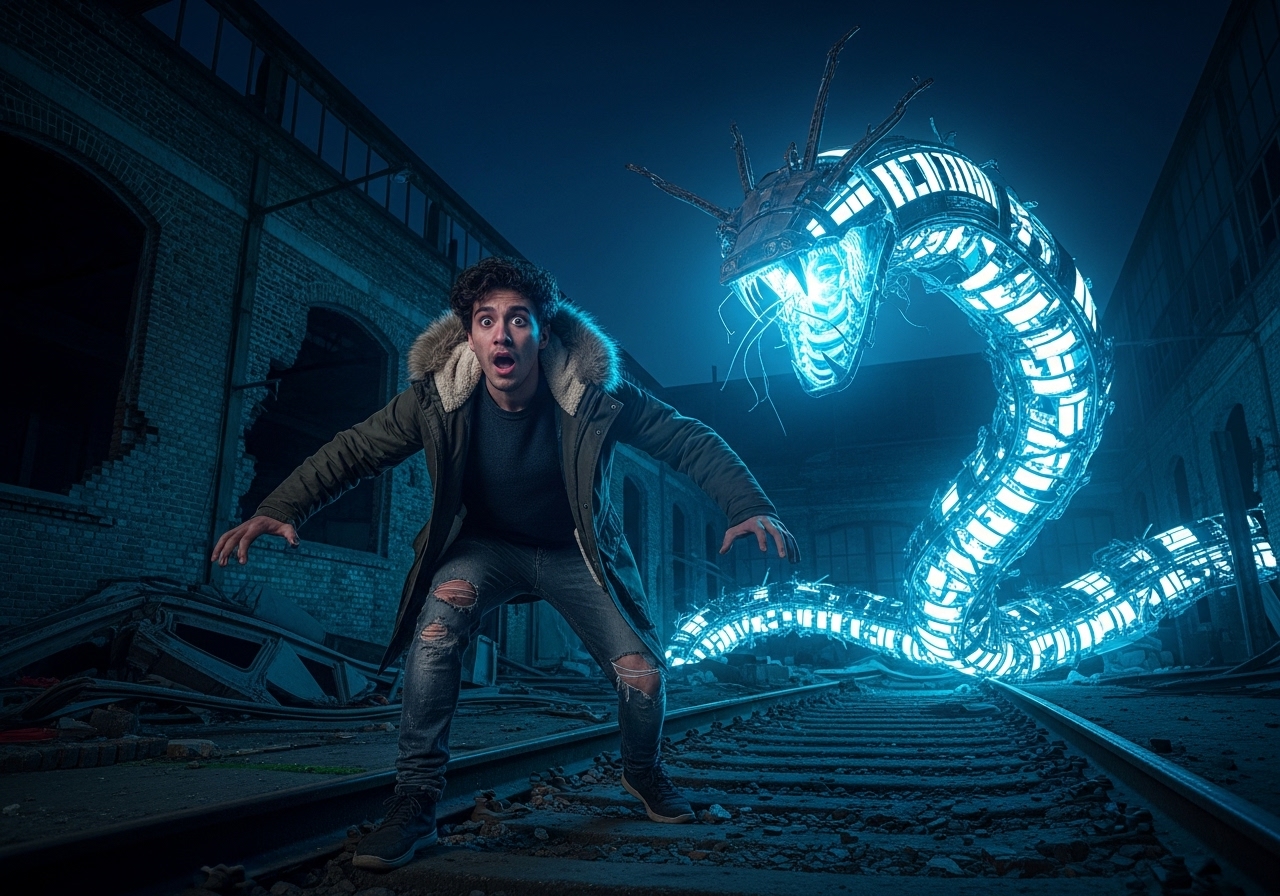
Where the Iron Snakes Sleep
Format: Short Film / Anthology Episode | Est. Length: 10-12 minutes
Logline
A weary architecture student, trapped alone on a runaway tram, discovers the city's public transit system is a conduit for an ancient, living energy source and must escape before he becomes a casualty of its catastrophic failure.
Themes
* The Hidden Infrastructure of Reality: The idea that our mundane, man-made world is built upon a foundation of ancient, incomprehensible systems we do not understand.
* The Fragility of Order: The terrifying speed at which the predictable rules of urban life can collapse, revealing a chaotic and dangerous underlying truth.
* Accidental Witness: The horror of being the wrong person in the wrong place at the wrong time, becoming the sole observer of an event that shatters one's perception of the world.
* Technology vs. The Primordial: The conflict between modern, inert technology (a steel tram) and the ancient, living power it has been unwittingly designed to channel.
Stakes
Ramon must escape the hijacked tram to not only save his own life but prevent the catastrophic collapse of the city's hidden power grid and the awakening of the ancient entities that inhabit it.
Synopsis
Ramon, a tired architecture student, falls asleep on the last tram home. He awakens to find he has missed his stop and is the only passenger left. The tram is speeding through an abandoned industrial district, far from its designated route. His attempts to get the attention of the silent, silhouetted driver are met with unnerving stillness.
His growing unease turns to awe and terror when he sees the tracks ahead are not reflecting light, but emitting a pulsing, blue luminescence. The tram, now moving impossibly fast, is being drawn towards the gaping mouth of a derelict tram depot. Inside, a corresponding vortex of blue energy waits. Ramon realizes the city's transit network is not just for transport; it's a massive energy circuit, and he's trapped on a live wire heading for a nexus point.
In a desperate act, he forces an emergency door open and leaps from the speeding vehicle just as it enters the depot. He watches, injured, as the tram connects with the energy vortex, glows brightly, and then derails, slamming into a central pillar. The crash results not in an explosion of fire, but a silent, absolute blast of white light that sweeps over him and the entire city. The wave feels like pure information, and in its wake, every light in the city goes out, plunging everything into a profound darkness and silence.
Stumbling away from the wreckage, his mind reeling from the city-wide blackout he has just witnessed, Ramon hears a sound. A slow, metallic scraping from the twisted metal of the crash. Peering into the gloom, he sees a long, segmented piece of the track pulling itself free from the debris, moving with an unnatural, serpentine fluidity. He has not just survived a crash; he has witnessed the awakening of what sleeps beneath the city.
Character Breakdown
RAMON (20s): An observant, intelligent, and pragmatic architecture student. He is grounded in the logic of structures and systems, which makes the illogical events he experiences all the more terrifying. He is not a hero, but an ordinary person whose exhaustion and momentary lapse of attention lead him into an extraordinary and horrifying situation.
* Psychological Arc: Ramon begins the story in a state of weary cynicism and mundane annoyance, preoccupied with his studies and the familiar drudgery of his commute. He ends the story in a state of traumatized enlightenment, his logical worldview shattered. He is now the sole keeper of a terrifying secret about the true nature of his city, burdened with the knowledge that ancient, living things exist just beneath the surface of reality.
Scene Beats
1. THE WRONG STOP: Ramon wakes on an empty tram. The view outside is unfamiliar—soot-stained, abandoned warehouses. He is at the end of the line, or somewhere else entirely.
2. THE SILENT DRIVER: Ramon approaches the driver's booth. The driver is a motionless silhouette in an old, outdated uniform. Ramon's calls and knocks on the glass are ignored. Unease curdles into fear.
3. THE LIVING RAILS: Through the front window, Ramon sees the tracks glowing with an internal, pulsing blue light. The mundane laws of physics are breaking. The tram accelerates violently.
4. THE NEXUS: The tram hurtles towards an old, cavernous depot. Inside, a vortex of the same blue light spirals down into the earth. It's not a depot; it's a destination.
5. THE JUMP: Realizing the tram is a sealed coffin, Ramon finds and wrenches open an emergency door. With the roaring hum of energy in his ears, he makes a desperate leap into the gravel and weeds alongside the track.
6. THE SILENT APOCALYPSE: The tram enters the depot and crashes. A wave of pure white, silent energy erupts, passing through Ramon. He feels the entire city grid as an extension of his own body, and then feels it all die.
7. THE AWAKENING: Total darkness and silence. The city is dead. As Ramon stumbles away from the wreck, he hears a scraping sound. A long, segmented piece of track pulls itself from the mangled tram, moving like a living serpent. The Iron Snake is awake.
Visual Style & Tone
The visual style begins with gritty, urban realism. The tram interior is worn and covered in graffiti, lit by the sickly yellow-green of fluorescent lights. The city outside is a palette of cold blues, grays, and damp concrete. This grounded reality serves to make the supernatural elements more jarring.
When the tracks begin to glow, the aesthetic shifts. The blue light is ethereal and beautiful but also deeply unnatural, casting sharp, moving shadows inside the rattling tram. The climax—the silent explosion—should be a stark, over-exposed whiteout, a visual representation of sensory and informational overload. The final scene is plunged into an oppressive, profound darkness, with the only detail visible being the glint of metal on the moving creature.
The tone aligns with the urban dread and technological paranoia of Black Mirror, the cosmic horror of H.P. Lovecraft's "The Colour Out of Space," and the slow-burn tension of a thriller like Arrival. The sound design is critical, moving from the familiar, rhythmic clatter of the tram to a high-frequency, bone-resonating hum, and finally to an absolute, terrifying silence.
Share This Treatment


