FILM TREATMENT
TITLE: Three Questions for Oliver
LOGLINE
In a rain-drenched cyberpunk future, a corporate journalist's interview with a reclusive artist about the threat of AI to human creativity reveals a shocking conspiracy that blurs the line between rebellion and control.
SYNOPSIS
SUTTON, a cynical, world-weary journalist for the monolithic OmniCorp, is tasked with interviewing OLIVER, a celebrated and supposedly anti-corporate artist. The assignment takes Sutton from the sterile, gleaming towers of the city’s center to a decaying industrial quarter, a deliberate choice by Oliver to signal his authenticity. Inside Oliver's chaotic, wire-strewn studio—a messy sanctuary of human creation amidst a world of algorithmic perfection—the two verbally spar over coffee. The interview is structured around three core questions about the future of storytelling. Oliver delivers a series of profound, impassioned arguments defending the messy, imperfect, and essential nature of human creativity, framing technology not as a threat, but as a democratizing tool. Sutton, initially dismissive, finds herself drawn into his charismatic and subversive worldview. As the interview concludes, Oliver gives Sutton a data chip containing a "collaborative" work between himself and an AI. However, just as Sutton is about to leave, a final cryptic comment from Oliver, combined with a discovery on the data chip, shatters his entire persona. Sutton realizes the artist is not a rebel fighting the system, but a sophisticated asset of the system, manufacturing the very narrative of dissent that OmniCorp needs to control it.
CHARACTER BREAKDOWN
* SUTTON (40s): A professional scribe for OmniCorp. Jaded, pragmatic, and deeply entrenched in the corporate system she serves. Her cynicism is a shield, but beneath it lies a flicker of the idealism she long ago abandoned. She is observant and sharp, her weariness born from seeing how every story, every truth, is ultimately packaged and sold.
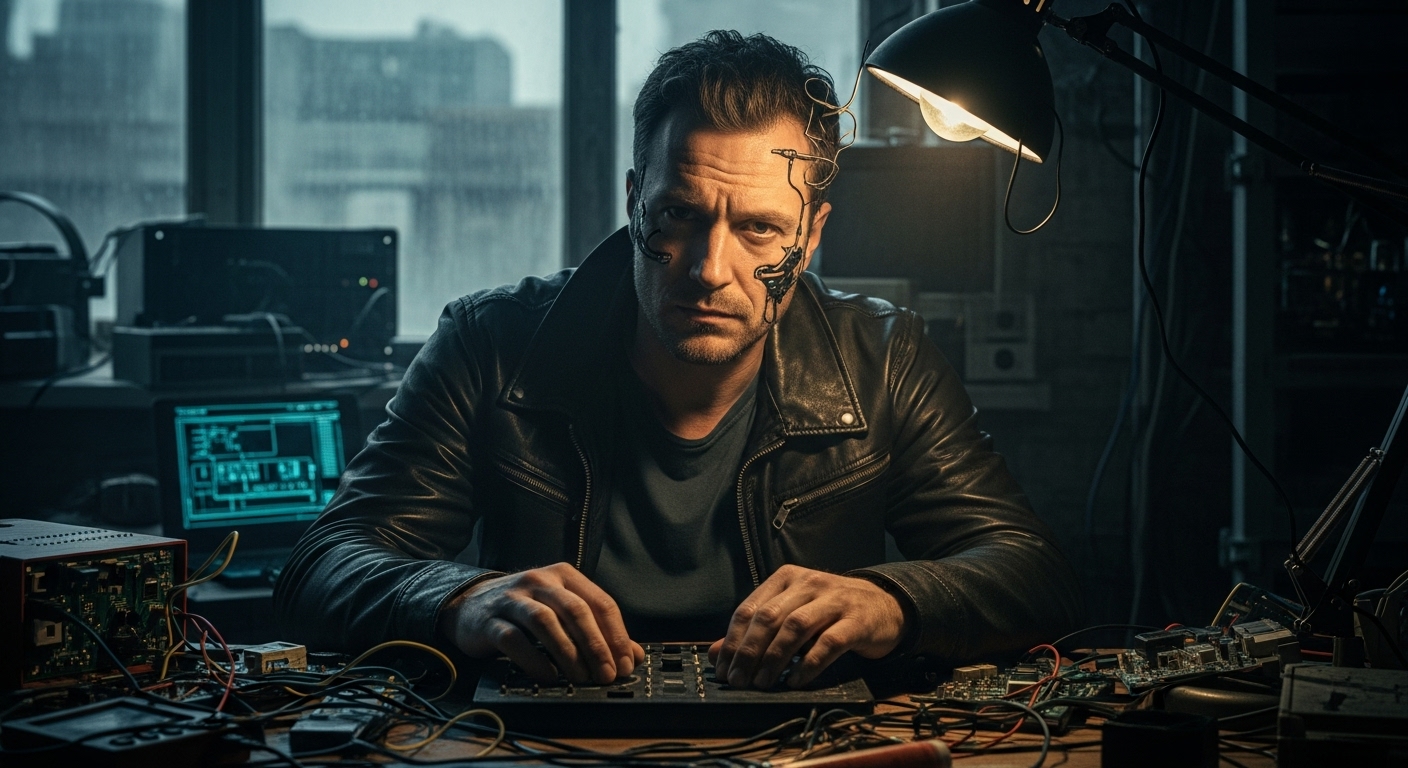
* OLIVER (50s): A reclusive and highly influential artist. He projects an image of weary authenticity, with an unkempt appearance and a studio that is a shrine to tangible, messy creation. He is articulate, philosophical, and intensely charismatic, his voice a gravelly rasp that commands attention. He is the perfect image of the rebel artist, a man fighting to keep the human spark alive.
SCENE BEATS
* OPENING: THE DESCENT. We follow Sutton’s journey into the city's old industrial quarter. The world is established through contrast: the impossibly clean OmniCorp towers in the distance versus the grime, decay, and failing technology of the lower levels. The rattling elevator cage and dilapidated hallway build a sense of dread and oppressive atmosphere.
* THE THRESHOLD. Sutton arrives at Oliver’s door—number 307. It’s analog, scratched, ancient. She buzzes. The door opens to reveal Oliver, a tall silhouette against the flickering holographic light of his studio. His first words establish his authority; he already knows who she is.
* THE SANCTUM. Sutton enters the studio. It’s a cavern of organized chaos. Wires snake like vines, old tech is jury-rigged to new, and half-finished digital and physical sculptures litter the space. The air is thick with the smells of solder, synth-leather, and burnt circuitry. This is a creator's den, a physical manifestation of a restless mind.
* THE RITUAL. Oliver offers coffee. It’s a simple, human gesture that also serves as a test. The exchange is terse, professional. They are two veterans of their respective fields, sizing each other up. Sutton sets up her recorder, the modern, sleek device a stark contrast to the rickety, stained table.
* QUESTION 1: THE POWER OF IMPERFECTION. Sutton asks why human storytelling still matters in an age of perfect, algorithmic narratives. Oliver delivers his first powerful monologue: perfect stories are lies, echo chambers. True human art is meant to disrupt, to unsettle. Its flaws, its "authentic scars," are its strength. We see a flicker of intrigue in Sutton's cynical eyes.
* QUESTION 2: THE GHOST IN THE MACHINE. Sutton pivots to technology, framing it as a threat. Oliver refutes this, calling AI a "mirror" and a tool for liberation. He argues it democratizes creation, giving a voice to the voiceless. He gestures around his studio, a hybrid of old and new, positioning himself as a master of both worlds, not a victim. The argument is compelling, almost dangerously so, challenging Sutton's corporate-mandated perspective.
* QUESTION 3: THE ARCHITECT OF MEANING. Sutton asks about the future role of the creator. Oliver defines it as an "architect of meaning," a "whisperer to algorithms." The human provides the heart, the intent; the machine provides the hands. His vision is seductive and revolutionary. He leans in, his intensity captivating.
* THE OFFERING. To illustrate his point, Oliver pushes a small data chip across the table. He calls it a "collaboration" between him and his algorithm, challenging Sutton to find the seam between them. This is the key plot device.
* A GLIMPSE OF THE PAST. Sutton’s eyes catch a small, faded photograph on a cluttered shelf—a younger, less weary Oliver in a natural, rural landscape. It’s a poignant, humanizing detail that seems to support his narrative of authenticity.
* THE PARTING SHOT. As Sutton prepares to leave, her professional mask back in place, Oliver offers a final, chilling piece of advice: "Even the purest algorithm has a ghost in the machine... You just have to know where to look."
* THE REVEAL. In the hallway, or perhaps back in the elevator cage, Sutton examines the data chip. As the file transfers to her slate, her eyes catch a tiny, almost invisible detail in the corner of the data—a watermark. It is not Oliver's signature. It is the sleek, unmistakable logo of OMNICORP.
* CLOSE ON SUTTON. A wave of cold dread washes over her face. Every word Oliver spoke is instantly re-contextualized. He is not a rebel. He is a high-level asset, crafting a controlled narrative of dissent for the very corporation he pretends to defy. The fight for authenticity is just another product.
VISUAL STYLE
* AESTHETIC: Cyberpunk Noir. The film leans heavily into the contrast between high-tech and low-life. The world is drenched in a perpetual, drizzling rain, with slick, reflective streets that amplify the glow of neon and holographic advertisements.
* COLOR PALETTE: A bifurcated scheme. The world of OmniCorp is defined by cold, sterile blues, whites, and metallic greys. Oliver’s studio, in contrast, is a pocket of warmth and chaos, lit by the amber glow of old Edison-style bulbs, the green of monochrome monitors, and the vibrant, flickering purples of his digital art. This warmth, however, is constantly pierced by the cold blue light from his advanced screens, hinting at the underlying deception.
* CINEMATOGRAPHY: The camera work will reflect Sutton’s perspective. Her journey to the studio will have a slightly handheld, grounded feel, emphasizing the grit and texture of the environment. The interview itself will be shot with a more classical, controlled style—intimate two-shots and slow, revealing close-ups on faces, hands, and details (the cracked mug, the worn jacket, the sleek data chip) to build tension through performance and subtext.
* SOUND DESIGN: The soundscape is crucial. The constant, oppressive hum of the city and the patter of rain will be the sonic foundation. Inside the studio, this is replaced by the diegetic sounds of creation: the whir of cooling fans, the soft clink of tools, the static hiss of old monitors, and the sharp, clear tones of new interfaces. Oliver's gravelly voice should dominate the audio mix during his monologues, drawing the audience in just as he draws in Sutton.
Share This Treatment


