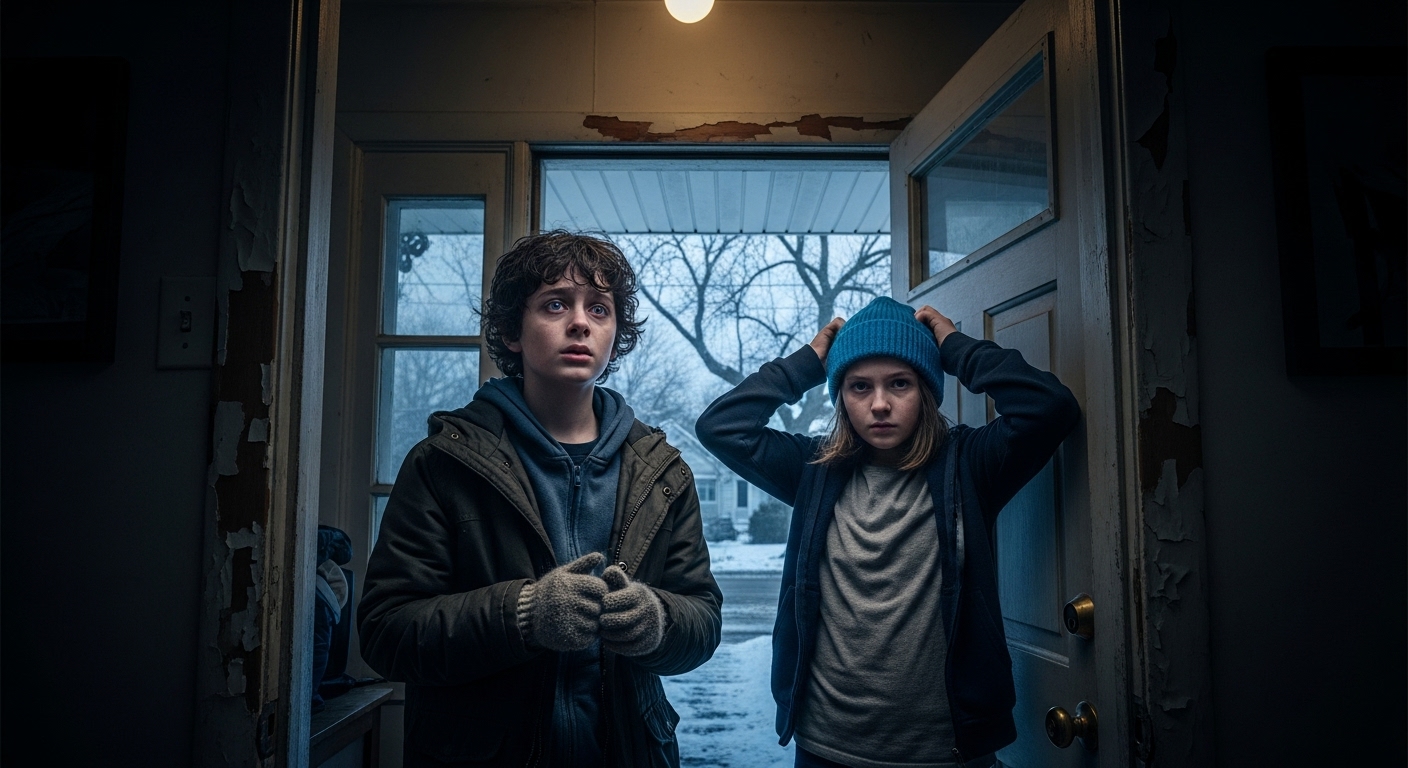
The Unseen Cold - Narrative Breakdown
Project Overview
Format: Single Chapter / Scene Breakdown
Genre: Young Adult Psychological Horror
Logline: Two young siblings walking home on a frigid night are stalked by an unseen presence, a feeling of dread that follows them from a dark alley into the supposed safety of their own home, becoming a permanent internal chill.
Visual Language & Atmosphere
The atmosphere is one of oppressive, biting cold and pervasive dread. Visually, the world is rendered in stark, high-contrast monochrome: the thick, white puffs of breath against the "ink-black dark" of a moonless night. The setting is a landscape of urban decay and neglect—an alley behind a cannery filled with leaning dumpsters, a deserted industrial park with broken machinery and a twisted, rusted fence.
Nature is hostile and personified. Tree branches are "skeletal" and resemble "bony fingers clawing at the sky." The environment itself feels predatory, with shadows that seem to "swallow sound." Light offers no comfort; the few streetlights are harsh, flickering, and create "long, exaggerated shadows that dance and twisted." The overall mood is somber, tense, and claustrophobic, reflecting the characters' internal state of escalating anxiety.
Character Dynamics
James: Roughly ten years old, James is sensitive and hyper-aware, serving as the audience's primary lens for the unfolding dread. He is physically and emotionally vulnerable, unable to pretend he isn't scared. He constantly seeks validation from his older sister for the terror he feels, a "prickle on the back of his neck." His fear is palpable and sensory, manifesting as a "low hum" or a "cold, heavy stone" in his gut. He is in a state of quiet desperation, wanting to retreat to the safety of childhood comforts but forced to navigate a terrifying new reality.
Chrissie: The older sister, Chrissie performs the role of the capable, pragmatic protector. She suppresses her own fear behind a facade of impatience and practicality, dismissing James's concerns and focusing on the logical (slipping on ice, finishing homework). However, this is a brittle defense. Her darting eyes, hunched shoulders, and eventual whispered admission, "You hear that?" reveal that she is just as terrified as her brother. Her motivation is to get them both home safely, believing that if she can control her emotions and their path, she can control the threat itself.
Their Interaction: The dynamic is defined by a shared, unspoken terror. James's open fear pushes against Chrissie's determined denial, creating a tense silence between them. His need for acknowledgment is finally met at the story's critical moment when Chrissie's facade breaks, uniting them in their fear. Their final, shared glance in the hallway of their home solidifies their new reality: they are no longer just siblings, but silent co-conspirators in the knowledge that something has followed them inside.
Narrative Treatment
On a freezing, moonless winter night, JAMES (9) walks beside his older sister, CHRISSIE. The cold is a physical presence, numbing his fingers and biting through his thin jacket. They take a shortcut through a dark alley behind an old cannery, a place that feels like it swallows sound. James is on edge, feeling a palpable, unseen gaze from the deep pockets of darkness. He wants to run, but Chrissie, trying to project strength, insists on walking to avoid slipping on the ice.
As they walk, James's internal sense of dread grows. He pictures it as a dark, oily stain seeping from the shadows, getting closer. Chrissie tries to distract them with talk of James's social studies project on the voyageurs, but her voice sounds too loud, cracking the oppressive silence. James can't focus, his mind consumed by the definite weight of being watched. He remembers seeing a rabbit frozen in fear right before a hawk swooped down, but this feeling is different—not natural, but mean.
They reach the boundary of a deserted industrial park, marked by a rusted chain-link fence. The shortcut is a small, muddy crawl space under the wire. Chrissie tells James to go first. He hesitates, the dark opening feeling like a trap, the feeling of being pushed from behind overwhelming him. He scrambles through, scraping his knee, the air thick with the smell of damp earth and metal. Chrissie wriggles through after him, her face flushed and her eyes wide. She brushes herself off and stops, her bravery finally cracking. "You hear that?" she whispers. James has heard it too—a faint scraping, like something dragging, just on the other side of the fence.
Panic sets in. They walk faster, almost running, their ragged breaths pluming in the air. They burst out of the alley onto their street, momentarily blinded by a single, buzzing streetlight that casts long, dancing shadows. They are almost home, but the feeling hasn't gone away. It has transformed. It's no longer a stalker behind them, but a cold passenger that has settled deep inside James's chest.
He sees Chrissie is still hunched and tense; she feels it too. The final walk down their block is heavy with this new awareness. The presence isn't behind them anymore; it's everywhere, a part of the cold air itself.
Chrissie unlocks the front door, and a sliver of warm, familiar light spills out. As James steps inside, the feeling of the watcher flows in with him, settling into the corners of the hallway. The house is warm, but the deep, pervasive chill remains. He and Chrissie exchange a final, knowing look. They both understand, without a word, that the thing from the alley, the watchful cold, has followed them inside. It is here to stay.
Scene Beat Sheet
1. James and Chrissie walk through a frigid winter night, James acutely aware of the cold and his own fear.
2. In a dark alley, James feels the distinct, prickling sensation of being watched.
3. Chrissie dismisses his fear, insisting they take the shortcut.
4. James's internal dread grows, imagining the presence as a spreading, oily stain.
5. Chrissie's attempt at a normal conversation about homework feels jarring and tense.
6. The feeling of being watched intensifies, feeling heavy and "mean" to James.
7. They reach a crawl space under a fence; Chrissie orders a hesitant James to go first.
8. After they both scramble through, Chrissie's facade breaks when she hears a scraping sound, whispering, "You hear that?"
9. Their fear is now shared and acknowledged; they almost run the rest of the way.
10. They reach their street, but the relief is temporary. The feeling of being watched has changed from an external pursuer to an internal "passenger."
11. They walk the final stretch home in heavy silence, the presence feeling like it's now part of the air around them.
12. They enter their house, but the physical warmth doesn't banish the chill.
13. The feeling of the watcher flows inside with them, settling into the house.
14. A final, silent glance between James and Chrissie confirms their shared understanding: the presence is now inside with them.
Thematic Context
This narrative is a study in the traumatic internalization of fear and the subsequent loss of childhood sanctuary. The journey home through the dark alley serves as a grim rite of passage, moving the children from a state of conditional safety to one of perpetual, low-grade vigilance. The central theme is how an abstract dread, when experienced intensely, becomes a permanent part of one's psychological makeup.
The "unseen cold" is a potent metaphor for an encroaching, inescapable anxiety—the dawning awareness of the world's inherent dangers. The horror is not a literal monster but the realization that the dark can follow you into the light, forever altering your perception of safety. The story's true climax is this psychological shift. When the children reach their house, the archetype of home as a sanctuary fails. The boundary between the dangerous outer world and the safe inner world is irrevocably breached as the presence flows inside with them. The narrative concludes not with an escape, but with the assimilation of the threat, suggesting that the most terrifying phantoms are not those that haunt a place, but those that take up permanent residence within ourselves.
Share This Treatment


