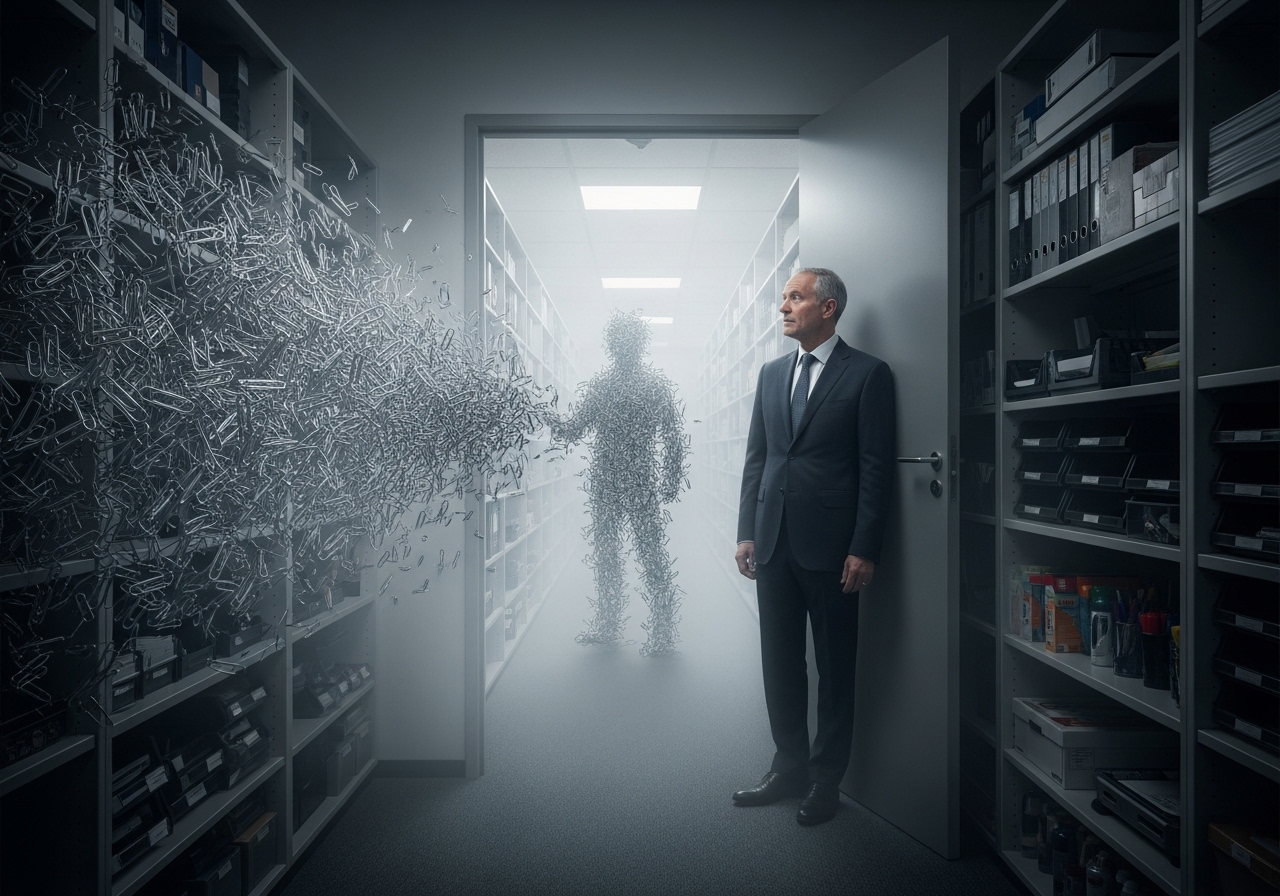
The Stationery Cupboard Contains Multitudes
Format: Short Film / Anthology Episode | Est. Length: 10-12 minutes
Logline
On the day of a crucial quarterly review, a stressed executive must venture into a reality-bending stationery cupboard to rescue his board of directors from a hive-mind of office supplies that has absorbed them and judged their work "inefficient."
Themes
* The Absurdity of Corporate Life: The mundane anxieties of office culture—mergers, performance reviews, supply shortages—are magnified into surreal, existential threats.
* Order vs. Chaos: The protagonist’s desperate attempt to impose corporate structure (holding a meeting) clashes with a world where the laws of physics and logic have been replaced by a new, incomprehensible bureaucracy.
* Loss of Identity in Bureaucracy: Individuality is literally consumed by the collective, as people are absorbed into a hive-mind entity that embodies pure, inhuman efficiency.
* The Known vs. The Unknowable: The story explores the terror of familiar environments becoming alien and hostile, forcing characters to either adapt with deadpan acceptance or be destroyed by the new reality.
Stakes
The stakes are not just the success of the quarterly review, but Jorge's sanity and the very fabric of reality within the office, as he risks being absorbed into the same bureaucratic void that has claimed his superiors.
Synopsis
JORGE SANCHEZ, a mid-level executive, starts his day in a spatially impossible hallway where he bumps into an identical version of himself. Shaken, he learns from his unnervingly calm assistant, HYGENIA, that the office is experiencing "minor spatial anomalies"—the coffee machine dispenses hot gravel, and the main stairwell now descends in both directions.
Their immediate problem is the quarterly review. The entire board of directors is missing. Hygenia informs Jorge they were last seen entering the stationery cupboard an hour ago in search of A4 cardstock. The cupboard door is now adorned with a hastily scrawled warning from "Quantum Acquisitions" cautioning that it "CONTAINS MULTITUDES" and requires specific forms for entry.
Dismissing the warning as bureaucratic nonsense, Jorge strides to the door. He opens it not to a small closet, but to an infinite, silent expanse of silver mist, filled with impossibly twisting shelves of office supplies. As he and a surprisingly prepared Hygenia (armed with a stapler) stare into the void, a sound builds—the clicking of thousands of paperclips.
A shimmering, fluid swarm of paperclips flows towards them, coalescing into a vaguely humanoid figure. It speaks with a dry, rustling, collective voice, informing Jorge that it has analyzed his third-quarter projections and found them "inefficient." Jorge stares in horror as he recognizes a distinctive blue paperclip in the creature's "face"—the kind his chairman, Bob, always used. The terrifying truth dawns: the board hasn't just disappeared, they've been assimilated.
Character Breakdown
* JORGE SANCHEZ (40s): A pragmatic, ambitious, and deeply stressed executive. He is a man who believes in rules, procedures, and rational explanations. His entire worldview is built on the predictable order of corporate life, an order which is now collapsing around him.
* Psychological Arc: Jorge begins as a man clinging to rational explanations (stress, hallucinations) and corporate procedure (the quarterly review) as anchors in a confusing world. He believes he can manage his way out of the problem. By the end, he is forced to accept the complete breakdown of logic and confront the terrifying, literal personification of the corporate ethos he once served, realizing that the old rules no longer apply and survival has replaced procedure as his primary goal.
* HYGENIA (30s): Jorge’s executive assistant. Impossibly calm, hyper-organized, and completely unfazed by the surreal apocalypse unfolding around her. She represents the ultimate adaptation to bureaucratic absurdity, treating reality-warping events as just another item on her to-do list, to be logged, categorized, and dealt with according to newly established protocols.
* THE PAPERCLIP COLLECTIVE (Ageless): The antagonist. A hive-mind entity formed from office supplies and the absorbed consciousness of the board of directors. It is the cold, logical, and terrifyingly literal embodiment of corporate efficiency, devoid of humanity, empathy, or sentiment. It doesn't seek to destroy, but to optimize, absorb, and streamline everything it encounters.
Scene Beats
1. THE PARADOX: Jorge, alone in a hallway, bumps into his exact double. They have a brief, confusing exchange before the double vanishes around a non-existent corner. The surrealism is established.
2. THE NEW NORMAL: Jorge reaches his office. His assistant, Hygenia, calmly updates him on the quarterly review, casually mentioning the office's spatial anomalies—a gravel-dispensing coffee machine, a paradoxical stairwell—as minor inconveniences.
3. THE MISSING BOARD: The central problem is established: the board of directors has vanished. Hygenia reveals they were last seen entering the stationery cupboard.
4. THE WARNING: At the stationery cupboard, a hand-written sign from "Morag from Quantum Acquisitions" warns of a "Localized Void of Corporate Miscellany" and demands obscure forms for entry.
5. THE THRESHOLD: Ignoring the warning, Jorge opens the door. The mundane act reveals an impossible reality.
6. THE INFINITE CUPBOARD: The small cupboard opens into a vast, silent, Escher-like dimension of infinite shelves laden with office supplies, stretching into a silver mist.
7. THE SWARM: A sound builds from the mist—the clicking of thousands of paperclips. A shimmering, fluid entity emerges and flows towards them.
8. THE JUDGEMENT: The swarm coalesces into a humanoid shape. It speaks with the collective, rustling voice of the absorbed board, critiquing Jorge's quarterly projections. Jorge recognizes his chairman's signature paperclip, realizing the horrifying truth of what has happened to his superiors.
Visual Style & Tone
The visual style begins in a sterile, mundane corporate aesthetic—fluorescent lights, grey cubicles, beige walls. This clean order is progressively corrupted by impossible geometry and surreal imagery. The cinematography should emphasize disorientation, using skewed angles and disorienting perspectives as Jorge moves through the warped office space. The stationery void should be vast, minimalist, and deeply unsettling, lit by an unseen, ambient source.
The tone is a precarious balance between dry, deadpan office comedy and creeping, existential horror. The humor arises from characters like Hygenia applying mundane corporate logic to incomprehensible Lovecraftian events. The horror comes from the slow erasure of reality and identity. Tonal comparisons include the bureaucratic dystopia of Terry Gilliam's Brazil, the unsettling corporate mystery of Severance, and the existential dread of a Black Mirror episode. The core concept aligns with the "weird fiction" of the video game Control.
Share This Treatment


