The Static Dream and the Scrap of Paper - Narrative Breakdown
Project Overview
Format: Single Chapter / Scene Breakdown
Genre: Dystopian
Logline: In a bleak, controlled future, a man haunted by oppressive nightmares discovers a cryptic, forbidden artifact that offers a dangerous glimpse of a world beyond the state-enforced static, forcing him and his pragmatic friend to confront the true cost of seeking the truth.
Visual Language & Atmosphere
The world is defined by a stark, oppressive duality. The interior, psychological landscape of the dream is a sterile prison of absolute control: vast, featureless grey rooms with polished obsidian floors that reflect a distorted, data-like version of the self. The air is synthesized and metallic, and figures at the periphery are corrupted, pixelated projections. This is a clean, geometric, digital hell.
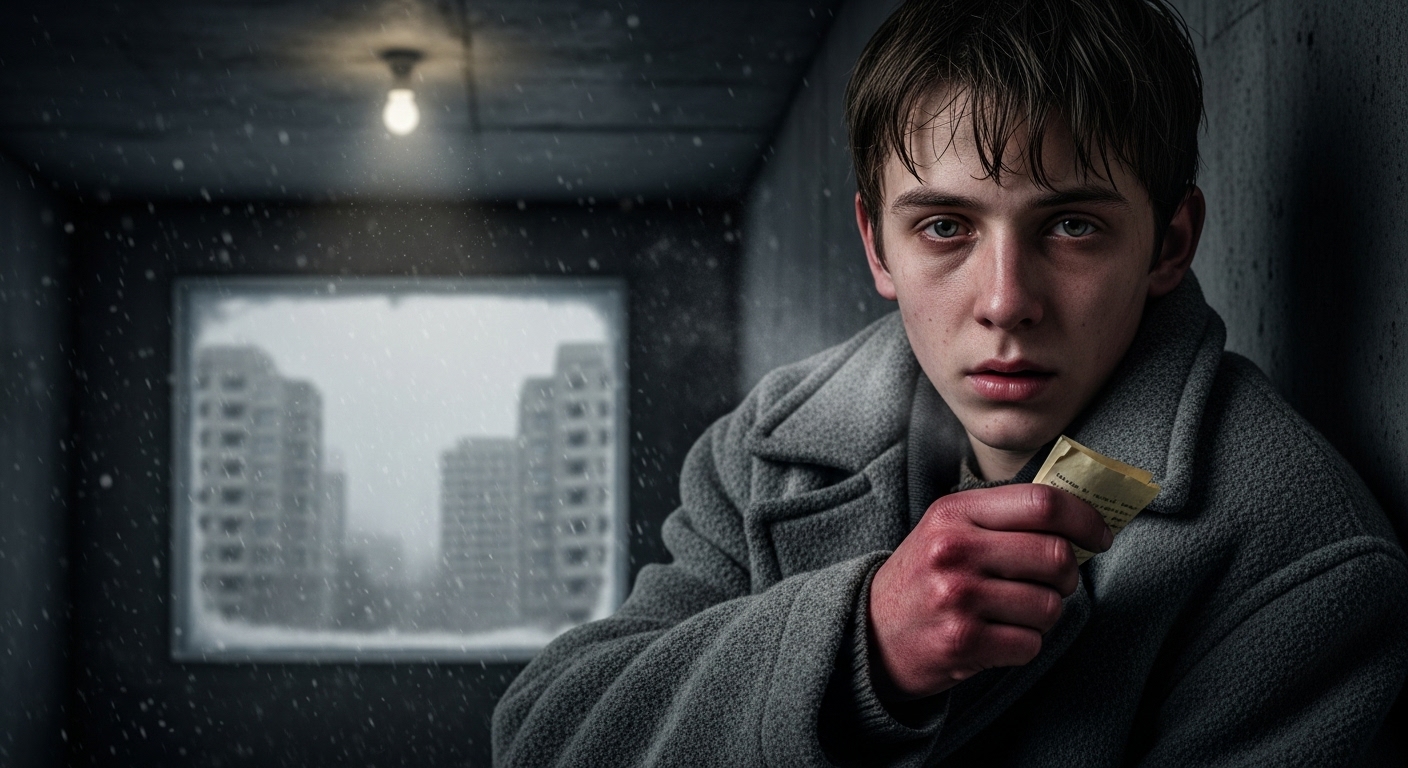
The waking world is a physical manifestation of this decay and control, rendered in a palette of monochromatic despair. A perpetual, heavy winter buries a city of towering, brutalist concrete blocks under sterile white snow. The sky is the color of old ash. Interiors are cold and failing; rooms are closet-sized, with damp, flaking paint, frosted windows, and cheap duraplast walls. The technology is functional but old and grim, like scratched data slates. The atmosphere is bone-chillingly cold, claustrophobic, and suffused with a dull, chronic misery and pervasive dread. The only color or warmth comes from the discovery of the yellowed, rough paper—a tiny, organic anomaly in a world of grey sterility.
Character Dynamics
JAMES: Existing in a state of profound psychological distress, James is caught between the abstract horror of his nightmares and the grinding misery of his reality. He is sensitive and introspective, deeply unsettled by the "existential wrongness" of his world. His recurring dreams of being a helpless component in a vast system are a direct reflection of his waking oppression. The discovery of the paper acts as a catalyst, transforming his passive dread into an active, dangerous purpose. He is the chapter's idealistic seeker, driven by a desperate need for meaning that overrides his instinct for self-preservation.
BETH: A pragmatic and vigilant survivor, Beth’s sharp cynicism is a form of psychological armor. She is grounded, observant, and acutely aware of the tangible dangers of their world, constantly scanning for threats like the Supervisor. Her immediate reaction to the paper is fear, a conditioned response to protect herself and James. However, her intellect is revealed when she identifies the symbol as a circuit diagram, betraying a suppressed curiosity and a thirst for knowledge. She serves as James's anchor to reality, her caution and pragmatism creating the central tension against his hopeful idealism. Their dynamic is one of wary trust and friendship, a microcosm of the conflict between dangerous hope and grim survival.
Narrative Treatment
The narrative begins inside a dream. JAMES is trapped in a vast, featureless grey room with a polished obsidian floor. A low, electric hum vibrates not in his ears, but in the marrow of his bones. His reflection is a distorted, shifting collection of data points. Shadowy, pixelated figures flicker at the edge of his vision, their faces a blur of featureless skin and glitching pixels. A modulated, inhuman voice drones in a language of pure data, its intent clear: control, order, compliance. The cold is absolute, freezing his very essence and hollowing him out. He is helpless, unable to move or scream, a mere component in an incomprehensible system. The perfect grey floor begins to crack, revealing a dark, organic blackness beneath. Panic claws at his throat.
James’s eyes snap open. He is in his small, cold room, the reality of stained plaster and a whining heating unit a grim comfort. His breath plumes in the frigid air. The world outside is buried under another layer of snow, a monochromatic landscape of brutalist architecture. His body aches with a cold stiffness. On his old data slate, he attempts to search for ‘Pre-Collapse History,’ only to be met with an ACCESS DENIED message. This engineered amnesia is a familiar, chilling aspect of his existence under the Collective.
Empty and restless, his attention is drawn to a loose brick in the duraplast wall—a small imperfection he’d noticed weeks ago. Prying it free, he discovers a small recess. Inside, his fingers find something alien: a thin, crinkled scrap of real paper. It feels ancient, rough, and warm. Unfolding it carefully, he finds a crude, hand-drawn symbol of three interlocking, jagged loops with a sharp line cutting through the center. Below it, fragmented words are scrawled in faded ink: ‘…not forgotten… beyond the static… find… the…’ Fear and a dangerous, unfamiliar excitement flood him. This is something real, a whisper from a forgotten time. He hides the paper and resolves to show it to his friend, BETH.
Later, James finds Beth on a derelict bench near the Sector 7 food distribution center. The line of citizens waiting for synthetic protein paste shuffles miserably. A hulking SUPERVISOR GRASSE patrols nearby. Beth is her usual self: hunched against the cold, armed with a shield of sarcasm about the ‘glorious day in paradise.’
In a hushed voice, James tells her he found something. He covertly passes her the scrap of paper. Beth’s eyes widen. She immediately recognizes the danger, warning him that possessing such an item is a ‘re-education’ level offense. But as she traces the symbol, her intellect takes over. She identifies it as a circuit diagram, or part of one, but one that also looks strangely organic, like veins or roots.
She presses the danger of the situation, reminding him that the Collective monitors everything, even dreams. But James, haunted by the static hum in his sleep, feels an undeniable connection to the paper’s message. He sees it as a key. Beth counters with pragmatism: a key to what? More trouble? Survival is already a full-time struggle.
James pushes back, asking if she doesn't truly wonder what might exist beyond their controlled reality. A flicker of curiosity crosses her face, though she remains outwardly disapproving. James is resolved. The weight of the paper in his pocket is no longer a burden, but an anchor, pulling him toward an unknown and dangerous truth. He has to know what it means.
Scene Beat Sheet
1. THE NIGHTMARE: James is trapped in a terrifying, abstract dream of digital control, helplessness, and a pervasive, bone-deep hum.
2. THE WAKING: He snaps awake into the bleak, freezing reality of his small room in a perpetual winter.
3. ACCESS DENIED: On his data slate, a search for history is blocked, reinforcing the state of "engineered amnesia."
4. THE ANOMALY: James investigates a loose brick in his wall, a flaw in the uniform structure.
5. THE DISCOVERY: He finds a hidden recess containing a single, folded scrap of ancient, forbidden paper.
6. THE MESSAGE: He unfolds the paper to find a cryptic, hand-drawn symbol and a fragmented message about something "beyond the static."
7. THE RENDEZVOUS: James meets his friend, Beth, at a grim food distribution line, under the watch of a Collective Supervisor.
8. THE REVEAL: James covertly shows Beth the scrap of paper.
9. THE WARNING: Beth’s first reaction is fear; she warns him of the extreme danger (“re-education”) the paper represents.
10. THE ANALYSIS: Despite her fear, Beth’s intellect is sparked; she identifies the symbol as a circuit diagram that also appears organic.
11. THE DEBATE: Beth argues for pragmatism and survival, while James, driven by his dreams, insists on pursuing the paper’s meaning.
12. THE RESOLVE: James solidifies his decision to investigate, seeing the paper not as a risk, but as the first real thing he’s held in years and a potential key to understanding his oppressive reality.
Thematic Context
This narrative is a psychological exploration of control versus rebellion within a classic dystopian framework. The Collective's power is not just political but ontological, enforcing an "engineered amnesia" to sever citizens from any historical context that could inspire dissent. The central conflict is internal for James, a battle against the encroaching mental "hum" of the state, a struggle to retain a sense of self against a system designed to hollow him out.
The pervasive "static" and "hum" are auditory symbols of this technological and psychological oppression. The perpetual winter mirrors the emotional and spiritual death of a society held in suspended animation. The scrap of paper is the story's catalyst, a powerful symbol of everything the Collective has tried to erase: history, human touch, imperfection, and organic reality. Its discovery transforms James's passive suffering into an active, perilous inquiry.
The story poses a fundamental question: is a life of guaranteed, cold survival preferable to a dangerous, uncertain search for truth? The paper, with its ambiguous symbol that is both technical and organic, suggests a forgotten synthesis between humanity and technology, a third way beyond the Collective’s sterile control. It is a fragile spark of hope in a frozen world, asserting that the most profound act of rebellion is to question the nature of one's own reality.
Share This Treatment


