AETHER-FROST - Project Treatment
Project Overview
Format: Limited Series, 3 Episodes (60 minutes each)
Genre: Sci-Fi / Cosmic Horror / Prestige Drama
Tone References: Arrival (for its intellectual approach to an alien presence and focus on emotional, human stakes over spectacle), Annihilation (for its beautiful, terrifying, and incomprehensible transformation of the natural world), True Detective: Night Country (for its oppressive arctic atmosphere, isolated community dynamics, and blend of procedural mystery with supernatural dread).
Target Audience: Fans of A24's elevated genre slate, audiences of thought-provoking sci-fi like Black Mirror, and viewers who appreciate character-driven dramas set against high-concept backdrops.
Logline: In a remote northern town plagued by an unnatural, shimmering cold, three friends discover a creeping alien intelligence transforming their world, forcing them to rally their isolated community against a threat that defies comprehension.
Visual Language & Cinematic Style
The visual identity of AETHER-FROST is built on a stark contrast between the human and the alien. Our community is depicted with a warm, intimate, and slightly cluttered verité style. Handheld cameras follow our characters through cozy but cramped interiors, capturing the lived-in textures of wood grain, worn flannel, and the steam of hot coffee. The palette here is tungsten-warm, earthy, and grounded. This intimacy is violently contrasted with the exterior world. The lake and the encroaching Aether-frost are shot with immense, static, and unnervingly symmetrical compositions. The camera will be locked down, emphasizing a cold, observational omniscience. The palette shifts to piercing, unnatural greens, sickly yellows, and deep, light-absorbing blues. We will use anamorphic lenses to subtly distort the edges of the frame when the phenomenon is present, creating a sense of physical pressure and warping reality. The "shimmering" effect of the frost won't be a simple CGI overlay, but an in-camera effect using manipulated glass and refractive elements, giving it a tangible, unsettling physical presence.
Tone & Mood
The tone is a slow-burn crescendo of dread, beginning in a place of grounded, slice-of-life realism and gradually descending into awe-filled terror. The emotional rhythm is dictated by the oppressive northern silence, which is steadily replaced by a low, pervasive hum—a sound design element that becomes a character in itself, vibrating in the viewer's chest. The mood is one of profound isolation, both geographical and existential. We prioritize psychological tension over jump scares. The horror is not in what jumps out of the dark, but in the slow, inexorable realization that the fundamental laws of physics and nature are being calmly and methodically rewritten. It’s the feeling of watching a beautiful sunset, only to realize the sun is setting in the north. The dialogue, initially filled with pragmatic concerns and community jargon, becomes increasingly spare and reactive as the characters find themselves without the words to describe the beautiful, lethal impossibility unfolding before them.
Themes & Cinematic Expression
The central theme is the conflict between human resilience and cosmic indifference. Sami’s constant references to "Sustainable Development Goal 11" and "capacity building" are initially presented as slightly naive jargon, but they become the literal thesis of the story. How does a community build resilience against a threat that isn't political or economic, but existential? This theme is expressed visually by contrasting scenes of frantic, messy community meetings in the town hall with the cold, silent, and perfect geometric patterns forming in the ice. Another key theme is the limit of human perception. This is visualized through Dale’s point-of-view, where the alien phenomena cause visual distortions, vertigo, and sensory overload. The sound design will reflect this, with the low hum often resolving into what sounds like distorted whispers or complex mathematical sequences just at the edge of hearing. The story explores the idea that what we perceive as malicious may simply be the byproduct of a higher intelligence operating on principles so alien they are indistinguishable from a natural disaster, forcing our characters to question whether survival depends on fighting back or simply getting out of the way.
Character Arcs
Dale
Dale begins as the pragmatist and skeptic, the relatable anchor for the audience who sees the community art project as a well-intentioned but frivolous distraction. His world is governed by tangible problems: fixing a snowmobile, hauling gear, staying warm. His primary flaw is a cynicism born from the harsh realities of remote life; he doesn't believe in grand gestures because he’s seen too many fail. The discovery of the alien artifact forces the incomprehensible into his hands, making him the unwilling guardian of the story's central mystery. His arc is one of reluctant acceptance and emerging leadership. He is forced to shed his cynicism and use his practical skills not just for survival, but to protect the very community he once quietly mocked. He transforms from a passive helper into a decisive protector, learning that belief isn't a weakness, but a necessary tool for survival against the impossible.
Sami
Sami is the passionate idealist, the community organizer whose belief in human potential is both her greatest strength and her most vulnerable point. She sees the world through a framework of social cohesion, capacity building, and engagement metrics. Her flaw is an over-reliance on these structured, human-centric concepts, leaving her unprepared for a problem that cannot be solved with a workshop or a community meeting. When the Aether-frost descends, her carefully constructed worldview is shattered. Her arc is about her idealism being brutally tested and forged into something harder and more practical. She moves from trying to organize an art gallery to organizing a town's survival, discovering that "social cohesion" isn't a buzzword but the literal lifeline that keeps people from turning on each other in the face of paralyzing fear.
Cassie
Cassie is the quiet observer, the intuitive soul who is more attuned to the subtle shifts in the world around her than anyone else. Where Dale is pragmatic and Sami is ideological, Cassie is perceptive. Her flaw is a hesitance to trust her own unusual perceptions, often keeping her unsettling observations to herself for fear of ridicule. As the Aether-frost intensifies, its strange energies resonate with her, making her a "canary in the coal mine." Her headaches, her visions of the patterns under the ice, and her understanding of the phenomenon's "intelligence" become crucial. Her arc is about embracing her unique sensitivity, transforming from a quiet follower into the trio's unlikely navigator of this new, terrifying reality. She becomes the only one who can begin to interpret the entity's purpose, not through science, but through a terrifying, direct form of empathy.
Detailed Narrative Treatment (Act Structure / Episodes)
Episode 1: The Shimmering
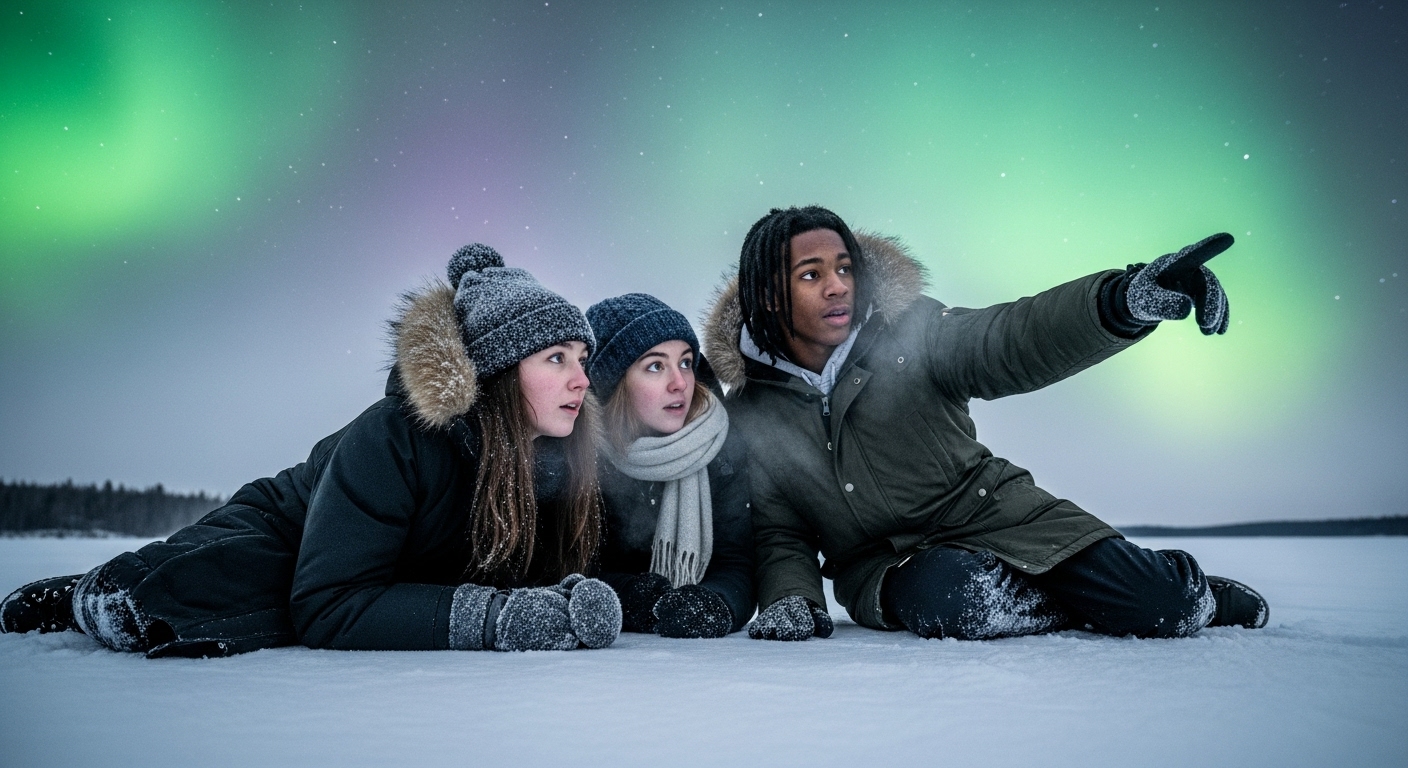
We are introduced to the remote, isolated town of Agogama, a community facing economic decline and the creeping weirdness of the "Aether-frost"—unpredictable auroras, strange cold snaps, and electronic glitches. DALE, a cynical but capable handyman, is reluctantly helping his friends SAMI and CASSIE set up a community ice art project on the frozen Lake Agogama. Sami champions the project as a vital "capacity-building" initiative to foster resilience. The chapter text serves as our inciting incident: while on the lake, the Aether-frost escalates from a passive curiosity into an active, advancing phenomenon. They witness the vibrating ice, the descending green mist, the unnatural tracks, and the glowing, veined ice. As the mist closes in, Dale finds a strange, humming metallic artifact. They barely escape back to town, shaken and terrified. They try to warn the town's mayor and a few skeptical locals, but their story is dismissed as a hallucination brought on by the strange lights. The episode ends with the green mist reaching the edge of the town, causing a cascading power failure that plunges Agogama into darkness and silence, save for a low, intensifying hum. They are cut off.
Episode 2: The Pattern
Days later, the town is completely isolated. The Aether-frost has settled, creating a shimmering, dome-like perimeter of cold mist. Inside, reality begins to fray. The hum is constant, causing headaches and paranoia. Strange, crystalline structures, like ice-ferns, grow on buildings overnight. Cassie's intuition sharpens; she suffers from debilitating migraines but begins sketching the complex spiral symbol from Dale's artifact, seeing it everywhere. Sami desperately tries to hold the community together, organizing rationing and search parties for a trapper who has gone missing, but her structured approach clashes with the town's rising panic. Dale, using his practical skills, works to keep a generator running while secretly studying the artifact, realizing it reacts to the mist, glowing brighter and humming louder as the phenomena intensify. The episode's midpoint is the discovery of the missing trapper, found near the lake, not dead, but encased in the shimmering, veined ice—his body being slowly, geometrically deconstructed and absorbed. All is lost when the trio realizes this isn't an invasion; it's a terraforming. The entity isn't hostile; it simply doesn't recognize them as anything other than raw material.
Episode 3: The Echo
The town descends into despair. The entity's terraforming accelerates, with the glowing veins spreading from the lake and appearing under the town's streets. Time itself seems to distort in certain areas. Cassie, now fully embracing her connection, follows her visions to the town's defunct radio tower. She believes the entity communicates through frequencies and patterns, and the hum is a byproduct of its massive, world-altering process. The climax is not a battle, but a desperate act of communication and disruption. Using Sami's organizational skills to rally a small group of believers and Dale’s technical know-how to power the old tower, they rig the artifact to the antenna. Guided by Cassie's intuitive understanding, they don't fight the entity's frequency but create a "resonant echo"—broadcasting its own complex spiral pattern back at it. This act, a form of "creative expression" that echoes their original art project, is the cosmic equivalent of a small creature making a noise to alert a giant that it's about to be stepped on. The result is catastrophic and beautiful. The hum crescendos, the ice structures shatter, and the Aether-frost violently recedes, leaving a permanently altered, alien-scarred landscape. The town is saved, but not unchanged. In the final scene, Dale, Sami, and Cassie stand together, looking out at a world that is now both theirs and not. They have built their resilient community, not through art, but through surviving the incomprehensible. The artifact in Dale's hand is now silent. For now.
Episode/Scene Beat Sheet (Source Material)
1. Introduction: Dale, Sami, and Cassie are on the frozen Lake Agogama at night, preparing for a community ice art project. The cold is unnatural, and the aurora is behaving erratically.
2. Character Dynamics: Dale expresses cynicism about the project's utility. Sami and Cassie defend its purpose, citing theories on community building, social cohesion, and resilience (SDG 11).
3. Phenomenon Escalates: The ice begins to vibrate with a low, resonant hum. A cold, green mist, part of the "Aether-frost," begins to descend from the aurora and creep across the lake towards them.
4. The Wind Dies: A sudden, oppressive silence falls as the wind stops completely, leaving only the sound of the hum. The air pressure drops, causing Cassie's ears to pop.
5. Discovery of Tracks: Cassie points out strange tracks in the snow leading into the mist—not human or animal, but long, slender drag marks with a glowing, repeating pattern.
6. The Threat Becomes Real: The group's banter ceases. Sami’s idealism gives way to fear, while Dale’s pragmatism shifts to a desire for a "strategic retreat."
7. Investigation: Despite the fear, they are drawn closer. Cassie notes the air feels denser near the tracks.
8. The Ice Transforms: Cassie directs their attention to the ice surface where the mist is thickest. It has become impossibly clear and glass-like, with a network of glowing, iridescent veins pulsing with sickly green light just beneath the surface.
9. A Vision: Dale experiences a moment of vertigo and nausea, briefly seeing what look like skeletal structures shifting within the veins before they disappear.
10. The Encroaching Mist: A gust of wind smelling of copper pushes the mist forward, nearly engulfing them. The cold becomes a physical, painful pressure.
11. Final Discovery: As Dale turns to flee, he spots a small, metallic object in the snow. He picks it up.
12. The Artifact: The object is a fragment of unknown metal, etched with a complex, interlocking spiral pattern that glows faintly and emits a tiny hum, echoing the larger phenomenon. The scene ends on their realization that this is alien and deliberate.
Creative Statement
AETHER-FROST is a story for our times, an intimate human drama played out against an existential canvas. In an era defined by overwhelming, seemingly incomprehensible crises—from climate change to social fragmentation—this story asks a vital question: how do we respond when the systems and beliefs that ground us are rendered obsolete? This is not a story about military heroes or brilliant scientists saving the world. It is about three ordinary people in a forgotten corner of it, armed only with a handyman's pragmatism, a community organizer's idealism, and an artist's intuition. By grounding cosmic horror in the tangible struggles of a small community, we explore the idea that our most potent tools against the unknown are not weapons, but our connections to each other. The alien "Aether-frost" serves as a powerful metaphor for any force—natural or man-made—that is too vast to fight, one that demands we adapt, communicate, and innovate not just to thrive, but to simply survive.
Audience Relevance
Contemporary audiences are drawn to stories that reflect their anxieties while offering a glimmer of meaningful human agency. AETHER-FROST taps directly into the modern zeitgeist of feeling small in the face of immense, impersonal forces. The isolation of the town of Agogama will resonate deeply with a post-pandemic audience familiar with quarantine and the fragility of supply chains. The story’s central conflict—trying to solve an existential problem with limited, local resources—mirrors the feeling of individual powerlessness in the face of global issues. By focusing on the interplay between three deeply relatable characters, the series offers a powerful and cathartic message: in the face of the incomprehensible, our greatest source of resilience is found not in grand, sweeping solutions, but in the strength, ingenuity, and empathy of the community right in front of us. It is a tense, terrifying, and ultimately hopeful exploration of humanity’s place in a universe far stranger than we can imagine.
Share This Treatment


