The Shifting Canvas
Format: Short Film / Anthology Episode | Est. Length: 10-12 minutes
Logline
When reality itself begins to dissolve into a surreal, chaotic dreamscape, three art history students must follow their enigmatic professor through a labyrinth of impossible spaces, learning that their only hope for survival lies not in logic, but in the creative act of perception itself.
Themes
* The Nature of Reality: Explores the idea that our shared reality is a fragile construct, a "shared dream" held together by collective belief, narrative, and meaning.
* Art as a Foundational Force: Posits that art is not mere decoration but a fundamental tool for imposing order on chaos, defining the world, and anchoring sanity.
* Logic vs. Intuition: Contrasts the rigid, analytical worldview with an intuitive, empathetic, and creative approach, arguing that the latter is essential when the former's rules no longer apply.
* Creation in the Face of Deconstruction: The characters must learn to create and imagine a path forward even as the world around them is actively being unmade.
Stakes
The students risk not only physical annihilation within a reality that is actively unmaking itself, but also the complete loss of their sanity and individual identity to the encroaching chaos.
Synopsis
On what begins as a normal spring afternoon, three university students—LEONARD, CASSIE, and SARA—find their world literally falling apart. The ground shifts from asphalt to dust, buildings stretch and warp, and the laws of physics become suggestions. They are walking to their art history lecture when this surreal collapse begins, forcing them to run for their lives through a landscape of impossible, glitching phenomena.
Guided by a cryptic message from their professor, ED CALDWELL, they find a temporary sanctuary in the university archives, a building that seems to hold its form better than the rest of the city. Inside, they find Caldwell calm and waiting. He explains that reality is not a fixed state but a "shared dream," and what they are experiencing is that dream unraveling. He posits that art—the act of creating meaning, structure, and narrative—is the only tool to navigate this deconstruction.
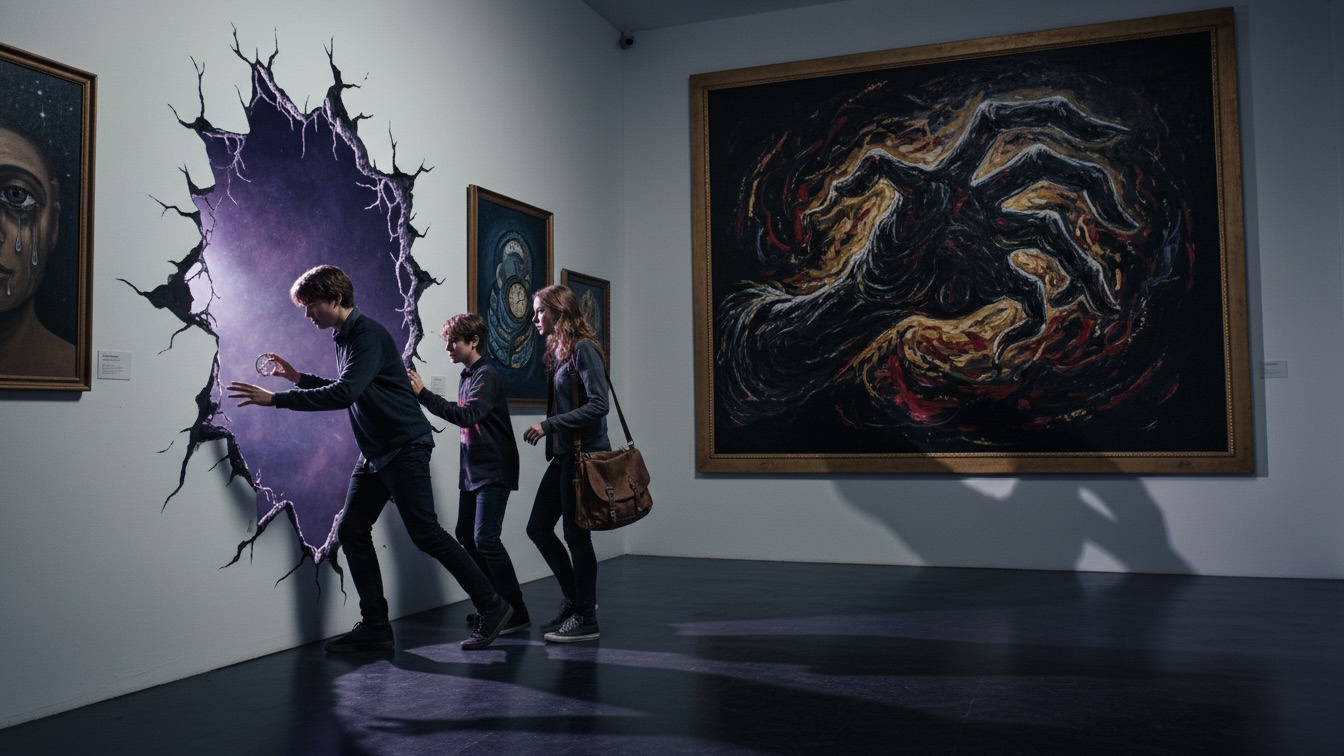
Caldwell leads them deeper into the archives, which has become a conceptual maze. They first encounter a solid wall of books, a "narrative block." While Leonard's brute force and Sara's analysis fail, Cassie's intuitive understanding allows them to pass through it as if it were mist. They emerge into a gallery of living paintings, each a window into a terrifying, beautiful, and active reality. As a monstrous hand from one painting begins to reach for them, they are forced to flee.
Their only escape is a dead end: a stark, blank white wall. Caldwell presents it as a final test—a "blank canvas" that demands they project their own meaning onto it to create an exit. Combining Leonard's desire for the concrete, Sara's search for a system, and Cassie's intuitive feel for flow, they collectively imagine a path forward. The wall gives way to a dark, humming void. They take a leap of faith, stepping through the canvas into the unknown, having learned that in a world without rules, the power to imagine is the only rule that matters.
Character Breakdown
* LEONARD (20s): The Pragmatist. Grounded, logical, and deeply unnerved by the collapse of the physical laws he trusts. He is initially resistant to Professor Caldwell's abstract philosophy, seeking concrete solutions and a way to fight back.
* Psychological Arc: Leonard begins in a state of angry denial, trying to apply logic to an illogical situation. His journey is one of forced surrender; he must abandon his rigid worldview and learn to trust in the abstract, the intuitive, and the creative power of his peers to survive. He ends not as a convert, but as a shell-shocked survivor who has been forced to accept that the world is far stranger than he ever believed.
* CASSIE (20s): The Intuitive. An artist at heart, she is more adaptable to the shifting reality. While frightened, she is also fascinated, able to perceive the underlying patterns and emotional currents of the chaos. She is the first to grasp Caldwell's lessons.
* SARA (20s): The Analyst. A systematic thinker who tries to categorize and understand the chaos as if it were a corrupted algorithm. She seeks patterns and rules within the madness, acting as a bridge between Leonard's rigid logic and Cassie's pure intuition.
* PROFESSOR ED CALDWELL (50s): The Guide. An enigmatic and unnervingly calm art history professor who seems to have anticipated reality's collapse. He is a mentor figure who sees the crisis not as an end, but as a profound and dangerous lesson in the foundational power of art and perception.
Scene Beats
1. THE UNRAVELING: The walk to class. The world glitches—the ground shifts, buildings warp, a phantom cherry tree appears. The students run in terror.
2. THE SANCTUARY: They find the university archives, a lone bastion of relative stability. They enter the impossibly long, flickering corridor.
3. THE LECTURE: They find Professor Caldwell, who calmly explains that reality is a construct and art is the "scaffold" that holds it together. He argues that understanding aesthetics is now the key to survival.
4. THE NARRATIVE BLOCK: Their path is blocked by a solid wall of books. Caldwell explains it's a "conceptual barrier" that must be "rewritten" with imagination, not force.
5. THE CONCEPTUAL PASSAGE: Cassie, using her intuition, visualizes the space between the words, the flow of the story. The wall becomes permeable, and they pass through.
6. THE LIVING GALLERY: They enter a corridor lined with living, breathing paintings. A giant, painted hand begins to emerge from its canvas, its shadow engulfing them.
7. THE BLANK CANVAS: They reach a dead end—a blank white wall. Caldwell calls it an invitation, a question they must answer.
8. THE LEAP OF FAITH: As the hand closes in, the students combine their mindsets—logical, analytical, and intuitive—to project an exit onto the canvas. A void opens. They step through into the unknown just as their world is consumed.
Visual Style & Tone
The film's tone is one of surreal, psychological dread and intellectual horror. It aligns with the high-concept, philosophical unease of Black Mirror, the beautiful, terrifying surreality of Annihilation, and the reality-bending nature of Doctor Who's most abstract episodes.
The visual style will be a constant, jarring juxtaposition of the mundane and the impossible. The "real world" should initially feel grounded and familiar, making its deconstruction all the more unsettling. The collapse should be depicted not with explosive CGI, but with a glitch-art aesthetic: textures failing to load, objects warping and stretching, impossible geometry, and sickening shifts in color and light. The archives will be a space of deep shadows and flickering, unreliable light, a maze of knowledge that is both a sanctuary and a prison. The living gallery should be visually rich and deeply disturbing, with paintings that move with the uncanny fluidity of deep-fake videos, blurring the line between art and a hostile, encroaching reality.
Share This Treatment


