The Render Farm - Narrative Breakdown
Project Overview
Format: Single Chapter / Scene Breakdown
Genre: Slice of Life / Tech Drama
Logline: In a cold community centre basement, three collaborators battle failing equipment and creative differences to build a VR simulation of a nuclear waste site, aiming to make complex science understandable for their local community.
Visual Language & Atmosphere
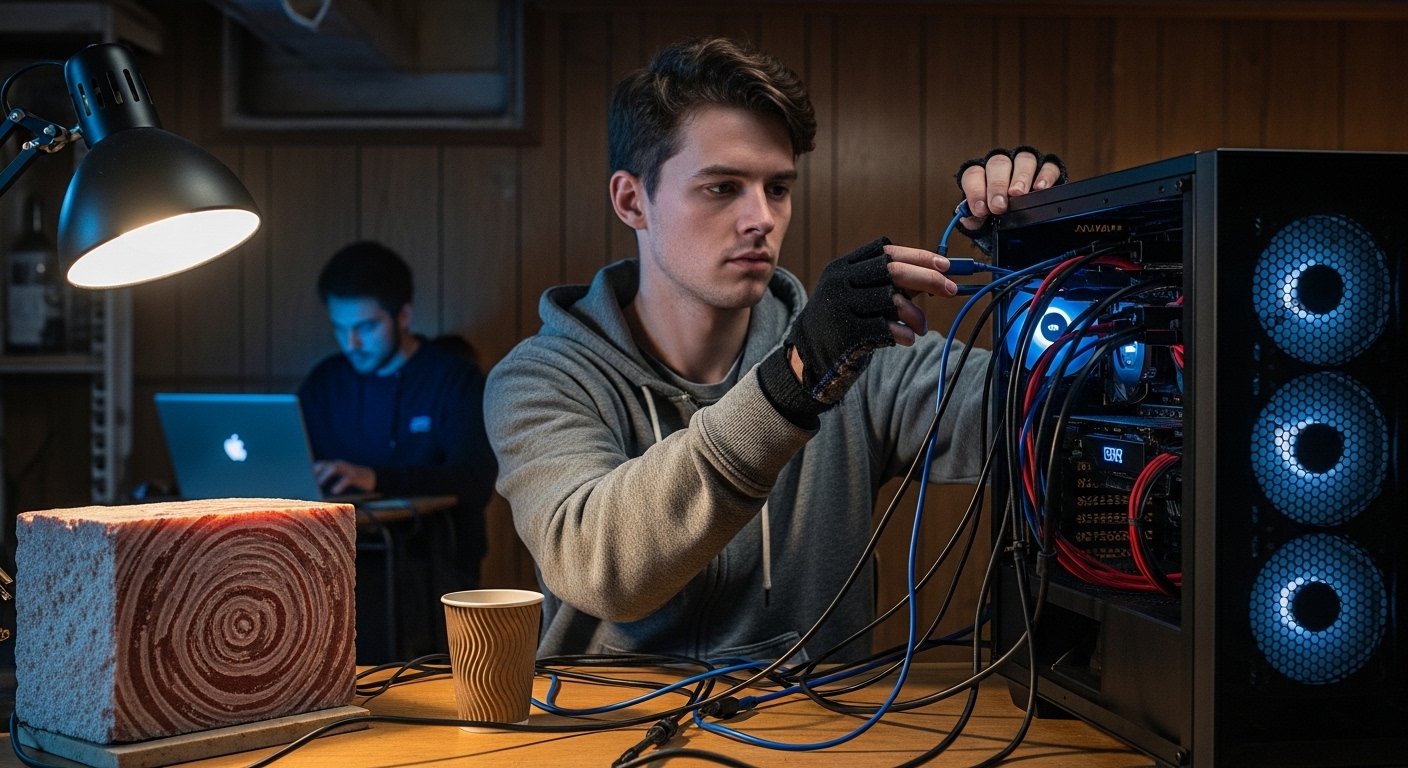
The setting is a drafty, cold community hall basement in late October, Northwestern Ontario. The atmosphere is one of low-budget, high-stakes creation. The dominant visuals are a chaotic mess of wires, taped-together cables, flimsy folding tables, and empty coffee cups. The lighting is harsh and functional, coming from buzzing overhead fluorescent lights, punctuated by the dim glow of monitor screens and the single point of warmth: the orange coils of a small space heater. The environment feels tangible and slightly grimy, characterized by the smells of wet wool, floor wax, and overheating electronics. Outside, the weather is cold, windy, and wet, adding to the sense of a small, dedicated team huddled against the elements, focused on their task.
Character Dynamics
* Sam: The passionate visionary. He is fixated on achieving visual fidelity to earn the community's trust, often pushing the hardware to its limits. He is hands-on and easily frustrated by technical failures but is also the driving force behind the project's artistic and community-focused goals. His arc in the scene moves from frustration to compromise, to awe at their success, and finally to a new burst of inspiration.
* Li: The pragmatic scientist. With a background in nuclear science at Lanzhou University, he is the voice of technical reason, constantly aware of the system's limitations. He advocates for stability over perfect resolution, emphasizing that a working simulation is better than a crashed one. He acts as the bridge between hard data and the team's creative interpretation.
* Bea: The sensory storyteller. Focused on the audio soundscape, she understands that immersion is more than just visuals. She is a grounding presence, both practically (bringing donuts) and creatively, helping to translate complex scientific ideas into relatable, human-scale analogies. She champions the importance of "speaking the same language" as the community.
The trio's dynamic is a collaborative friction. They argue over methods—fidelity vs. frame rate, AI-generated text vs. human dialogue—but their goal is shared. They respect each other's expertise, leading to compromises that strengthen the final product.
Narrative Treatment
In the cold, drafty basement of a community centre in Northwestern Ontario, SAM struggles with a faulty monitor cable for their main VR rig. The screen flickers, showing a wireframe rendering of a tunnel for a proposed deep geological nuclear waste repository. He is frustrated by their low-budget, failing tech, especially with a presentation for the town council only a week away.
LI, the team's technical expert, diagnoses the problem from his laptop, surrounded by empty coffee cups. He insists the issue isn't the cable but the GPU, which is struggling to render the dense textures of the granite bedrock. He argues for lowering the visual fidelity, drawing on his experience simulating similar sites in Lanzhou. Sam pushes back, insisting that high-fidelity detail is crucial for earning the local community's trust in the science.
BEA arrives, bringing a gust of cold wind and a tray of donuts. As the project's audio designer, she sides with Li, arguing that immersive sound can do half the work of creating a sense of realism, making hyper-detailed visuals less critical. A compromise is struck: they will lower the texture resolution on the tunnel walls but keep the primary subject, the copper waste canister, in 4K.
While the new lighting bakes for forty minutes, the three huddle around a small space heater for a coffee break. The conversation shifts to the immense time scales of the project—designing something to last millennia while they struggle with immediate problems in a freezing room. Li explains the scientific challenges and how this arts-based approach to community engagement differs from his lab work. Bea emphasizes the importance of storytelling, needing to explain the science in a way her uncle, a forestry worker, can understand.
The talk turns to the project's narration. Li reveals the script he generated using a university AI, which was fed safety reports and instructed to sound "reassuring but scientific." The result is comically simplistic, describing the rock as a "granite blanket" and the repository as a "copper house," which Bea and Sam find hilarious. They agree the AI-generated structure is useful, but the dialogue needs a complete human rewrite.
They spend the next hour collaborating on the script. Bea paces and acts out lines while Li fact-checks against technical schematics. They discard the AI's awkward metaphors and replace them with concrete, relatable analogies, like comparing the repository's multi-barrier system to wearing layers of clothing in winter. Li notes they are using the AI as a skeleton and putting the "meat on the bones" themselves.
Once the render is complete, Sam puts on the scuffed VR headset. The dreary basement vanishes, replaced by a bright, sunny boreal forest. He walks his virtual avatar to the repository entrance and begins the descent. The transition is smooth, and as the elevator doors open 500 metres below ground, he steps into a breathtakingly solid-looking tunnel carved from granite. He triggers an interactive cross-section, revealing the nested layers of the repository system. The simulation holds steady, free of glitches. The combination of the visuals and Bea’s stark, quiet audio design creates a powerful sense of isolated, reliable engineering.
Sam removes the headset, a look of success on his face. The team shares a moment of relief and triumph—it works. As they pack up for the night, however, Sam looks at a map of the site on the wall. He realizes that while the underground portion feels real, the forest on the surface was built from generic assets and felt fake. A new idea strikes him. He points to a dusty drone case in the corner, proposing they go to the actual site the next day. They can use the drone to capture the real topography and trees, perfectly overlaying the real world on top of their simulated one. Bea and Li agree, their successful test now serving as the foundation for an even more ambitious goal.
Scene Beat Sheet
1. Technical Failure: Sam struggles with a flickering monitor and a taped-together cable, frustrated by their equipment.
2. The Diagnosis: Li identifies the real problem: the GPU is overloaded by high-resolution textures. He suggests lowering the fidelity.
3. The Debate: Sam argues for high fidelity to build community trust; Li argues for stability to ensure the simulation runs at all.
4. A Grounding Presence: Bea arrives with donuts and supports Li, arguing that immersive audio is as important as visual detail.
5. The Compromise: They agree to lower the tunnel's texture resolution but keep the key waste canister in 4K.
6. The Coffee Break: While a new version renders, the team huddles around a space heater, discussing the project's immense time scale.
7. The AI Script: Li shares an AI-generated script, which is comically simplistic ("the copper house"), providing a moment of levity.
8. Collaborative Rewrite: The team rewrites the script together, replacing AI jargon with relatable, human analogies like "a coat in winter" and "a self-healing wound."
9. Moment of Truth: The render finishes. Sam puts on the VR headset to test the new build.
10. The VR Experience: Sam enters the simulation. The descent is smooth, and the underground repository looks and feels incredibly real and stable.
11. Success: Sam removes the headset and confirms the test was a success. The team shares a moment of relief and victory.
12. A New Problem: While packing up, Sam realizes the surface-level forest in the simulation felt generic and fake.
13. The New Idea: Sam points to a drone case and proposes they fly it at the actual site to capture photorealistic data, making the simulation truly authentic from the start.
14. Renewed Purpose: Bea and Li agree, ending the scene with a new, ambitious plan.
Thematic Context
This narrative explores the intersection of high-level science and grassroots community engagement. The central theme is translation: the challenge of converting complex, abstract scientific data (radionuclide migration, deep-time geology) into a tangible, human-scale story that fosters trust and understanding. This is evident in the team's debate over visual fidelity versus stability, and more pointedly in their rejection of the simplistic AI script in favor of carefully crafted, relatable analogies.
The story also highlights the friction between aspiration and limitation. The team is trying to visualize a multi-billion-dollar, millennial-scale project using failing hardware in a cold basement. This contrast underscores their passion and ingenuity. Their success is not just about the technology working, but about their ability to collaborate and find creative compromises.
Finally, the narrative is a meditation on authenticity. Sam's initial insistence on 4K textures and his final idea to use a drone are driven by a belief that true authenticity is the only way to bridge the gap between the scientific establishment and a skeptical local community. The project's ultimate goal is not just to show data, but to make people feel the reality and safety of the engineering.
Share This Treatment


