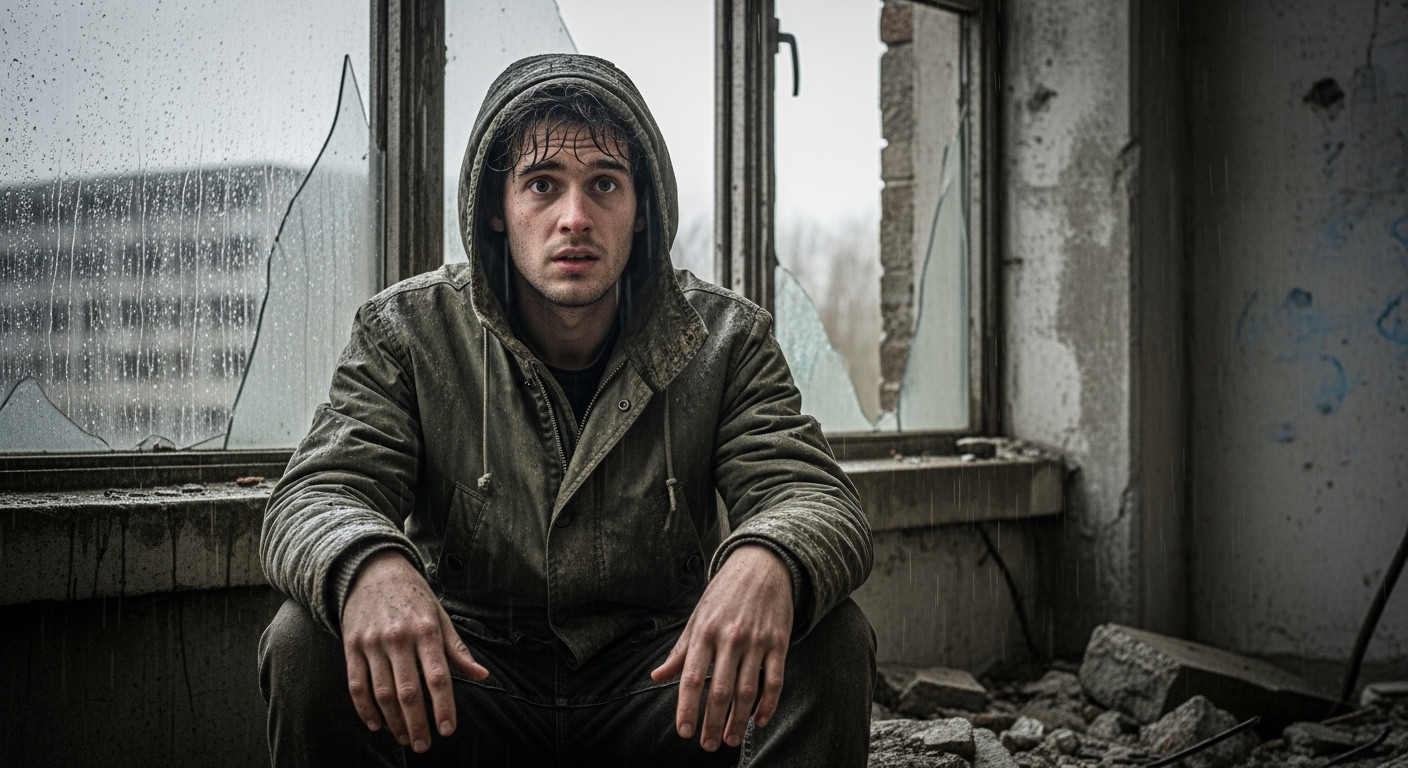
The Mire of Wakefulness - Narrative Breakdown
Project Overview
Format: Single Chapter / Scene Breakdown
Genre: Psychological Horror / Existential Thriller
Logline: Awakening with amnesia in a desolate, ruined structure, a man's search for answers leads him to a mysterious woman who reveals that their reality is a fragile construct that begins to violently unravel when he is unable to help her hold it together.
Visual Language & Atmosphere
The atmosphere is one of profound desolation and perceptual unease, rendered in a muted, almost monochrome palette. The primary setting is a cavernous, ruined concrete building, a skeleton of its former self. Massive, flaking pillars soar towards a jagged hole where a roof once was, allowing a fine, persistent grey rain to sift down. The dominant colours are shades of grey, the dull brown of rubble, and the oxidised, blood-like red of rust stains bleeding down the walls.
The world outside is a uniform, oppressive grey, featuring skeletal trees and broken structures. The light is anemic and gives no indication of the time of day. This visual decay is punctuated by a single, defiant splash of bright green moss, an anomaly of life in the desolation.
The mood is disorienting and melancholic, underscored by a constant, low static hum. The climax shatters this monochrome palette, introducing an impossibly vivid kaleidoscope of deep purples, brilliant oranges, and electric blues as the sky "cracks." The final image is a stark contrast: a single, crimson-coloured leaf against a bruised twilight sky, its tangible reality rendered terrifying in the wake of the world's dissolution.
Character Dynamics
The scene's tension is built entirely around the interaction between two characters in a state of metaphysical crisis.
* JARED: He is the audience's surrogate, waking in a state of acute ontological shock, deeper than simple amnesia. He is driven by a desperate, fundamental need for orientation—to know who, where, and when he is. His interactions are characterized by panicked, clumsy questions. He clings to physical sensations—pain, cold, texture—as proof of a stable reality. His horror escalates as the woman's cryptic answers dismantle his assumptions, pushing his already fractured psyche toward a complete collapse. He is not a hero, but a victim of his own dissolving perception.
* THE WOMAN: She initially presents a façade of weary resignation, a veteran of this unstable existence. Her coping mechanism is the ritual of sketching, a constant act of will to "draw" the world into a stable form. She acts as a reluctant, detached guide, offering not comfort but a terrifying philosophy of their shared predicament. Her calm is a thin veneer; when reality unravels faster than she can capture it, her composure shatters, revealing a raw terror that mirrors Jared's. She is not a gatekeeper of knowledge, but a more experienced prisoner fighting a losing battle.
Their dynamic is one of a desperate newcomer seeking an anchor and a weary inhabitant whose anchor is failing. Jared’s panic destabilizes the fragile reality the woman is working to maintain, creating a feedback loop of existential terror.
Narrative Treatment
The world comes into focus through a haze of pain and confusion. JARED is lying on a cold, gritty concrete floor inside a vast, ruined structure. His mind is a blank grey canvas; he knows his name, but nothing else. Pushing himself up, he takes in the desolation: massive concrete pillars, a shattered roof open to a perpetually grey sky, and rubble strewn everywhere. The air is cold, smelling of damp dust and decay.
He stumbles through the ruin, his body stiff and aching. Through a gaping hole in a wall, he sees a monochrome landscape of broken structures and skeletal trees. Every sensory detail feels both intensely real and deeply wrong. A patch of impossibly bright green moss seems to shiver at his touch, a subtle crack in the world's logic.
Rounding a corner, he sees a WOMAN, her back to him, hunched over and sketching in a notebook. He calls out. She turns slowly, her face young but lined, her blue eyes filled with an ancient recognition. She greets him with a simple "Morning," her calmness unnerving. Jared's desperate questions about the day are met with a sad smile and a cryptic response: "It's always this day, isn't it? The day after. Or the day before."
He admits his amnesia, asking where they are. "In the grey," she replies, never stopping her sketching. She identifies him as a newcomer from "the mire" and notes that the shock is always jarring "the first few times." The phrase chills Jared. He asks if this is a dream, pinching his arm hard enough to draw blood, showing her the proof. "Look. It hurts. This is real."
The woman is unmoved. She tells him that everything in this place is "drawn," "remembered," or "feared"—it's all just ink. She offers him a blank sketchbook and tells him to "Draw the pain," explaining it's the only way to make it real, even for a moment. Panicked, Jared insists he can't draw. As he refuses, he feels an internal shift. The walls around them begin to waver, the rust stains rippling like water. "You have to," she insists with a new urgency, "Or it starts to unravel."
A wave of vertigo hits Jared. He reaches out to a pillar for support, and his hand passes directly through the solid concrete. The pillar shimmers and returns, but the violation of physics is undeniable. He turns to the woman, pleading, but her face is becoming indistinct, like an unfinished drawing. She is sketching furiously now. "You’re waking up," she says, her voice flat, "Or you’re falling deeper."
The space between them seems to stretch as he tries to approach her. The ground shifts texture beneath his knees. The woman's form begins to blur and dissolve into lines of charcoal and swirls of blue pigment. "Hold onto something!" she screams, her voice fragmenting into echoes as she disappears.
The ruin collapses into a surreal nightmare. Pillars twist like trees, and the sky cracks open, revealing a swirling, liquid nebula of impossible color. The sensory overload is crushing. Jared squeezes his eyes shut, trying to will it away. When he opens them, everything is gone. He is lying on his back on cool soil, under the skeletal branches of a massive, twisted tree. The woman is gone. A single, crimson leaf drifts down from the sky, landing gently on his forehead, its touch feeling utterly, terrifyingly real.
Scene Beat Sheet
1. AWAKENING: Jared wakes on a concrete floor in a ruin, his body in pain and his memory gone.
2. ORIENTATION: He slowly gets up, taking in the desolate, monochrome environment of concrete, rubble, and grey rain.
3. EXPLORATION: He walks through the ruin, noting the skeletal landscape outside and a strange, living patch of moss.
4. DISCOVERY: Jared finds a woman sitting alone, sketching in a notebook.
5. FIRST CONTACT: He calls out. The woman greets him calmly, without surprise.
6. CRYPTIC DIALOGUE: Jared's frantic questions are met with the woman's unsettling, philosophical replies about their reality being "the grey."
7. THE REVELATION: She explains that their world is a construct—drawn, remembered, or feared—and that he has just emerged from "the mire."
8. PROOF OF REALITY: In desperation, Jared pinches his arm, drawing blood to prove this is real.
9. THE TASK: The woman urges him to "Draw the pain" in a sketchbook to help make reality solid.
10. THE REFUSAL: Jared panics, insisting he cannot draw.
11. THE UNRAVELING: As he refuses, the world begins to visually distort. The walls ripple and the ground shifts.
12. PHYSICS BREAKS: Jared's hand passes through a concrete pillar. Reality is fundamentally broken.
13. DISSOLUTION: The woman screams a final warning to "Hold onto something!" before her form dissolves into a sketch.
14. APOCALYPSE: The ruin transforms into a surreal vortex of twisting shapes and kaleidoscopic color.
15. THE SHIFT: The chaos abruptly ends. Jared finds himself lying on the ground beneath a massive, twisted tree as a single crimson leaf lands on his forehead.
Thematic Context
This narrative is a study in ontological vertigo, exploring the violent collision between the human desire for objective reality and the terrifying possibility of its absence. The entire scene is filtered through Jared's disoriented consciousness, trapping the audience in his existential condition. The core conflict is not good versus evil, but coherence versus dissolution. The horror arises from the suggestion that reality and identity are not inherent states but fragile, willed constructs.
The setting is a direct externalization of Jared's psyche: the ruined building is his fractured mind, the failing pillars are the support structures of his consciousness, and the oppressive "grey" symbolizes the amorphous void of his amnesia. The central metaphor is the act of sketching, which represents the creation of reality itself—a conscious act of imposing order on formless chaos. The woman's pencil is the instrument that holds the world together, and her failure signifies the overwhelming power of that chaos.
The narrative draws from the traditions of existential horror, echoing Philip K. Dick's explorations of subjective reality and Franz Kafka's sense of struggling against an incomprehensible system. Ultimately, this is not a story about a post-apocalyptic world, but about the apocalypse of the self. Its horror is rooted in the chilling realization that the border between consciousness and chaos is permeable, and that the act of waking up may not be a return to safety, but the beginning of an endless fall.
Share This Treatment


