The Intolerable Geometry of 'Fine'
Format: Short Film / Anthology Episode | Est. Length: 10-12 minutes
Logline
The seemingly simple task of assembling a flat-pack wardrobe becomes the battleground for a couple's conflicting life philosophies, leading to a catastrophic collapse that ultimately strengthens their foundation.
Themes
* Perfectionism vs. Pragmatism: The central conflict explores the tension between a meticulous, by-the-book approach to life versus a flexible, "good enough" attitude, questioning where the line between quality and obsession lies.
* The Symbolism of "Building a Life": The wardrobe is a direct metaphor for the couple's relationship. Their struggle to build it reflects the challenges of merging two different personalities into a stable, shared future.
* Communication and Projection: A minor disagreement escalates into a major philosophical battle, revealing how couples often project their deeper anxieties and insecurities onto mundane tasks.
* Finding Strength in Failure: The story posits that true connection isn't found in flawless execution, but in the shared vulnerability and humor that comes from spectacular failure.
Stakes
At stake is the couple's newly established shared life; their inability to reconcile their fundamental differences threatens to collapse their relationship before it's even been properly built.
Synopsis
In a sparse, newly-inhabited apartment, ALEX and CALEB are building a flat-pack wardrobe. The project immediately stalls when Alex, a stickler for precision, questions Caleb’s casual assessment that a shelf is "fine." Alex’s insistence on objective truth, proven by a spirit level, reveals the shelf is dramatically un-level.
This small disagreement quickly spirals into a larger, metaphorical argument. Caleb accuses Alex of being overly rigid, while Alex sees Caleb’s approach as slipshod and careless. The argument, dubbed "The Great Dowel Debate," becomes a physical and philosophical theatre, with the two men using wardrobe parts as props to debate their opposing worldviews: planning versus spontaneity, structure versus improvisation.
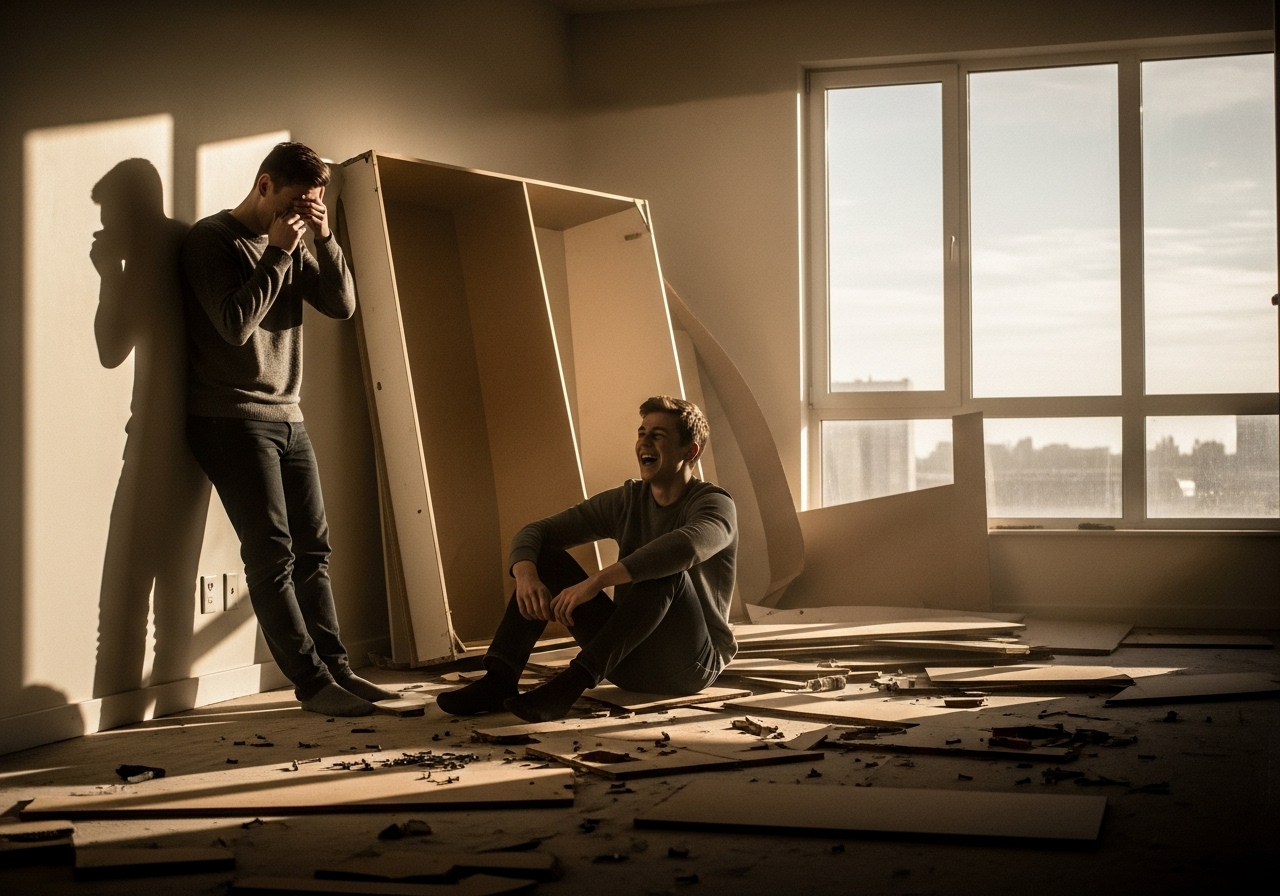
Their increasingly heated argument sends vibrations through the precarious structure. A misplaced thud from Caleb is the final straw. With an agonized groan, the entire wardrobe collapses into a heap of particleboard and screws.
A stunned, thick silence fills the room as they stare at the wreckage—a perfect monument to their incompatibility. But just as the tension reaches its peak, Caleb begins to laugh. The absurdity of the situation—their grand "foundation" in a heap on the floor—is too much. After a moment of resistance, Alex joins in, and the shared, helpless laughter provides a cathartic release. In the aftermath, surrounded by the debris, they agree to order pizza, finding a new, more resilient starting point in their shared failure.
Character Breakdown
* ALEX (30s): Meticulous, anxious, and a devout planner. He believes that structure, rules, and precision are the only things that stand between order and chaos. His need for control is a defense mechanism against a deep-seated fear of failure and the unknown. He equates doing things "the right way" with showing care.
* Psychological Arc:
* State at Start: Alex believes that a successful life and relationship must be built with perfect precision, like the wardrobe. He sees any deviation from the plan—any imperfection—as a critical flaw that threatens the entire structure.
* State at End: After witnessing the spectacular failure of his rigid approach, Alex is forced to confront the absurdity of his perfectionism. Through shared laughter, he realizes that their foundation isn't built on flawless geometry but on their ability to navigate and find humor in chaos together. He learns to embrace the "good enough."
* CALEB (30s): Spontaneous, pragmatic, and charmingly improvisational. He believes life is for living, not for planning down to the last millimeter. He is comfortable with imperfection and sees Alex’s rigidity as an obstacle to happiness. He values connection and experience over flawless execution.
Scene Beats
1. THE PRECISION PROBLEM: Alex is on his knees, trying to fit a screw. He asks Caleb if the shelf he's holding is level. Caleb’s casual reply, "Yeah, it's fine," triggers Alex's anxiety.
2. INTRODUCTION OF TRUTH: Alex refuses to accept "fine" as a measurement. He retrieves a spirit level, which proves the shelf is dramatically off-kilter. He declares it a "travesty."
3. THE METAPHOR REVEALED: Caleb, frustrated, suggests propping the shelf up. Alex is horrified. Caleb realizes the argument isn't about the wardrobe; it's about Alex's judgment of his entire approach to life.
4. THE GREAT DOWEL DEBATE: The conflict escalates. They circle the half-built wardrobe, using a wooden dowel (Alex) and a side panel (Caleb) as props in a philosophical duel about planning versus spontaneity.
5. THE CATALYST: Caleb punctuates a point by thudding his panel on the floor. The vibration shudders through the precarious structure. A screw pops out. They both freeze.
6. THE COLLAPSE: With a series of groans and creaks, the wardrobe gives up and folds in on itself in a chaotic, final crash.
7. THE WRECKAGE: Silence. Alex and Caleb stand on opposite sides of the debris field, a physical manifestation of their conflict. The failure feels total and symbolic.
8. THE BREAK: Caleb looks at the mess, at the mocking instruction manual, and at Alex's horrified face. He breaks the tension with a deep, uncontrollable laugh.
9. CATHARSIS: After a moment of shock, Alex sees the farce for what it is. He joins in, and they both laugh until they cry, releasing all the pent-up tension.
10. THE NEW FOUNDATION: The laughter subsides. In the quiet aftermath, Caleb suggests pizza on the floor, wryly noting that the floor is probably level. Alex agrees, dropping his dowel. They have found connection not in success, but in shared disaster.
Visual Style & Tone
The visual style will be intimate and contained, set entirely within a single, box-filled room with stark, natural light that softens as the afternoon fades. The camera will employ tight shots on details—the wobbly bubble in the level, the Allen key, the threads of a screw—to heighten the feeling of focused tension. The collapse will be shot for maximum tragicomic effect, a slow-motion ballet of failure.
The tone is a dramedy that balances sharp, witty dialogue with genuine emotional stakes. It begins with relatable domestic tension, builds to an almost theatrical absurdity, and resolves with cathartic warmth. The overall feeling aligns with the character-driven, dialogue-heavy intimacy of Marriage Story or Before Midnight, while the climactic collapse and emotional release share a tragicomic spirit with shows like Fleabag or Catastrophe.
Share This Treatment


