The Index of Lost Selves
Format: Short Film / Anthology Episode | Est. Length: 10-12 minutes
Logline
A disgraced academic, searching a mystical archive for a stolen memory to vindicate his ruined mentor, uncovers a devastating truth that implicates himself in the very crime he sought to solve.
Themes
* The Unreliability of Memory: Memory is not a perfect record but a malleable construct that can be stolen, altered, or suppressed, leading to a dangerously false sense of self and justice.
* The Price of Truth: The obsessive pursuit of a perceived truth can become a self-destructive act, revealing a reality far more horrifying than the lie one sought to expose.
* Hidden Power in Plain Sight: Mundane settings and unassuming individuals can conceal immense, ancient power and secret orders that guard the boundaries of reality.
Stakes
Denny risks his last chance at professional redemption and personal vindication, only to discover his entire identity is built on a lie he can never escape.
Synopsis
DENNY ALLEN, a disgraced academic ostracized for his fringe theories, haunts the basement of a city archive. He believes certain microfilm reels are not newspaper records but stolen human memories. His goal: find the memory of ALISTAIR FINCH, the sole witness to an alchemical experiment that ruined his mentor and, by extension, his own career. He is convinced this memory will prove his mentor was framed, offering him a path back to legitimacy.
His search is quietly monitored by JUDY, the archivist. She appears to be a typical, overworked librarian, but her sharp eyes and cryptic comments reveal she is a guardian of the archive's true nature. She knows Denny is not researching local history and her presence is a constant, low-level threat, a warning not to disturb the secrets she protects.
After weeks of painstaking work, Denny discovers a reel that emanates a faint psychic warmth. This is it. As he threads the film into a viewer, his hands trembling with anticipation, Judy approaches. She warns him that the past doesn't like to be changed and has ways of "pushing back."
Ignoring her, Denny activates the viewer. Instead of a dim projection, a vivid, three-dimensional memory pours out, transforming the dusty basement into a stone-walled laboratory. He is an invisible spectator to the past. He sees his mentor arguing with Finch, pleading to abort the unstable procedure. Finch, driven by greed, refuses. This is the proof Denny has sacrificed everything for.
But as his heart soars with vindication, the memory's perspective shifts. It pans past the two men to reveal a third figure in the shadows: a younger version of Denny himself. He watches in horror as his younger self opens a small, intricate box, speaks a word of power, and unleashes a wave of dark energy that sabotages the experiment, causing a catastrophic explosion.
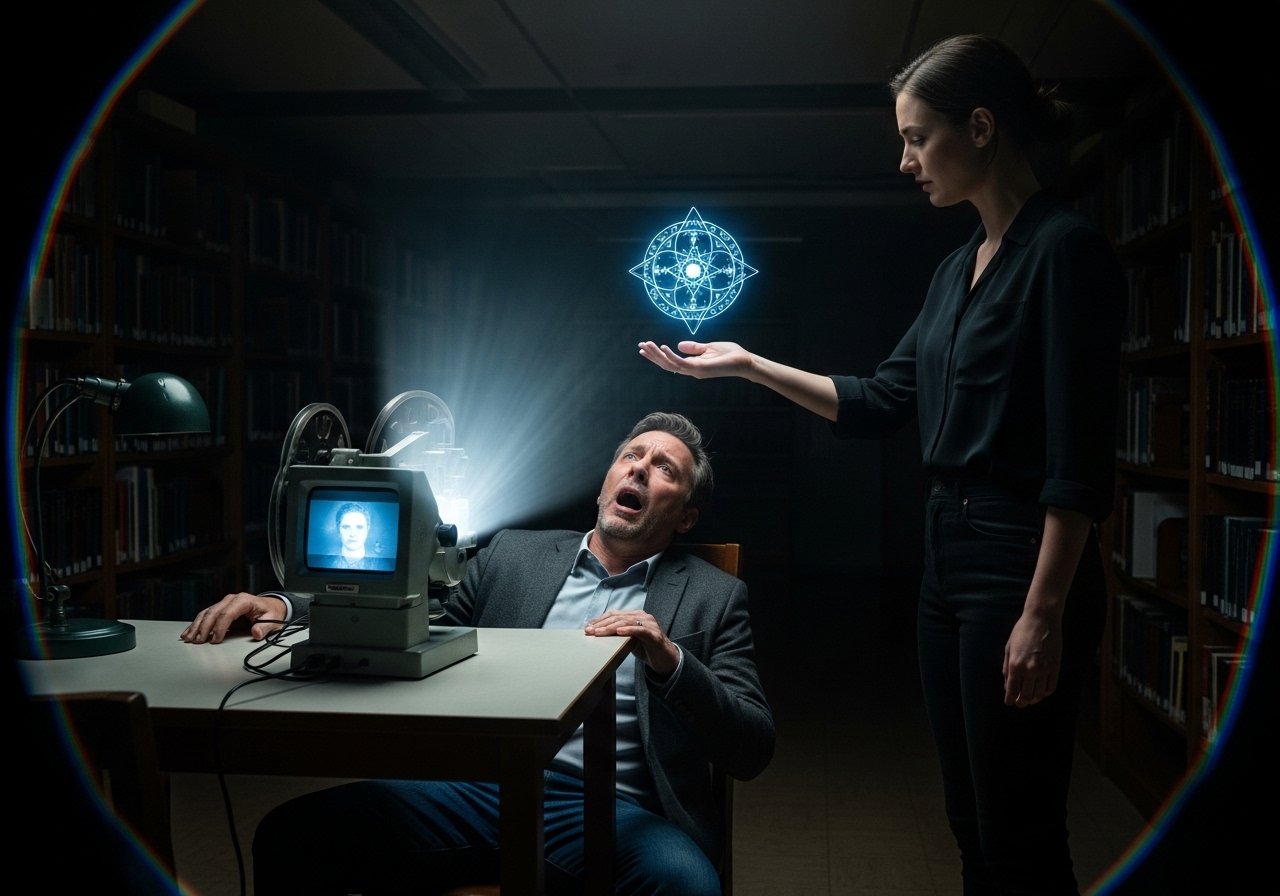
The memory collapses, plunging Denny back into the reality of the archive basement. He stumbles back, his mind reeling from the revelation. He wasn't the loyal apprentice; he was the saboteur. His entire quest for justice has been built on a memory he himself suppressed. Looking up, he sees Judy standing over him, no longer a librarian but an enforcer. Her hand is outstretched, ready to deliver the past's judgment.
Character Breakdown
* DENNY ALLEN (40s): Intense, obsessive, and driven by a righteous sense of injustice. Once a respected academic, he now operates on the fringes, consumed by his quest to clear his mentor's name. He is intelligent and perceptive but blinded by his single-minded mission.
* Psychological Arc: Denny begins as a self-styled martyr, convinced of his own victimhood and his mentor's innocence. His entire motivation is to expose an external conspiracy to reclaim his honor. He ends completely broken, stripped of his righteous anger and forced to confront the horrifying reality that he is the villain of his own story, his identity shattered by a truth he unknowingly suppressed.
* JUDY (50s): The archivist. On the surface, she is a mundane, overworked librarian in a cardigan and sensible shoes. Beneath this facade, she is a calm, knowing, and powerful guardian of the archive's secrets. She is the gatekeeper, observing and testing those who seek its forbidden knowledge with quiet authority.
Scene Beats
1. THE HUNT: In the dusty archive basement, Denny sifts through microfilm, not reading but feeling for a psychic resonance. The mundane setting is charged with unseen energy.
2. THE GUARDIAN: Judy, the archivist, watches Denny. Their brief, coded conversation establishes the tension and her awareness of his true, forbidden purpose.
3. THE DISCOVERY: Denny finds the reel. A palpable buzz of energy confirms it's the one containing the memory. His hope and desperation peak.
4. THE WARNING: As Denny sets up the viewer, Judy approaches. She delivers a cryptic warning about the dangers of trying to rewrite the past.
5. THE PROJECTION: Denny hits the switch. A vivid, three-dimensional memory floods the room, transporting him to a chaotic alchemical lab.
6. THE "VINDICATION": Inside the memory, Denny witnesses the argument between his mentor and Finch, seemingly confirming his theory of a setup. A brief, soaring moment of triumph.
7. THE REVELATION: The memory's point-of-view shifts, revealing a younger Denny in the shadows. He watches himself sabotage the experiment, causing the explosion.
8. THE JUDGMENT: The memory collapses. Denny is in shock, his reality shattered. He looks up to see Judy standing over him, her librarian facade gone, replaced by the calm authority of an enforcer.
Visual Style & Tone
The visual style will be one of stark contrast. The archive basement is shot with a gritty, noir sensibility—low-key lighting, deep shadows, and dust motes hanging in the air to create a sense of forgotten history and oppressive secrets. The world is desaturated and claustrophobic.
When the memory is projected, the style shifts dramatically to a vibrant, hyper-real, and slightly unstable visual language. The camera becomes fluid, almost floating, to immerse the viewer in the memory. Lens flares, subtle focus pulls, and slight image distortion will convey the volatile and subjective nature of the projected memory.
Tonal Comparisons: The film aligns with the cerebral, tech-paranoia of Black Mirror, the concept of forbidden, archived knowledge found in Archive 81, and the oppressive atmosphere of a society hiding dark truths, reminiscent of Fahrenheit 451.
Share This Treatment


