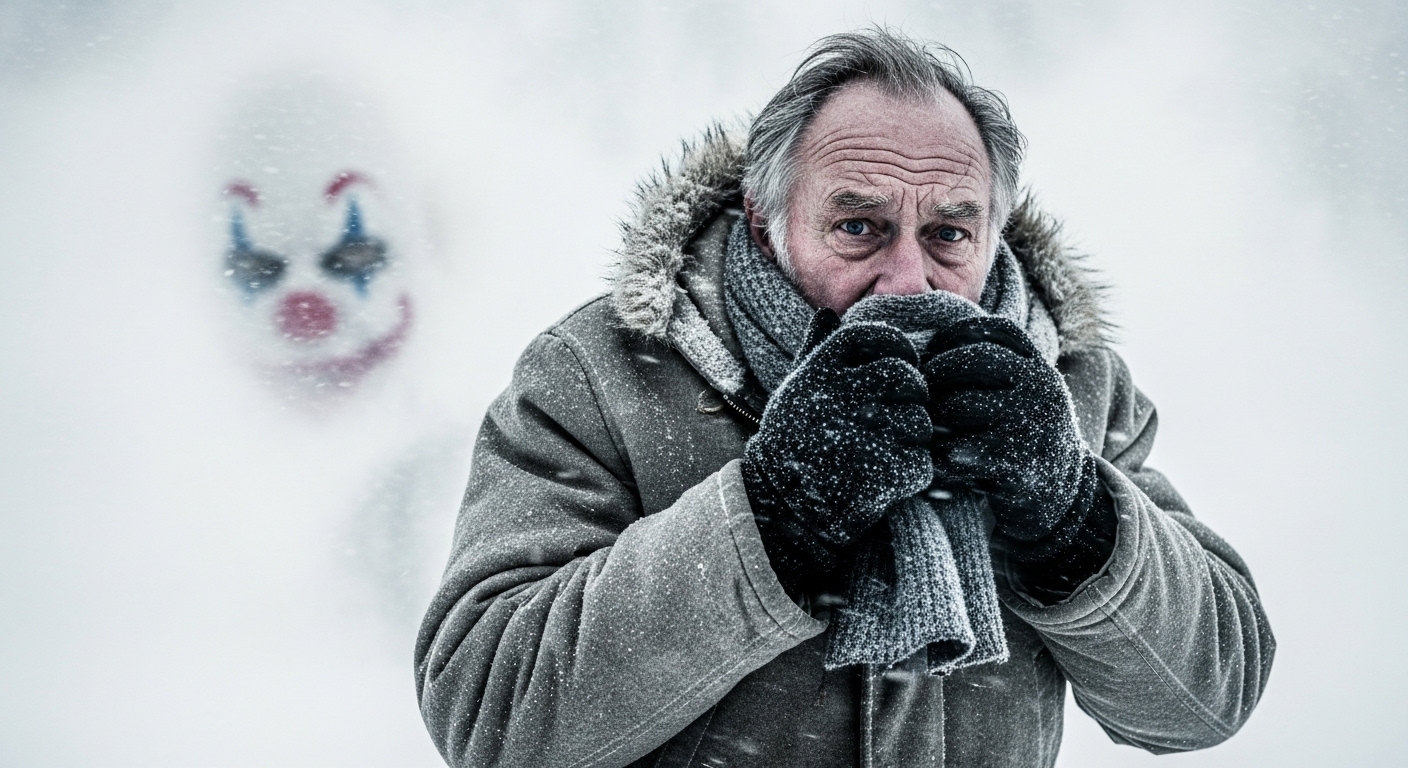
THE HARLEQUIN'S GLARE THROUGH THE FLURRY
A Film/TV Treatment
---
1. Logline
Trapped by a severe blizzard at a desolate roadside motel, an elderly man's grip on reality is tested when he is haunted by a grotesque harlequin figure, forcing him to venture into the storm to confront a terror that may be supernatural or a product of his own failing mind.
---
2. Synopsis
In the suffocating quiet of a snowbound motel, DESMOND (70s), a man physically and emotionally weathered by time, tries to convince the weary motel owner, PATSY (60s), that he saw something impossible in the blizzard: a grotesque, grinning harlequin. Patsy dismisses his claim as cabin fever, reinforcing Desmond's own deep-seated fear that his mind is beginning to fray. Retreating to his room, Desmond is trapped between the churning white chaos outside and his own internal storm of doubt. The line between reality and delusion blurs entirely when he discovers a tangible piece of evidence: a small, crudely carved clown face left on his windowsill. The discovery is punctuated by an unearthly, childlike giggle that pierces the howl of the wind. Realizing he is being hunted and taunted, Desmond makes a desperate choice. Overcoming his age and fear, he pushes out into the blinding snowstorm, drawn by a fleeting glimpse of the creature, and takes his first steps into a surreal and deadly chase through an unforgiving, frozen landscape.
---
3. Character Breakdown
* DESMOND (72): A man in the winter of his life, with a body that creaks and fails him (a bad hip, trembling hands). He is isolated and wrestling with the quiet terror of senility. While he appears fragile, beneath the surface is a stubborn resolve and a desperate need to trust his own senses. His journey is not just about surviving the monster, but about reclaiming his own sanity.
* PATSY (60s): The proprietor of the rundown motel. She is pragmatic, exhausted, and has the practiced air of someone who has seen too much weirdness on the midnight highways to be easily rattled. She serves as the anchor to the mundane world, her skepticism forcing Desmond to confront his terror alone. She isn't cruel, merely resigned.
* THE HARLEQUIN: Not a person, but an entity. It moves with an unnatural, deliberate slowness, its form seeming to coalesce and dissolve into the snow itself. Its features are painted and exaggerated—a crimson slash of a grin, stark white makeup—making it a violent splash of color in a monochrome world. Its motivations are unknown, but its actions suggest a cruel, playful intelligence, like a cat toying with a mouse.
---
4. Scene Beats
* THE DISMISSAL: In the bleak, empty motel lobby, Desmond, trembling, recounts his vision to a disbelieving Patsy. The air is thick with the smell of burnt toast and loneliness. Patsy shuts him down with a tired, rational explanation, planting the seed of doubt: is he just another old man losing his mind in the snow?
* THE MEMORY OF A MONSTER: Alone in his room, the claustrophobia closes in. Desmond is haunted by the vivid memory of what he saw: a grotesque, ballooning form against the white, its painted grin a wound in the grey light, waving a single, elongated glove in a slow, obscene gesture before vanishing. The vision is sharp, jarring, and utterly unbelievable.
* THE DOUBT: Pacing his room, Desmond battles himself. The silence of the motel, the relentless howl of the wind, and Patsy's words echo in his mind. He clutches his aching hip, the physical pain a dull counterpoint to his sharp mental terror. He is on the verge of accepting he is losing his grip.
* THE ARTIFACT: His gaze catches on something new on the windowsill—a tiny, thumb-sized wooden carving of a crude, smiling clown face. It feels warm to the touch. This is the turning point. The terror is no longer just a vision; it has left a physical trace. It was in his room.
* THE SOUND OF MADNESS: As Desmond reels from the discovery, a high-pitched, joyless giggle cuts through the roar of the blizzard. The sound is impossibly close, as if it's right outside his door. It's a direct, personal taunt. The trap is closing.
* THE POINT OF NO RETURN: Panic gives way to a grim resolve. The room is no longer a shelter; it's a cage. Grabbing his heavy parka, Desmond understands he cannot hide. He must face whatever is out there, if only to prove to himself that he is not insane.
* CROSSING THE THRESHOLD: Desmond enters the empty lobby and confronts the front door. He hesitates, his hand on the cold handle—one last chance to retreat into delusion. He rejects it. He pushes the door open, and the blizzard explodes into the lobby, a violent, blinding wall of white.
* THE INVITATION: In the churning chaos, for a split second, he sees it: a flash of red and white, a bobbing shape, beckoning him forward before being swallowed by the snow. It's a confirmation and a challenge. The chase is on.
* INTO THE WHITE: Desmond pulls his scarf tight, takes a breath that freezes in his lungs, and steps out into the storm. He is a small, frail figure against an immense, hostile, and haunted landscape. The real nightmare is just beginning.
---
5. Visual Style
TONE: Slow-burn psychological horror meets survival thriller. The atmosphere is paramount, emphasizing isolation and disorientation, in the vein of John Carpenter's The Thing or the stark dread of The Lodge*.
* COLOR PALETTE: Heavily desaturated. The world is a spectrum of whites, grays, and muted, sickly blues. The interior of the motel is lit with the depressing yellow of old tungsten bulbs and the cold hum of fluorescents. The only vibrant colors will be the blood-red and stark-white of the Harlequin, making it appear as an aggressive tear in the fabric of this bleak reality.
* CINEMATOGRAPHY: The camera should reflect Desmond's state of mind. Inside, shots are tight, claustrophobic, and often handheld to convey his trembling anxiety. Outside, the camera pulls back to vast, empty wide shots, dwarfing Desmond in the terrifying, featureless expanse of white. POV shots from Desmond's perspective will be used to create a sense of disorientation in the blizzard, with snow blurring the lens.
* SOUND DESIGN: Sound will be a key character. The near-constant, oppressive roar of the wind outside will contrast with the dead, humming silence inside the motel. Creaks, groans, and the frantic scratching of snow against glass will build tension. The Harlequin's giggle will be mixed to be piercing and unnatural, cutting through all other sounds with chilling clarity. The score should be minimalist and ambient, using low, dissonant tones rather than traditional melodies to heighten the sense of dread.
Share This Treatment


