The Glass Apple - Narrative Breakdown
Project Overview
Format: Single Chapter / Scene Breakdown
Genre: Magical Realism / Psychological Drama
Logline: An elderly widower, prompted by a mysterious Christmas ornament appearing in spring, undertakes a strange ritual with his enigmatic neighbor to align his house with a time outside of time, culminating in a supernatural quest.
Visual Language & Atmosphere
The visual tone is built on stark, unsettling contrasts. The narrative opens in a pale, watery spring morning, with light illuminating dust motes in a quiet, lonely house. This muted reality is violated by the intrusion of winter—an ice-cold glass ornament, the sudden smell of pine and woodsmoke, and frost fern-ing across a bay window that looks out onto a vibrant, greening lawn.
The atmosphere is one of dream-logic and melancholy. The familiar space of Andrew's home becomes distorted and cavernous; the hallway stretches to an impossible length, and the living room ceiling recedes into darkness as the ritual progresses. Memories are not internal but are projected onto the walls like flickering, silent films. The lighting is dominated by the warm but insufficient amber glow of a partial string of Christmas lights, which only serves to deepen the encroaching shadows. The final scenes shift from the frozen, artificial interior to a supernaturally vibrant exterior—a familiar park transformed into a primeval, threatening forest where a single, perfect blossom glows with an inner light.
Character Dynamics
Andrew: A 74-year-old widower, Andrew is physically frail and steeped in the profound silence of his empty house. He is a man adrift in memory and loneliness. When confronted with the inexplicable, he doesn't react with panic but with a quiet, whispery curiosity. He quickly succumbs to the "dream-logic" of the situation, accepting the necessity of the bizarre ritual as if he is recalling a forgotten script. His actions are driven by a deep, unspoken melancholy and a desire to connect with a time when his house was full, making him a willing participant in the supernatural alignment.
Jared: Andrew's neighbor is a theatrical, skeletal figure who appears to be an arbiter or guide for the supernatural event. Dressed perpetually in a tweed suit and carrying a silver-skulled cane, he is an anachronism. He is not surprised by the temporal disturbance; he seems to have been expecting it. His dialogue is cryptic, grand, and declarative ("The calendar is a tyrant," "Imperfection is the hallmark of humanity"). He acts as a master of ceremonies, directing Andrew through the steps of the ritual with an unnerving, calm authority. The dynamic between them is not one of friendship, but of two players in an ancient, necessary performance.
Narrative Treatment
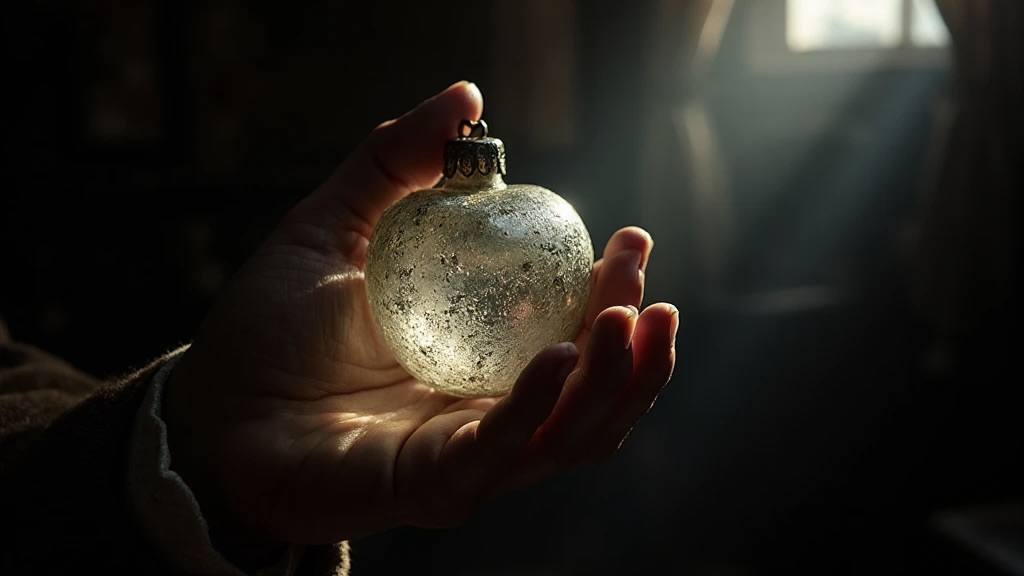
The April morning is quiet and pale in ANDREW’s (74) house, but a sound from deep winter—the scritch-roll of a glass ornament on the hardwood floor—pulls him from bed. His body aches with age, and the house is heavy with a three-year silence since his wife’s passing. In the hallway, he finds the source: a vintage, ice-cold mercury glass apple. He has no idea how it got there.
Holding the ornament, the house shifts around him. The spring scent of tulips is replaced by the sharp tang of pine and woodsmoke. A crushing melancholy, familiar as a December twilight, settles on his chest. He understands, with a slippery dream-logic, that the house is confused, and time must be corrected.
Andrew retrieves the artificial Christmas tree from the attic, a space that feels less like storage and more like a waiting room. As he prepares to assemble the tree in the living room, the vibrant green lawn and budding trees outside serve as a violent contrast to the artificial winter he is constructing. A sharp knock announces the arrival of his neighbor, JARED, a skeletal man in a tweed suit. Uninvited, Jared strides in, tapping his silver-skulled cane, fully aware of the "great resurrection" Andrew has begun. He declares the ornament a "harbinger" and speaks of escaping the tyranny of the calendar.
Together, they fall into the rhythm of the ritual. As Andrew assembles the tree, the room's temperature plummets. Frost blooms across the window, obscuring the spring day. With each branch he arranges, memories flicker on the walls like silent movies—his wife Martha laughing, his daughter crying over a broken candy cane. Jared notes that "the ghosts are lively." The artificial tree slowly becomes real, its plastic needles turning to bark and sap.
They decorate it with old ornaments, hanging a partial string of lights that casts a dim, amber glow, making the shadows in the room stretch and deepen. The house itself seems to expand, the furniture receding into a vast, dark space. Andrew feels his physical ailments fade as he becomes untethered from normal reality. When he asks Jared if he is going mad, Jared replies that he is not losing anything, but finding.
The ritual stalls when Andrew realizes the tree topper—an angel—was broken years ago. Jared declares the ritual cannot close without a crown. Panicked at the thought of being trapped in this cold twilight, Andrew is told he must finish the indoor winter by crowning it with a piece of the Spring outside—something that "bleeds."
Leaving Jared to "guard the fortress," Andrew dons his coat and steps out of the frozen house into the warm, humid air of the spring afternoon. The sensory shock is immense. He walks towards a small wooded park, but the neighborhood warps around him, and the park transforms into a deep, primeval forest. After walking for what feels like hours, he finds a thorny bush with a single, glowing, star-shaped white blossom. Recalling Jared’s words, he grips the stem. A thorn pricks his thumb, and a single drop of red blood wells up against the white petal. He snaps the stem, the sound echoing like a gunshot. When he turns to go back, the path is gone. He is lost, alone in the woods, clutching the bleeding star.
Scene Beat Sheet
1. Andrew is woken by the sound of a glass ornament rolling on the floor.
2. He finds an ice-cold, silver glass apple in the hallway.
3. Holding it triggers a sensory shift: the smell of pine fills the air and the hallway seems to stretch.
4. Andrew accepts the "dream-logic" that he must assemble the Christmas tree.
5. His neighbor, Jared, arrives unannounced, seemingly aware of the supernatural events.
6. Jared confirms they must perform a "resurrection" to correct time.
7. They begin assembling the tree. The room grows cold and frost covers the bay window.
8. As Andrew decorates, vivid memories of his family project onto the walls.
9. Jared observes that "the ghosts are lively" and approve of the disruption.
10. The artificial tree miraculously transforms into a real, living pine tree.
11. Andrew realizes the angel tree topper is missing and broken.
12. Jared insists the ritual is incomplete and must be crowned with something from the Spring outside.
13. Jared gives Andrew a quest: find the topper, saying "You will know it when it bleeds."
14. Andrew leaves the frozen house and steps into the warm, vibrant spring day.
15. The familiar neighborhood park transforms into a vast, primeval forest around him.
16. He discovers a single, glowing, star-shaped blossom on a thorny bush.
17. He pricks his thumb on a thorn, drawing blood onto the flower.
18. He picks the flower, and the path back to his house vanishes, leaving him lost.
Thematic Context
The narrative is a surreal exploration of grief, memory, and the subjective nature of time. The central conflict is not between characters, but between opposing forces: Winter and Spring, past and present, life and death. For Andrew, the linear march of the calendar is a "tyrant" that has carried him away from the time his life was full and into a present defined by loneliness and physical decay.
The ritual is a desperate, magical act to reclaim agency over his reality. By physically manifesting winter in the heart of spring, he attempts to create a "reprieve" or a "loop," a pocket of time where his memories—"the ghosts"—can be alive and present again. The transformation of his house into a vast, timeless space and the artificial tree into a living thing represents the power of his inner world overwhelming external reality. Jared acts as a psychopomp, guiding Andrew through this thinning of the veil between worlds. The story ultimately suggests that this communion with the past requires a sacrifice from the present, forcing Andrew out of his curated winter and into the "thrumming, green violence" of spring to complete the circle. His final state, lost in a supernatural forest, implies that once the boundaries of reality are broken, there may be no easy way back.
Share This Treatment


