THE DEEPWOOD YIELD - TREATMENT
LOGLINE
In a dying remote town, a pragmatic retired lawyer discovers that the unusually bountiful harvest his friend plans to build a business on is the product of an ancient, alien intelligence slowly warping the land and its yield.
SYNOPSIS
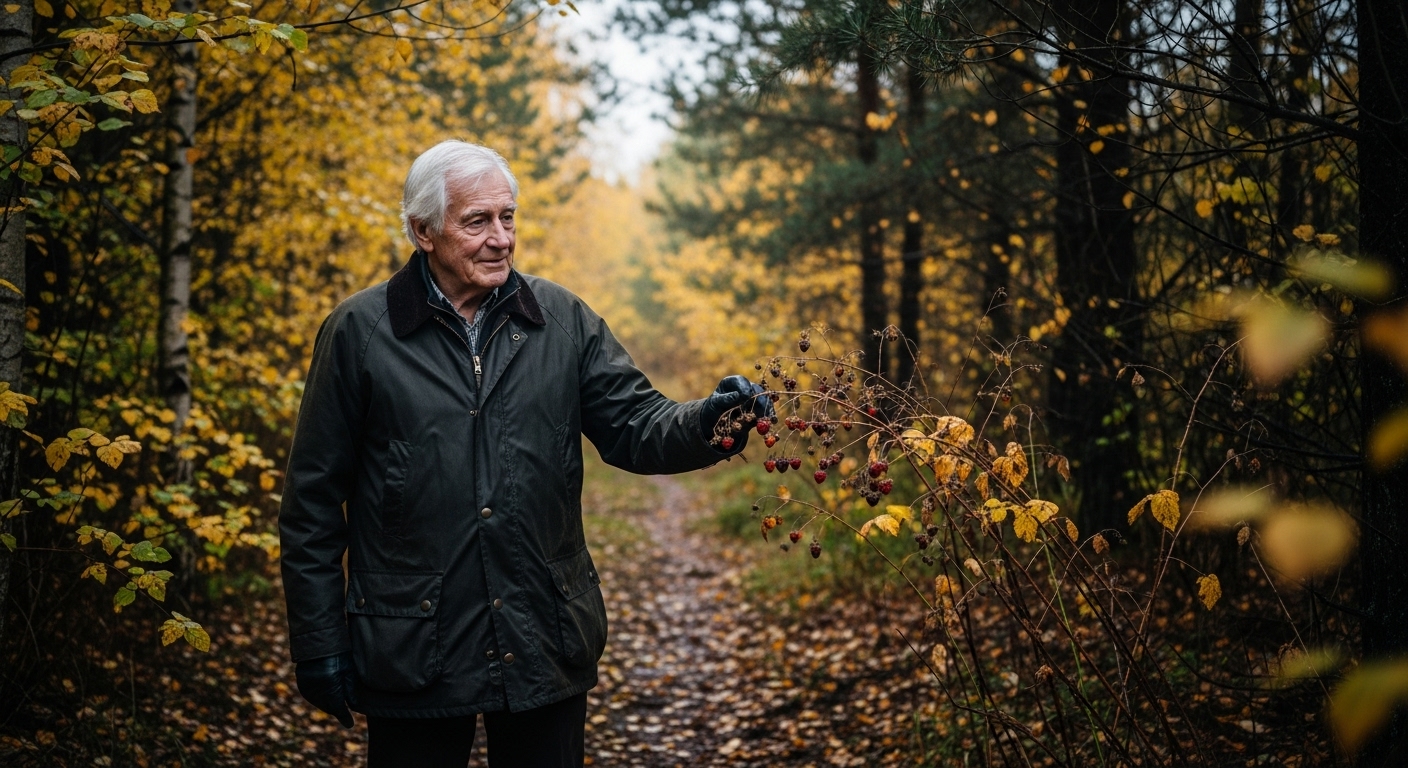
THOMAS CALDWELL (70s), a retired corporate lawyer whose life is governed by logic and precedent, discovers a disturbing anomaly at the community-run Deepwood Land Lab: a raspberry cane that has twisted itself into an unnatural, bruised-purple knot. This single, defiant plant triggers his legal mind's instinct for discrepancies. His friend and colleague, the fiercely optimistic MIRIAM (late 60s), arrives, her mind full of plans to turn the lab's spectacular recent yield into an artisanal food business, "The Deepwood Preserve," to save their economically ravaged community.
As they walk the property, Miriam celebrates the past season's bounty, oblivious to the growing number of unsettling signs that Thomas observes with mounting dread: strange, inky-black fungi; desiccated cucumber vines that have contorted in the same manner as the raspberry cane; and a shrivelled cucumber mottled with a geometric, purplish pattern that feels unnaturally metallic. Thomas’s unease is amplified by a resurfacing memory from an old land dispute case involving a redacted geological report that mentioned "anomalous subsoil readings" and a "peculiar resonant frequency" in this very region.
The conflict escalates as Miriam’s hopeful plans for branding and marketing—invoking the "magic" and "ancient spirit" of the land—clash with Thomas's growing, unspoken terror. He realizes the land’s "generosity" is not a blessing but a symptom of a profound, alien corruption. The story culminates at twilight, with Thomas holding the unnatural cucumber, understanding that their venture isn't about preserving the local bounty, but cultivating and potentially unleashing something ancient, incomprehensible, and utterly hostile to the natural world.
CHARACTER BREAKDOWN
* THOMAS CALDWELL (70s): A retired corporate lawyer. Sharp, analytical, and grounded in the rational world. He sees life as a series of contracts and predictable outcomes. His retirement to the quiet woods was meant to be a peaceful epilogue, but his keen eye for detail and inconsistency now forces him to confront a reality that defies all logic. He is our reluctant investigator, his legal mind the only tool he has to decipher a cosmic horror.
* MIRIAM (late 60s): The heart and soul of the community. Energetic, indefatigably optimistic, and driven by a fierce love for her home. She sees the Deepwood Land Lab and her "Preserve" project as the last, best hope for a town hollowed out by economic collapse. Her hopefulness makes her blind to the subtle wrongness Thomas perceives, creating a poignant dramatic irony and isolating Thomas in his growing fear.
SCENE BEATS
* THE ANOMALY: In the quiet of the autumnal Deepwood Land Lab, Thomas Caldwell, a man of logic, finds a single raspberry cane twisted into a grotesque, unnatural, purple-black knot. It’s a biological discrepancy that snags his legal mind.
* A SPLASH OF HOPE: The silence is broken by Miriam, a vibrant splash of colour and energy. She arrives full of enthusiasm for their successful harvest, her optimism a stark contrast to the quiet dread of the scene.
* BLIND TO THE TRUTH: Miriam joins Thomas by the strange cane but sees only the memory of a bountiful summer. Her inability to perceive the wrongness isolates Thomas, making him question his own senses.
* THE STAKES: As they walk, Miriam passionately outlines her business plan for "The Deepwood Preserve," framing it as the economic salvation for their dying community. The success of the harvest is not just about profit; it's about survival and identity.
* A SPREADING SICKNESS: Thomas's unease deepens as he spots more anomalies: a patch of unnervingly dark fungi, and then the remains of the cucumber patch, where the dead vines are also unnaturally knotted. The problem is not isolated; it's systemic.
* A BURIED MEMORY: Holding a desiccated, strangely mottled cucumber, Thomas’s mind flashes back to a decades-old legal case. He recalls an obscure geological report mentioning "anomalous subsoil readings" and a "peculiar resonant frequency" in this area. The mystery expands from a local problem to something geological, even cosmic.
* THE WEIGHT OF THE LAND: The conversation turns to the land's "generosity" and "roots." The words take on a sinister double meaning for Thomas, who now suspects the fertility comes from an unnatural, ancient source.
* DENIAL AND DREAD: Miriam cheerfully suggests using local "magic" and the "spirit of the land" for marketing. Thomas reacts with uncharacteristic sharpness, his scientific and legal mind recoiling from concepts that now feel terrifyingly real. The chasm between their perspectives widens.
* THE UNNATURAL ARTIFACT: Thomas examines the desiccated cucumber in his hand. Its feel, weight, and the geometric pattern of its discolouration defy the physics of organic decay. It is a piece of alien evidence.
* A CHILLING REALIZATION: As twilight falls, Miriam beams about the future of "The Deepwood Preserve." Thomas forces a smile, but his mind is racing. He looks from the unnatural fruit in his hand to the dark woods, understanding with cold certainty that what they are "preserving" is not the bounty of the earth, but the yield of something else entirely.
VISUAL STYLE
* PALETTE: A muted, desaturated autumn palette—ochres, deep browns, slate greys—that emphasizes the feeling of decay and encroaching cold. This is violently punctuated by the unnatural, bruised purple and inky black of the anomalous flora, and the vibrant orange of Miriam's scarf, representing a hope that feels increasingly out of place.
* CINEMATOGRAPHY: The camera should be steady and observant, mirroring Thomas’s methodical point of view. Utilize slow, creeping zooms and extreme close-ups on the unnatural textures of the plants—the twisted fibres of the cane, the velvety surface of the fungi, the geometric mottling on the cucumber. Contrast wide, beautiful but lonely shots of the landscape with claustrophobic framing when in the deeper woods, suggesting an unseen pressure.
* LIGHTING: Low-angle, weak autumn sunlight that struggles to penetrate the canopy. An emphasis on long, deep shadows. As the story progresses, the light should feel as if it is being absorbed by the landscape, culminating in a bruised, violet twilight that mirrors the colour of the corruption.
* SOUND DESIGN: A minimalist and atmospheric approach is key. The dominant sound is a profound, almost surgical silence, broken by hyper-realistic sounds: the crisp crunch of leaves, the snap of a twig, the wind. Underneath it all, a subtle, low-frequency hum could be introduced and slowly amplified, a sonic manifestation of the "resonant frequency" from the geological report, audible only in moments of intense focus. The score should be sparse and dissonant, using tense strings and low drones rather than traditional melody to build a sense of intellectual and cosmic dread.
Share This Treatment


