The Collapse of Conviviality - Project Treatment
Project Overview
Format: Feature film, 90–105 minutes
Genre: Satirical Thriller / Dark Comedy
Tone References: Sorry to Bother You for its surreal descent into corporate horror and sharp satirical bite; Don't Look Up for its depiction of societal absurdity in the face of an undeniable crisis; After Yang for its quiet melancholy and exploration of authenticity in a manufactured world; and Severance for its chillingly sterile corporate aesthetic and slow-burn mystery.
Target Audience: Fans of high-concept, director-driven films from studios like A24 and Neon; audiences who appreciate smart, socially relevant satire that blends comedy with genuine tension.
Logline: After a corporate-sponsored ice sculpture inexplicably collapses, a cynical festival employee and an obsessive artist discover the bizarre, living secret at its core, forcing them to expose a grotesque corporate conspiracy before they are silenced forever.
Visual Language & Cinematic Style
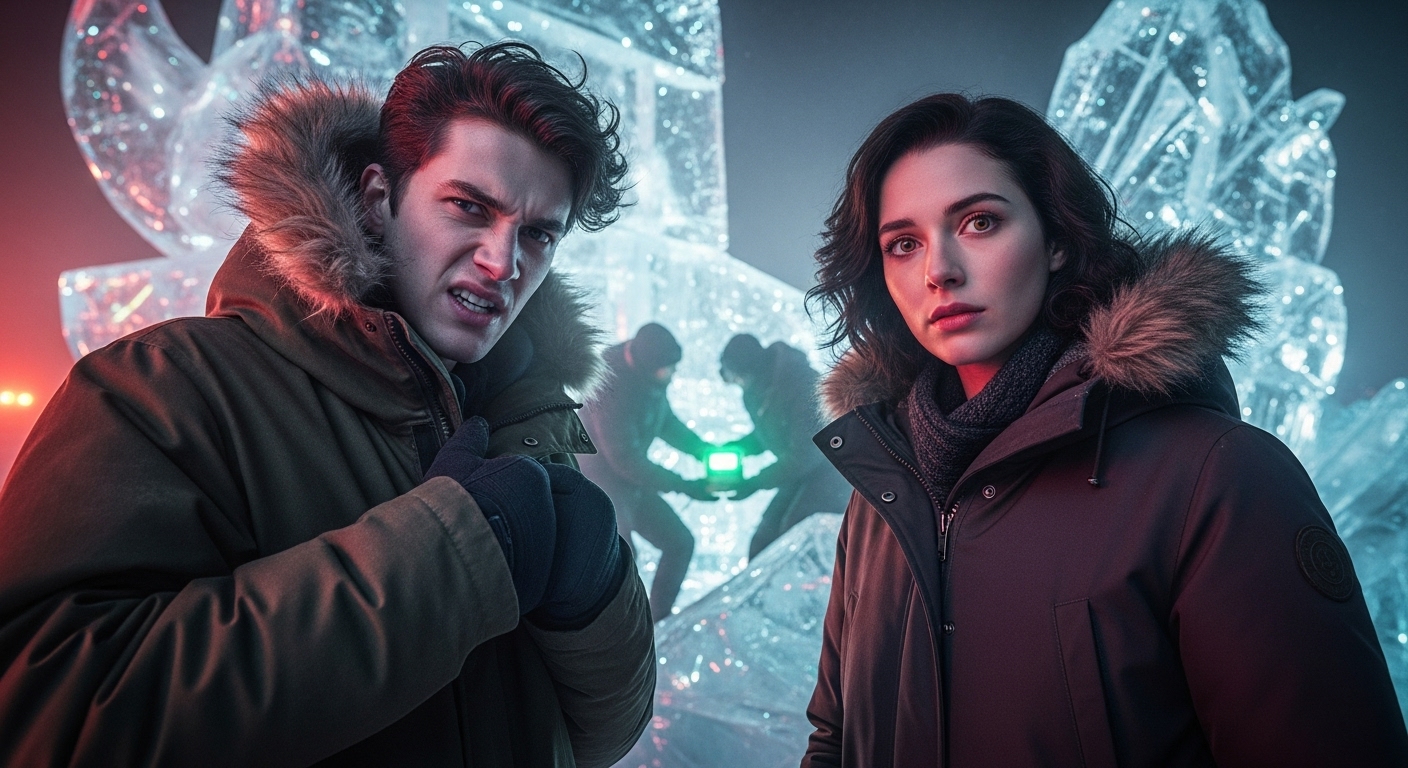
The film's visual identity is built on a foundation of stark contrast. The "Grand Glacial Grotto" is a world of cold, sterile hyper-reality. We will use clean, wide-angle anamorphic lenses to capture the scale of the manufactured environment, emphasizing its emptiness despite the crowds. The color palette is dominated by artificial blues, cyans, and the magenta glow of corporate branding, all lit with the flat, unforgiving glare of LED event lighting. This creates a world that feels both over-lit and deeply shadowed, where every surface has a synthetic, plastic sheen. The camera work is initially observational and static, reflecting Dill's detachment. As the Vortex collapses and the mystery unfolds, the camera becomes more frantic and handheld, mirroring the characters' loss of control. The "secret" at the heart of the conspiracy will be visualized as the complete opposite: warm, organic, bioluminescent, and pulsing with a natural, chaotic energy that the clean corporate lines cannot contain. The space of the festival functions as a pristine cage, which, once broken, reveals the messy, uncontrollable truth underneath.
Tone & Mood
The tone is a delicate tightrope walk between laugh-out-loud absurdity and heart-pounding paranoia. The film begins as a tragicomedy, a symphony of late-capitalist banality where the greatest tragedies are a spilled artisanal pretzel or a cracked phone screen. The initial collapse of the Vortex is treated not with the gravitas of a disaster film, but with the bewildered, almost comedic pacing of a slow-motion pratfall. This comedic foundation serves to make the shift into a thriller all the more unsettling. The mood will grow progressively darker as Dill and Cassie move from being witnesses to an absurdity to being targets of a conspiracy. The humor never fully vanishes but becomes more pained and desperate, a coping mechanism against a genuinely threatening corporate machine. The emotional rhythm is one of surreal dissonance, where the mundane—like the lingering scent of fake pine—is juxtaposed with existential dread, creating a sustained feeling of uncanny unease.
Themes & Cinematic Expression
The central theme is the conflict between manufactured experience and authentic connection. This is visualized in every frame: the chemically-enhanced "everlasting" ice sculptures versus the tiny, flawed, artisanal ice squirrel Cassie tries to save. The sound design will constantly underscore this, contrasting the looped, synthetic "Arctic Echo" soundtrack with the organic, unsettling groans of the collapsing ice and the quiet, intimate sound of Dill and Cassie's shared breathing in moments of conspiracy. Another key theme is corporate dehumanization and the commodification of nature. Quantum Foods Inc. hasn't just built a festival; they've packaged and sold a distorted effigy of the natural world. This is expressed through the omnipresent, pixelated corporate logos carved into the ice, turning a polar bear into a billboard. The film explores how, in a world saturated with branding and spin, the raw, unmarketable truth becomes the most dangerous thing of all. This truth—the living organism at the core of the Vortex—is a literal manifestation of an exploited natural world fighting back against its packaging.
Character Arcs
Dill
Dill begins as the ultimate passive observer, a man whose cynicism is a shield against the soul-crushing absurdity of his job and the world around him. His role is to be invisible, a cog in the machine he despises. His personality is defined by a dry, internal monologue of scathing commentary, but his outward actions are pure compliance. His flaw is his apathy; he believes that nothing matters and that engaging is a fool's errand. The collapse of the Vortex, and his shared, inexplicable moment with Cassie, cracks this shield. His arc is a reluctant journey from detached irony to active engagement. He is initially dragged into the mystery by Cassie, but as the corporate threat becomes real and personal, he discovers a protective instinct and a moral core he thought he'd lost. He ends the film not as a wide-eyed idealist, but as a pragmatic, committed participant in the fight for something real, having found that connection—not cynicism—is the only viable defense against a meaningless world.
Cassie
Cassie initially appears as an eccentric, almost comically focused individual, risking her safety for a tiny, insignificant ice squirrel. Her role is to be the story's catalyst, the one who sees the value in small, authentic details that everyone else overlooks. Her personality is obsessive, intuitive, and deeply unimpressed by spectacle. She is not a naive person, but one who actively searches for the genuine amidst the fake. Her flaw is a myopic focus; she can get so lost in saving the symbolic "squirrel" that she misses the larger, more dangerous "avalanche." Her encounter with Dill forces her to widen her perspective. Her arc is about channeling her passion for the small and meaningful into a larger, more impactful battle. She provides the moral and emotional drive for their investigation, pushing a reluctant Dill to act. By the end, she learns that saving the world's soul sometimes means looking up from the squirrel and facing the collapsing monument head-on, translating her artistic integrity into moral courage.
Evelyn Reed
Evelyn is the polished, articulate, and utterly soulless face of Quantum Foods Inc. As the Senior VP of Experiential Marketing, her role is the film's primary antagonist. Her personality is a terrifying blend of corporate wellness jargon and veiled threats. She is a master of narrative control, capable of framing a catastrophic failure as a "successful controlled deconstruction" or a "dynamic brand event." Her flaw is her complete inability to comprehend any value system outside of profit and public relations. The living organism at the heart of the Vortex is, to her, not a miracle of nature but a "bio-asset" that malfunctioned. Her arc is one of escalating pressure. As Dill and Cassie get closer to the truth, her calm, professional veneer begins to crack, revealing a ruthless, cornered executive willing to do anything—discredit, threaten, erase—to protect the company's image and stock price. She is the embodiment of the film's central conflict: the human cost of manufactured reality.
Detailed Narrative Treatment (Act Structure / Episodes)
Act I
The film opens on the Grand Glacial Grotto, a hyper-commercialized winter hellscape. We meet DILL, a cynical employee, going through the motions of his absurd job. Through his eyes, we see the soullessness of the event and the gullibility of its patrons. A low thrum signals impending doom. The "Vortex of Vapour," a 15-meter ice monument sponsored by Quantum Foods Inc., begins to groan and crack. As it collapses in a slow, surreal cascade, panic is replaced by millennial outrage over ruined selfies and dropped snacks. In the chaos, Dill spots CASSIE, a visitor who is strangely trying to save a tiny, artisanal ice squirrel from the destruction. As a large chunk of ice hurtles toward her, she looks up and her eyes lock with Dill's—a shared moment of acknowledging the profound stupidity of it all. As the dust settles, they both glimpse something impossible in the wreckage: a brief, warm, bioluminescent pulse from the core of the shattered monument. Before they can process it, corporate security, led by the impeccably professional EVELYN REED, descends, cordoning off the area and expertly spinning the disaster as a minor technical issue. Dill and Cassie are separated, but the image of the strange light—and their shared glance—lingers.
Act II
Haunted by what they saw, Dill and Cassie reconnect. Cassie, an artist, is convinced the light was something organic, while Dill is reluctantly pulled from his apathy by the sheer weirdness of the event. They decide to investigate. Their initial attempts are thwarted by Quantum Foods' seamless PR machine. Evelyn Reed gives a press conference blaming the collapse on "unprecedented thermal fluctuations" and announcing an even bigger, better festival to come. Dill uses his employee access to sneak them back into the cordoned-off collapse site at night. Amidst the ruins, they find a piece of the "ice" from the core that isn't melting; it's warm to the touch and emits a faint, pulsing light. This is their proof. This discovery marks the midpoint. As they dig deeper, they uncover Quantum's secret: the corporation discovered a prehistoric, cryo-volcanic organism trapped in permafrost and attempted to exploit it as a self-sustaining, "eco-friendly" cooling and misting system for their monument. Their meddling woke it up. Realizing Dill and Cassie are getting too close, Evelyn shifts from spin-doctor to threat. Dill is fired under a false pretense. They are followed by unnervingly polite corporate security agents. Their evidence is dismissed as a hoax. The All Is Lost moment arrives when Evelyn’s team breaks into Cassie’s apartment, stealing their proof and leaving behind a subtle but clear threat. They are now isolated, discredited, and in genuine danger.
Act III
With no proof and no credibility, Dill and Cassie realize they can't fight Quantum Foods on corporate terms. They have to create a spectacle of their own. Their plan is to expose the truth during Quantum's biggest media event: a live-streamed press conference where Evelyn will unveil the "Vortex 2.0." The climax is a tense, high-stakes infiltration of the event. While Cassie creates a diversion using her artistic skills to project damning images onto the new, pristine ice sculptures, Dill hacks into the presentation feed. Just as Evelyn begins her speech about corporate responsibility and innovation, the screens behind her switch to Dill and Cassie's feed. They present their story and the last piece of evidence they managed to hide—a recording of the organism's pulsing light. They don't just present facts; they reveal the grotesque truth of a living thing being turned into a corporate novelty. The public revelation sends Quantum Foods Inc. into a death spiral. In the resolution, we see the aftermath: news reports of corporate investigations and stock plummets. Dill and Cassie are not heroes in the traditional sense; they are just two people sitting in a simple, non-corporate diner, sharing a genuinely warm cup of hot chocolate. They watch the real snow fall outside, having torn down a manufactured world to find a small, quiet, authentic moment together.
Episode/Scene Beat Sheet (Source Material)
1. Introduction to Dill & Setting: Dill supervises the "Enchanted Ice Lantern Walk," inwardly mocking the soulless, corporate "Grand Glacial Grotto."
2. The First Sign: A deep, unnatural thrum vibrates through the ground, distinct from the festival's ambient noise.
3. The Cracks Appear: Dill notices thin cracks spreading across the base of the "Vortex of Vapour" centerpiece. The crowd, distracted, doesn't see it.
4. Escalation: The thrum intensifies into a growl. A chunk of ice falls from the top with a muffled thud, still unnoticed by most patrons due to the loud sound system.
5. The Giving Way: A main structural seam sighs open, and the entire 15-meter structure begins to lean with a "sickening, accelerating grace."
6. First Reactions: A few people gasp. The absurdity is highlighted as the misting system sprays pine-scented fog into the path of the collapse.
7. The Collapse Begins: Dill's attempt to shout a warning is lost. The structure disintegrates in a slow-motion cascade of glassy debris.
8. The Crowd's Absurd Panic: Dill observes people reacting not with terror for their lives, but with outrage over damaged phones and dropped artisanal pretzels.
9. Dill Takes Cover: He ducks behind a scented candle kiosk as the main crushing sound of the collapse fills the air.
10. The Sighting of Cassie: Through a clearing in the mist, Dill sees Cassie crouched near a small, ridiculous ice sculpture of a squirrel.
11. Cassie's Mission: Instead of fleeing, Cassie is reaching out, trying to save the tiny ice squirrel from the destruction.
12. Imminent Danger: A microwave-sized chunk of ice careens towards Cassie. Dill tries to yell a warning but can't.
13. The Near Miss & The Look: Cassie turns just as the ice narrowly misses her. Her eyes, filled with "philosophical annoyance," lock with Dill's.
14. A Shared Moment: The moment stretches—a tableau of shared understanding of the absurdity of the situation.
15. Authority Arrives: A security guard's tinny voice over a bullhorn announces an evacuation, officially labeling the event a "structural integrity failure."
16. The Connection Holds: Cassie and Dill maintain their gaze, a fixed point of comprehension in the manufactured chaos.
17. Dill's Decision Point: Dill stands up from behind the kiosk, the smell of fake cinnamon clinging to him, ready to move from observer to participant.
Creative Statement
"The Collapse of Conviviality" is a story for a world drowning in artifice. We live in an age of curated Instagram feeds, branded "experiences," and corporate narratives that obscure unsettling truths. This film takes that reality and cracks it open, literally and figuratively. By using the framework of a satirical thriller, we can explore the profound anxiety of our time without succumbing to despair. The story is a pressure valve, allowing us to laugh at the sheer absurdity of a society that would mourn a pretzel before a person, while also feeling the very real chill of what happens when truth is inconvenient to profit. This is not a story about saving the world; it is a story about two people trying to save one small, real thing in it, and in doing so, finding each other and themselves. It posits that the most powerful act of rebellion in a synthetic age is to demand, and fight for, what is authentic.
Audience Relevance
In an era of rampant misinformation, corporate greenwashing, and digital noise, "The Collapse of Conviviality" offers a story that is both cathartic and deeply resonant. Contemporary audiences are acutely aware of the disconnect between the polished surfaces presented to them and the often-messy realities they conceal. The film's central conflict—two ordinary people against a monolithic corporation that controls the narrative—taps directly into the modern feeling of powerlessness against inscrutable systems. The story's blend of dark humor and genuine stakes will appeal to a generation fluent in the language of memes and existential dread. It validates the feeling that things are absurd, but argues that noticing the absurdity is the first step toward changing it. By grounding its high-concept premise in the relatable quest for a genuine human connection, the film provides not an escape, but a lens through which to view our own beautifully, stupidly, crumbling world.
Share This Treatment


