The Brown Water Files
Format: Short Film / Anthology Episode | Est. Length: 10-12 minutes
Logline
A resourceful 12-year-old boy uses the scientific method to prove the water in his neglected apartment building is toxic, forcing his defeated mother and neighbors to confront the systemic negligence they’ve been conditioned to accept.
Themes
* Empowerment Through Data: The transformation of anecdotal complaints and vague feelings of unease into undeniable, structured evidence as a powerful tool for justice.
* Systemic Neglect: The quiet horror of institutional apathy, where the health of a vulnerable community is sacrificed for profit until they can prove their own suffering.
* Youth Agency: The subversion of adult authority, where a child steps into a role of scientific rigor and moral leadership when the adults around him are resigned to their fate.
* The Invisible Threat: The tension and paranoia that arise from a danger lurking within the mundane—the tap in your own kitchen—and the difficulty of fighting a problem you can’t always see.
Stakes
The long-term health and physical safety of an entire community of tenants are at risk, pitted against the systemic apathy and calculated negligence of their powerful landlord.
Synopsis
In the frigid basement of the Oakridge Tenements, 12-year-old LEO operates not as a child, but as a field scientist. Evading the building super, he collects a sample of cloudy, amber-colored water dripping from a rusted pipe. This is just one piece of a larger investigation.
Upstairs, his mother, SARAH, is overwhelmed by bills and exhaustion, clinging to the landlord’s official notices that the water is safe. She is unaware that her son’s bedroom has become a command center. His wall is dominated by a hand-drawn map of the apartment complex, dotted with red pushpins marking sick tenants and blue pins marking reports of brown water.
Inspired by "Youth Participatory Action Research" he discovered online, Leo has spent weeks systematically gathering data. Posing as a chocolate-bar salesman, he has surveyed his neighbors, meticulously logging their symptoms—headaches, rashes, coughs—and cross-referencing them with water quality complaints. His research reveals a terrifying pattern: every affected unit is connected to a single, corroded, unrenovated supply line. The adults call it bad luck; Leo calls it a dataset.
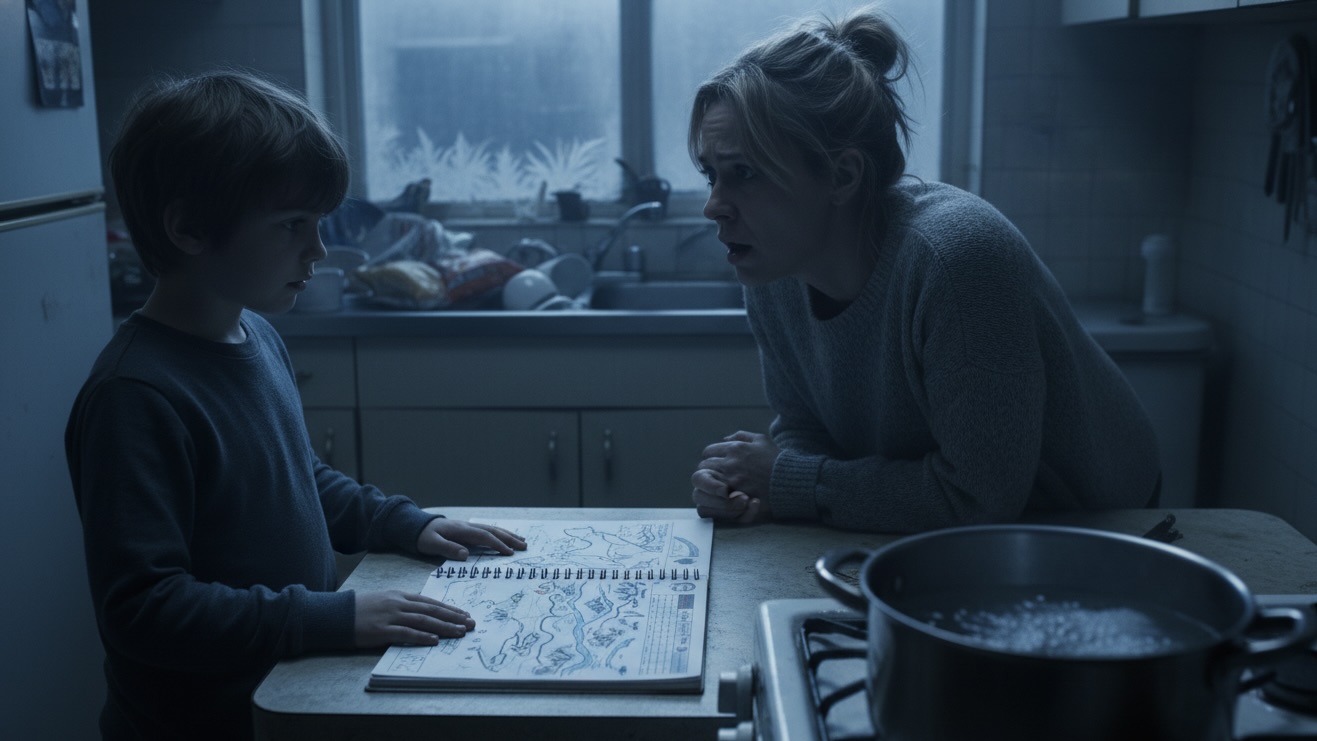
The conflict comes to a head when Leo finds Sarah about to cook pasta using water from their tap. He calmly but firmly tells her to stop. Frustrated, Sarah dismisses his fears, but Leo doesn't argue. Instead, he presents his evidence: the map, the survey results, the clear, logical conclusion that the building's north intake valve is poisoning them.
Seeing the methodical, undeniable proof laid out before her, Sarah's exhaustion gives way to alarm, and then to respect. The child's game she might have imagined is revealed to be a rigorous, damning indictment of their living conditions. In a pivotal moment, she pours the pot of water down the drain. The power dynamic has shifted. They are no longer just victims, but experts on their own suffering. Sarah tells Leo to get his coat; they are going to present his findings to the head of the Tenants' Association.
Character Breakdown
* LEO (12): Inquisitive, methodical, and quietly intense. He processes fear and injustice through observation, data collection, and scientific rigor. While other kids have posters of superheroes, he has blueprints and data tables. He is the building's silent guardian, operating with a maturity and focus far beyond his years.
* Psychological Arc:
* State at Start: A covert investigator, isolated by his knowledge and burdened by the secret of the building's sickness. He operates in the shadows, viewing his mother and neighbors as passive victims to be saved rather than as potential allies.
* State at End: An empowered advocate who has successfully translated his private research into a catalyst for collective action. He has bridged the emotional gap with his mother, transforming their relationship from one of protector/protected to one of partners in the fight for justice.
* SARAH (30s): Leo's mother. Worn down by financial pressure and the daily grind of survival. She is pragmatic to a fault, initially choosing to believe the landlord's reassurances over her son's warnings out of a desperate need for stability, however fragile. Her deep love for Leo is her core motivation, ultimately allowing her to see the terrifying truth he presents.
Scene Beats
1. THE COLLECTION: In the freezing, industrial basement, Leo executes a clandestine operation, collecting a sample of foul, brown water in a sterilized jar. He meticulously labels it, establishing his scientific process.
2. THE COMMAND CENTER: In his bedroom, Leo analyzes his data. We see the wall map with its damning constellation of red and blue pushpins, revealing the clear pattern of sickness and contamination along a specific plumbing line.
3. THE METHOD: Through a review of his notebook, we understand his process: door-to-door surveys under a false pretense, careful questioning, and compiling a dossier of symptoms that correlates perfectly with the building's blueprints.
4. THE CONFRONTATION: Leo walks into the kitchen to find his mother, Sarah, filling a pot from the tap. He tells her to stop. She dismisses his concerns, weary and unwilling to face another problem.
5. THE REVELATION: Leo lays his notebook on the table, open to the map. He doesn't plead; he presents. He calmly explains the data, the pattern, and his conclusion about the corroded intake valve.
6. THE SHIFT: Sarah studies the map. The neat handwriting, the precise pins, the list of her neighbors' illnesses. It’s not a fantasy; it’s an indictment. Her exhaustion turns to alarm, then to a profound respect for her son.
7. THE ALLIANCE: In a decisive, symbolic act, Sarah pours the contaminated water down the drain. She looks at her son, no longer as a child to be protected, but as a leader. "Get your coat," she says. "We're going to 3B." Their fight has officially begun.
Visual Style & Tone
* Visuals: The film will employ a cold, desaturated color palette to reflect the building's decay and the oppressive atmosphere—chilly blues, institutional grays, and the sickly amber of the contaminated water. This will be contrasted with the warm, focused light of Leo's desk, framing his command center as an island of clarity and hope. Camerawork will be handheld and observational, creating a documentary-like intimacy. Extreme close-ups will be used to emphasize key details: the particulates swirling in a glass of water, the tip of a pushpin piercing the map, the tremor in a sick resident's hand.
Tone: The tone is a grounded, social-realist thriller. It builds suspense not through jump scares, but through the methodical, chilling process of uncovering a hidden, domestic poison. It blends the quiet tension of an investigative drama like Spotlight with the emotional weight of a David-vs-Goliath story like Erin Brockovich. The core theme of using information as a weapon against a powerful, faceless system aligns it with the intellectual paranoia of modern anthology series like Black Mirror*, but with its feet planted firmly in a recognizable, everyday reality.
Share This Treatment


