Synthetic Grass and Fraying Edges
A Film/TV Treatment
LOGLINE
On a sticky summer evening, two aging, cynical friends find their bleak worldview perfectly mirrored in the cheap artifice, environmental decay, and engineered frustration of a travelling carnival.
SYNOPSIS
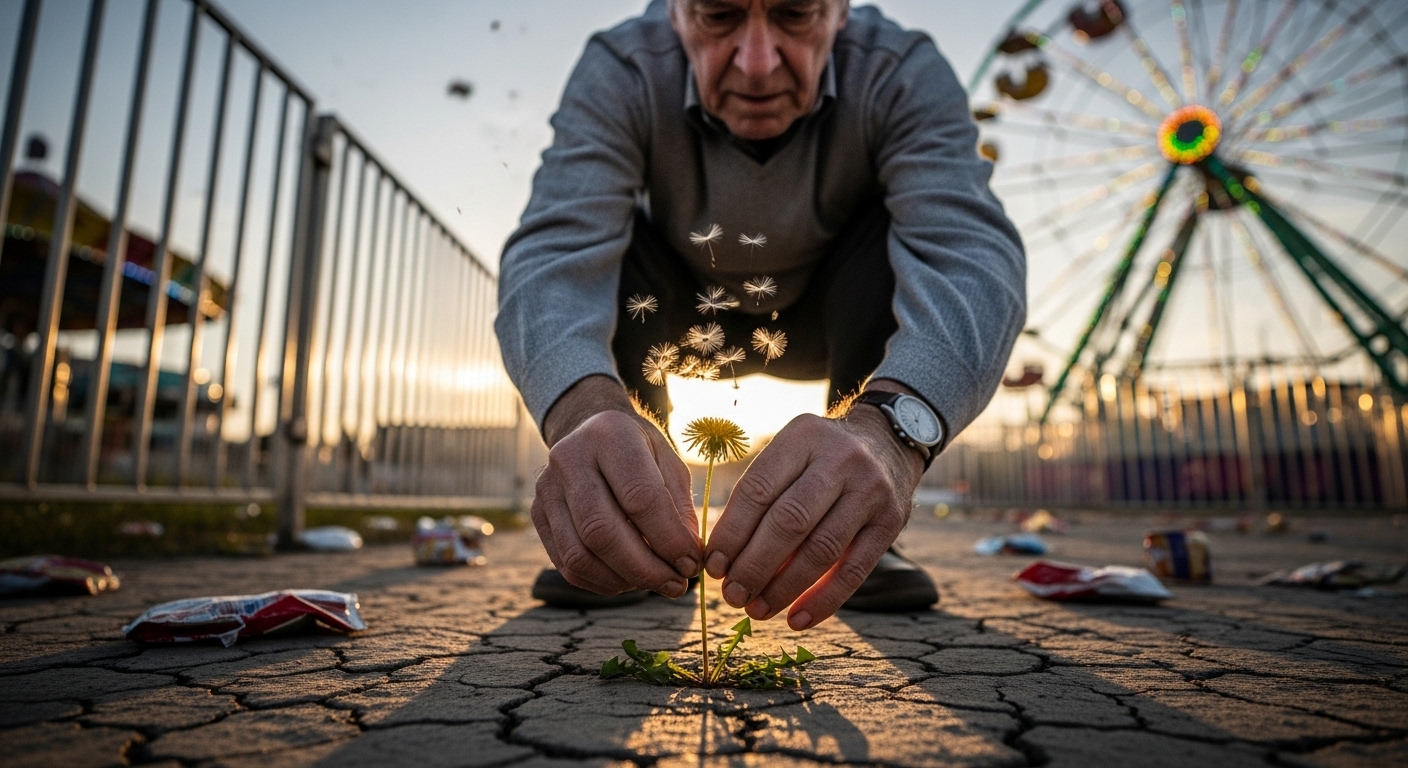
JOSE (60s), a man worn down by his anxieties about the decline of industrial civilization, arrives late to meet his friend BEA (60s) at a tawdry travelling carnival. Their reunion is a familiar dance of cynical banter, with Jose seeing every rigged game and plastic prize as a metaphor for a broken system, while the more pragmatic Bea finds a dark amusement in the spectacle. After predictably losing at a ring toss game, they take a ride on the Ferris wheel. From above, the carnival transforms into a "glittering rubbish heap," and the temporary escape only sharpens Jose's awareness of the immense waste and dirty energy powering the cheap thrills below. Their descent back into the grime is met with further small indignities, culminating in a bold pigeon stealing a chip from Bea’s hand. The evening's simmering dread comes to a head when Jose discovers a generator behind a food stand, leaking thick, black oil into the earth—a quiet, toxic secret hiding in plain sight. This stark image confirms all his fears, and the two decide to leave, their brief attempt at distraction utterly defeated. In the quiet darkness of the car park, Jose finds a single, resilient dandelion, a small, tangible piece of the real world to hold onto amidst the overwhelming synthetic noise.
CHARACTER BREAKDOWN
* JOSE (60s): Thinning grey hair, a noticeable weariness in his movements, and a mind that never stops cataloguing the world's decay. He is an intellectual cynic, burdened by his awareness of the hidden systems of waste and consumption that underpin modern life. Every frustration, from traffic to a rigged game, is another piece of evidence for his thesis on entropy. He is not angry, but deeply, profoundly tired.
* BEA (60s): Sharp, grounded, with a dry wit that acts as both a shield and a scalpel. She shares Jose's cynical outlook but wears it more lightly. Where Jose sees impending doom, Bea sees a grimly fascinating human comedy. She is the realist to his philosopher, gently mocking his grand pronouncements while fundamentally agreeing with his conclusions.
SCENE BEATS
* A SEA OF PLASTIC: We open in the heart of a cheap carnival. The sensory experience is overwhelming: garish lights, dissonant music, the smell of sugar and grease. JOSE navigates the crowd, the synthetic ground crunching under his feet. He finds BEA by a rigged ring toss game, her expression a mask of resigned amusement. Their initial conversation immediately establishes their dynamic: Jose’s five-minute lateness is, to Bea, a symptom of global waste.
* THE GRAND ILLUSION: Jose, goaded by Bea, plays the ring toss. The game is a microcosm of his worldview: a closed system designed for failure. The rings are too light, the bottles too slick. He loses, as expected. The moment isn't about winning; it's about confirming a shared belief that the game is rigged, a perfect metaphor for everything else.
* ABOVE THE GLITTERING RUBBISH: On the Ferris wheel, they rise above the chaos. The camera ascends with them, the cacophony below softening into a dull hum. From this vantage point, the carnival is a beautiful, shimmering smear of light. But Jose sees only the artifice—a temporary city powered by diesel, built on waste. He can smell the industrial tang in the air, a scent that cuts through the fried onions. The brief moment of peace only serves to highlight the ugliness it conceals.
* NATURE'S SCAVENGERS: Back on the ground, the assault on the senses returns. They attempt a simple pleasure: a cone of greasy fries. As they talk, a bold PIGEON swoops down and snatches a chip directly from Bea's cone. The moment is both comical and bleak—urban wildlife, corrupted and brazen, adapting to humanity's detritus. Even this small attempt at enjoyment is tainted.
* THE LEAK: As Jose complains about the sheer volume of single-use plastic, he notices something out of place: a low, rhythmic DRIP. Behind a popcorn stand, a portable generator hums. From its base, a dark, viscous OIL is seeping into the dirt, the puddle reflecting the distorted carnival lights. This is the physical manifestation of all of Jose's abstract anxieties—the quiet, unacknowledged poison that powers the fun. It is the final straw.
* A USELESS SOUVENIR: They leave the carnival, the noise and smells clinging to them. Just beyond the car park, Jose kneels and pulls a single DANDELION from the hard-packed earth. He studies it for a moment—a small, tenacious piece of authentic life in a world of plastic. He pockets it, a quiet, personal act of defiance. The hum of the world continues, indifferent.
VISUAL STYLE
The film should embrace a stark contrast between manufactured beauty and grimy reality.
* COLOR PALETTE: The carnival itself will be a riot of oversaturated, almost sickly, neon colours—pinks, blues, and yellows that bleed into each other. This vibrant palette will be constantly undercut by the muted, dirty reality of the ground level: greasy browns, dull greys, and the bruised purple of the twilight sky. The oil leak should be a deep, light-absorbing black.
* LIGHTING: The lighting will be harsh and artificial. The flashing, strobing lights of the rides will create a disorienting effect, casting long, moving shadows. We will use lens flare to capture the overwhelming glare. The final scene with the dandelion will be lit by a single, cold, sodium-yellow streetlamp, isolating Jose in the darkness.
* CAMERA & TEXTURE: The camerawork will be intimate and tactile. We will use shallow depth of field to isolate our characters within the chaotic crowd. Handheld shots will convey the jostling, unsteady feeling of walking through the fairgrounds. Extreme close-ups will focus on textures: the sticky residue on a handrail, the greasy sheen on a chip, the brittle feel of a plastic ring, the viscous drip of the oil, and finally, the gritty earth on Jose's fingers. The visual language will constantly remind the audience of the physical, often unpleasant, reality of the world.
Share This Treatment


