Static on the Line
Format: Short Film / Anthology Episode | Est. Length: 10-12 minutes
Logline
An anxious young photographer, desperate to escape his stifling rural town, confronts his stoic best friend in a cluttered workshop, forcing them both to face the unspoken feelings and fears that anchor them to their home and to each other.
Themes
* Artistic Aspiration vs. Economic Reality: The conflict between the need to create meaningful art and the practical necessity of survival in a working-class environment where art is a luxury.
* The Gravity of Home: The intense push and pull of leaving a place that is both suffocating and deeply familiar, exploring the fear of staying versus the fear of leaving.
* Unspoken Intimacy and Masculinity: The deep, complex bond between two young men, expressed through arguments, shared silence, and mutual support rather than direct emotional language.
Stakes
At stake is the potential dissolution of a deep, defining friendship and the forfeiture of their last chances to pursue a life of creative fulfillment beyond the confines of their dead-end town.
Synopsis
Paralyzed by self-doubt over a looming grant deadline, photographer JIMMY flees the oppressive silence of his apartment for the one place that offers solace: the chaotic garage workshop of his best friend, SIMON. He finds Simon, a welder and sculptor, lost in his work, a stark contrast to Jimmy’s own creative block.
Their initial conversation is a familiar dance of sarcastic jabs and dry humor, with Jimmy lamenting his "pretentious" artist statement and Simon deflecting with pragmatic cynicism. The tension shifts when Jimmy sees Simon’s latest sculpture: a desperate, reaching hand made of welded chain, shackled to a heavy brake drum. The piece is a raw, physical manifestation of the entrapment Jimmy feels, and it forces their conversation into more vulnerable territory.
Jimmy pushes Simon about his resignation to their small-town life, accusing him of being afraid to leave. The argument escalates, touching on their differing life paths and the unspoken emotional currents between them. The confrontation peaks and then diffuses into a quiet truce over cheap beer. In this moment of vulnerability, Simon coaxes Jimmy into reading his artist statement aloud. Instead of mocking it, Simon validates Jimmy’s words, recognizing the shared truth in the feeling of being eroded by their environment.
The evening ends with an invitation for dinner and a quiet, loaded exchange. Jimmy promises that if he leaves, he’ll come back, but Simon counters with the painful reality of how people drift away. His final, quiet admission—"I know. That's what I'm afraid of"—reveals the depth of his fear of being left behind, leaving Jimmy to grapple with the weight of their bond and the true cost of his potential escape.
Character Breakdown
* JIMMY (23): Anxious, articulate, and a chronic over-thinker. A photographer whose work focuses on the "liminal spaces of rural decay." He feels intellectually and creatively stifled by his small northern town and pins all his hopes for escape on a grant he's convinced he won't get. He is emotionally expressive but masks his vulnerability with academic language and sarcasm.
* Psychological Arc: Jimmy begins the story paralyzed by external pressures and internal self-doubt, believing his art and his life are failures. Through his confrontation and connection with Simon, he finds a sliver of validation, realizing his art is an honest reflection of a shared experience, which gives him the courage to face his future, even if it remains uncertain.
* SIMON (23): Grounded, pragmatic, and physically competent. By day, he fixes heavy machinery; by night, he welds scrap metal into haunting, jagged sculptures. He projects a stoic, cynical exterior, using dry humor as a shield. Beneath the surface, he is deeply tied to his home, his family's failing shop, and his friendship with Jimmy. He is a man of action and art, not words.
Scene Beats
1. THE FREEZE: In his rattling car, JIMMY stares at a peeling garage door, trapped by the cold outside and the anxiety of his grant application within. Defeated by the silence, he kills the engine.
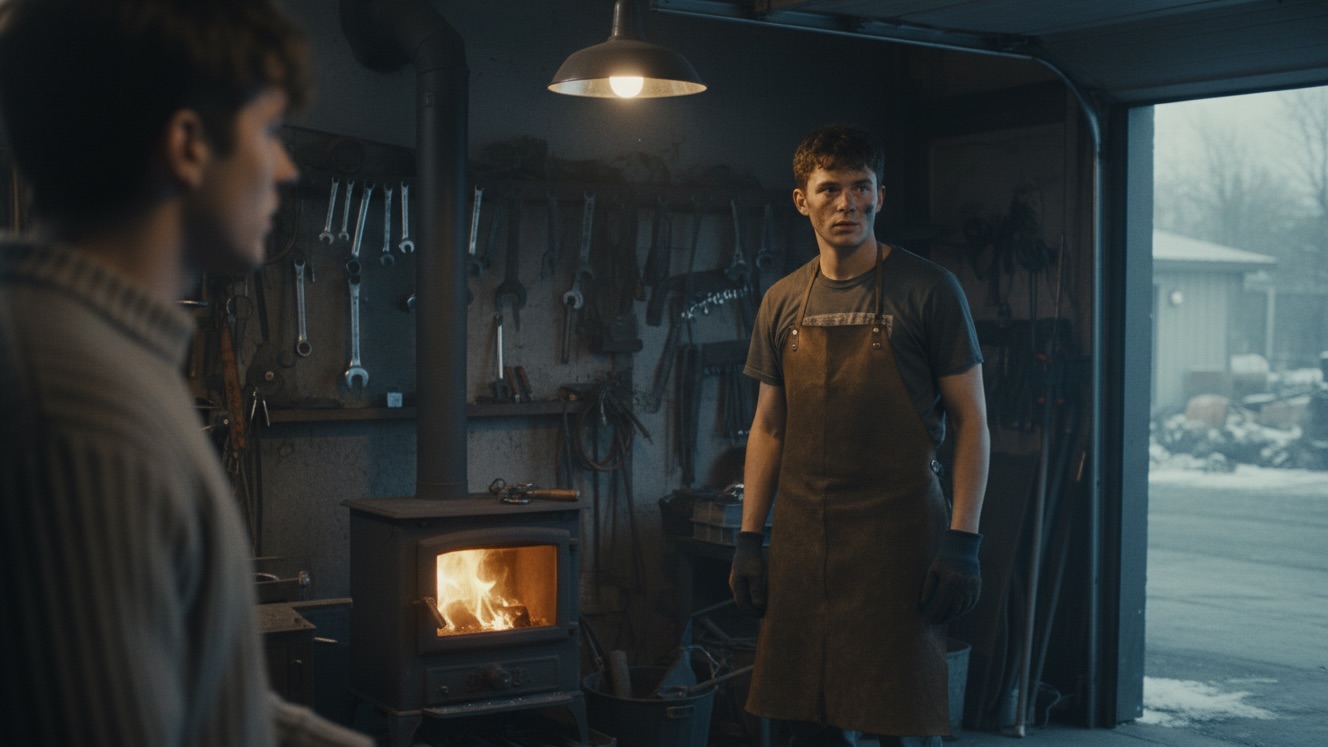
2. THE FORGE: Jimmy enters Simon's garage—a sensory assault of heat, noise, and the smell of metal. SIMON is a silhouette amidst a shower of sparks, a creator in his element. Jimmy kills the music, shattering the trance.
3. VERBAL SPARRING: The friends trade familiar barbs. Jimmy vents his artistic frustrations ("poverty porn," "juxtaposition"), while Simon parries with world-weary cynicism ("The Esso isn't that bad").
4. THE SCULPTURE: Simon reluctantly reveals his new piece: a hand made of chain, shackled to a brake drum, reaching for nothing. Jimmy is struck by its raw, desperate honesty—it's how he feels.
5. THE CONFRONTATION: The art becomes a catalyst. Jimmy accuses Simon of being "comfortable being unhappy," terrified of leaving. The tension snaps, culminating in Simon slamming his tools down and telling Jimmy to shut up.
6. THE TRUCE: The anger breaks. Simon offers a beer, an unspoken apology. They sit shoulder-to-shoulder against a workbench, the physical contact a silent acknowledgment of their bond.
7. THE STATEMENT: Simon makes Jimmy read his artist statement. Instead of mocking the pretentious language, Simon finds the truth in it: "Like the wind is slowly sanding you down." For the first time, Jimmy feels seen.
8. THE FEAR: As they part for the night, Jimmy promises he won't abandon Simon if he leaves. Simon’s quiet, devastating reply—"I know. That's what I'm afraid of"—exposes the raw fear beneath his stoicism, leaving the weight of their future hanging in the cold air.
Visual Style & Tone
The film will employ a stark visual contrast between two worlds: the exterior world is cold, desaturated, and still, shot with wide lenses to emphasize the oppressive emptiness of the northern landscape. The interior of the garage is the opposite: warm, chaotic, and kinetic, filled with the orange glow of the wood stove and the harsh, brilliant light of the welding torch. Handheld, intimate camerawork will be used inside the garage to capture the raw energy and claustrophobia of the space and the characters' emotional proximity.
The tone is melancholic, intimate, and tense, focusing on the subtext and longing in the spaces between words. It aligns with the quiet desperation and repressed masculinity of films like Brokeback Mountain and The Power of the Dog, set against the stark, working-class backdrop of a film like Winter's Bone.
Share This Treatment


