Light Through Frozen Glass
Format: Short Film / Anthology Episode | Est. Length: 10-12 minutes
Logline
In a remote, winter-locked city, a small group of disparate artists must overcome their own cynicism and the daunting practicalities of organization to build a creative collective, finding a flicker of shared purpose against the isolating cold.
Themes
* Idealism vs. Pragmatism: The necessary tension between grand artistic visions and the unglamorous, essential work of building a sustainable infrastructure to support them.
* Community as Resilience: The concept that collective action, shared ownership, and mutual support are the most effective defenses against creative burnout, isolation, and a harsh external environment.
* Authenticity vs. Sustainability: The core conflict of securing funding and appealing to a broader audience without diluting the raw, original artistic impulse that sparked the endeavor.
Stakes
If they fail to unite and build a functional structure, their individual creative sparks will be extinguished by isolation and financial hardship, leaving the local arts scene fragmented and voiceless.
Synopsis
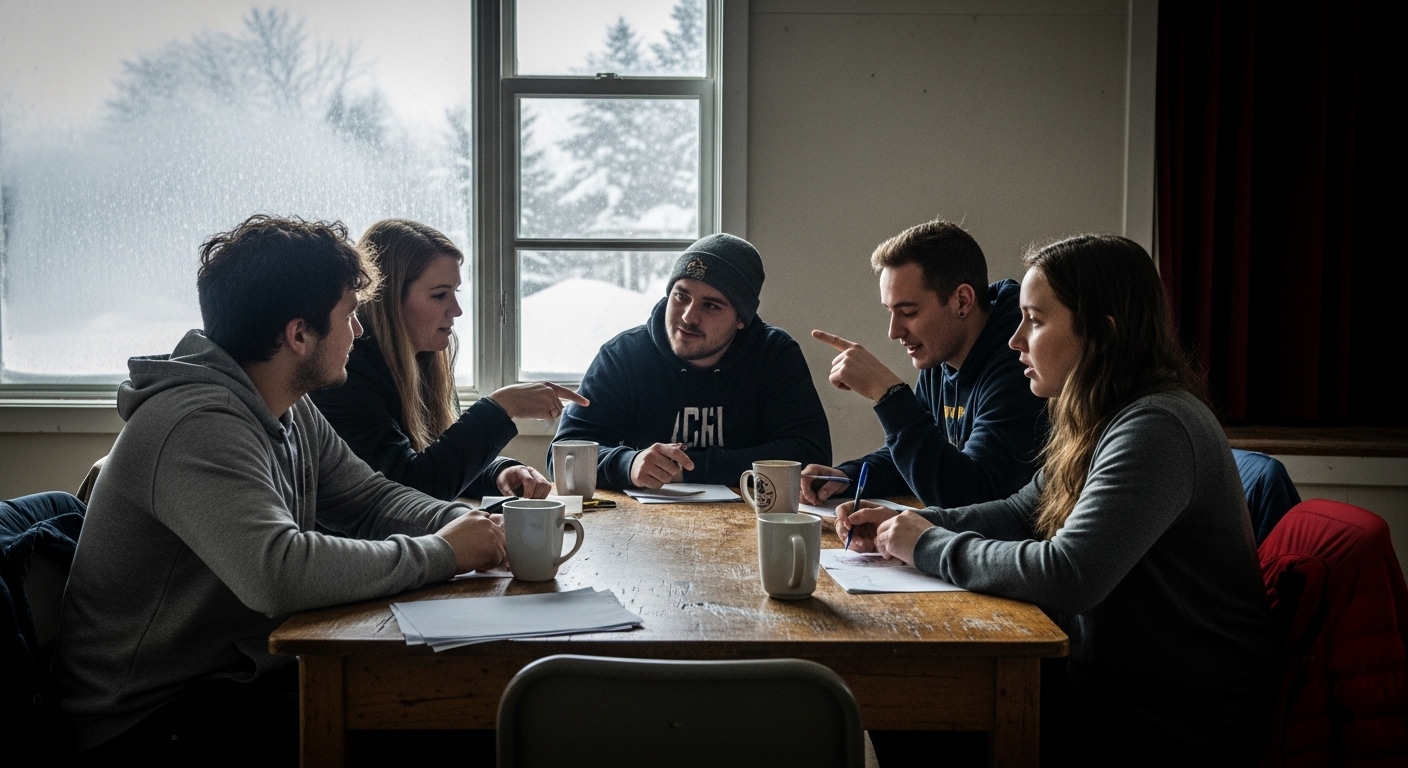
In a humble room against the backdrop of a deepening Northern Ontario winter, five artists gather to discuss forming a collective. RYAN, our point-of-view character, is immediately overwhelmed by the scale of the task, comparing it to "building a snow fort with one glove on." The group's dynamic quickly emerges: BEN is the passionate idealist, PATTI is the sharp-edged pragmatist, ANNIE is the quiet observer concerned with the human cost, and EVELYN is the wise, experienced elder guiding the conversation.
The initial discussion is fraught with the core anxieties of any grassroots project. They debate the "why" versus the "how," raising the critical hurdles of funding, burnout, and the risk of artistic compromise—of becoming "palatable" to sponsors. Just as the weight of these problems threatens to crush the nascent idea, Evelyn gently reframes their challenges as manageable tasks. She speaks of diversifying funding like building a house with many kinds of nails, and of preventing burnout through clear delegation and shared ownership, calling it the "scaffolding of shared purpose."
This shift from abstract fears to practical strategy opens the door for concrete ideas. Ben’s suggestion of a massive mural is tempered by Patti’s insistence on first building infrastructure. Annie proposes smaller, low-risk events to "test the waters." This pragmatic momentum inspires Ryan, who, in a moment of clarity, suggests a digital hub—a virtual space to connect local artists, share resources, and build community before committing to a physical location.
The idea is a catalyst. It perfectly synthesizes the group's idealism with a tangible, achievable first step. The energy in the room transforms from anxious apprehension to focused excitement. As a snowstorm intensifies outside, blanketing the world in white, the group begins hashing out the first logistical details. The film ends not with a grand success, but with the quiet, powerful moment of a true beginning—a small pocket of collaborative warmth pushing back against the encroaching winter darkness.
Character Breakdown
* RYAN (20s): The protagonist. An introspective and cautious artist, prone to seeing the obstacles before the opportunities. He is grounded but initially paralyzed by the scope of the project and cynical about its potential pitfalls.
* Psychological Arc: Ryan begins the story feeling intimidated and overwhelmed, viewing the collective as an insurmountable burden. Through the guided, practical discussion, he moves from a state of passive anxiety to one of active engagement, ultimately finding his own voice to propose the key idea that galvanizes the group and makes him a hopeful, proactive co-creator of their shared future.
* EVELYN (60s-70s): The Mentor. A veteran of community organizing with kind eyes and a calm, pragmatic demeanor. She doesn't provide easy answers but instead offers frameworks and analogies that empower the others to solve their own problems.
* PATTI (30s-40s): The Pragmatist. Sharp, organized, and direct. She is the voice of logistical reality, constantly focused on the "how." While she can seem blunt, her meticulous nature is essential to building something that will last.
* BEN (20s): The Idealist. Brimming with a barely contained, infectious enthusiasm. He represents the passionate "why" of the collective, dreaming of big, visible projects that will make an immediate impact.
* ANNIE (20s): The Observer. Thoughtful, quiet, and perceptive. She is attuned to the human element, voicing the crucial but often overlooked concerns of emotional labor and burnout, ensuring the group doesn't forget the people inside the project.
Scene Beats
1. THE PROBLEM: The meeting begins. Ryan voices his apprehension, framing the task as huge and daunting. The core conflict is established: a powerful idea meets overwhelming practical reality.
2. THE HURDLES: The group identifies the main obstacles. Ryan fears losing artistic integrity ("palatability"). Annie fears burnout. Patti focuses on the lack of a legal or organizational framework. The weight of the task feels immense.
3. THE MENTOR'S WISDOM: Evelyn gently steers the conversation. She reframes their fears into solvable problems, offering practical strategies for funding, delegation, and community engagement. She provides the "scaffolding" of experience.
4. THE SHIFT TO ACTION: The dialogue moves from abstract anxieties to concrete ideas. Ben’s grand mural idea is grounded by Patti's call for infrastructure. Annie’s suggestion of pop-up events makes the project feel more manageable and less risky.
5. THE SPARK: Inspired by this new, grounded momentum, Ryan proposes the digital hub. This idea acts as a catalyst—a perfect synthesis of Ben's desire for connection and Patti's need for structure. It is the first truly achievable step.
6. THE BEGINNING: The group's energy coalesces around Ryan's idea. They immediately pivot to logistics—domain names, web developers, moderation policies. The abstract meeting becomes a concrete planning session as the snowstorm outside intensifies, contrasting the growing warmth and collaboration inside. The final shot is of Patti underlining "Digital Hub Proposal" twice, signifying commitment.
Visual Style & Tone
The visual style will rely on a stark contrast between the exterior and interior worlds. Exteriors are shot with a cool, desaturated palette, emphasizing the vast, isolating beauty of the Northern winter—drifting snow, grey skies, blurred streetlights. Interiors will be warm, intimate, and alive with soft, practical lighting. The camera will use close-ups on hands holding warm mugs, pens scratching on legal pads, and the subtle, expressive faces of the characters as they listen, think, and connect. The overall effect is naturalistic and character-focused.
The tone is grounded, hopeful, and quietly inspiring, focusing on the unglamorous but essential work of building community. It aligns with the intimate, character-driven storytelling of films like The Station Agent or Paterson, which find profound meaning in small-scale human connection and creativity. It shares a thematic spirit with the gentle, collaborative ethos of a series like The Detectorists, celebrating the quiet passion of ordinary people creating something meaningful together.
Share This Treatment


