Frostbitten Futures
Format: Short Film / Anthology Episode | Est. Length: 10-12 minutes
Logline
Stranded in a train station by a Christmas blizzard, a nine-year-old girl, her stressed mother, her pessimistic great-aunt, and her boisterously optimistic uncle must navigate their own eccentricities to transform a miserable delay into an imaginative adventure.
Themes
* The Resilience of Family Bonds: Exploring how a family unit, despite its internal frictions and clashing personalities, instinctively pulls together to create a pocket of warmth and normalcy in a chaotic environment.
* Perspective as a Survival Tool: The story illustrates how reframing a negative situation—from a dreadful delay to a "survival mission"—can be a powerful mechanism for coping with anxiety and boredom.
* Finding Magic in the Mundane: The narrative focuses on the transformation of a sterile, frustrating public space into a playground for the imagination, where card games become strategic battles and a food run becomes a heroic quest.
* The Generational Divide: The contrasting attitudes of Pippa (childlike frustration turning to imagination), Angela (adult pragmatism), Donnie (unflappable optimism), and Mildred (cynical pessimism) highlight different ways of confronting adversity.
Stakes
The family risks succumbing to the overwhelming frustration and despair of their situation, allowing the external chaos of the blizzard to fracture their already strained holiday spirit.
Synopsis
On the cusp of Christmas, nine-year-old PIPPA, her pragmatic mother ANGELA, and her curmudgeonly GREAT-AUNT MILDRED are stranded in a bustling train station. A massive blizzard has caused a 27-hour delay, crushing Pippa’s holiday excitement and fraying Angela’s nerves. The atmosphere is one of collective misery, amplified by Mildred’s constant complaints.
Their grim vigil is shattered by the arrival of UNCLE DONNIE, a human sunbeam who brings lukewarm sausage rolls, a deck of cards, and an unshakeable optimism. He reframes their predicament as a "pre-Christmas pre-party," much to Mildred's chagrin. The family carves out a small space for themselves, and a game of Crazy Eights on an upturned suitcase creates a fragile bubble of normalcy and laughter amidst the station's growing malaise.
As hours bleed into one another, the initial fun wears off. Food runs out, the station's resources dwindle, and the reality of their confinement sets in. Angela, driven by practicality, decides to brave the blizzard to find food, leaving Pippa with her two highly eccentric relatives.
Angela’s departure triggers a wave of anxiety in Pippa. Seeing her fear, Donnie and Mildred instinctively shift their approach. They transform Angela's simple errand into a dangerous "expedition" and their own situation into a top-secret survival mission. Inspired by this new, adventurous narrative, Pippa’s fear turns to excitement. She sheds her role as a passive victim of circumstance and becomes the leader of their small troupe, declaring they need a plan for their "procurement protocols." The miserable wait is no longer something to be endured, but an adventure to be conquered.
Character Breakdown
* PIPPA (9): The protagonist. Bright, imaginative, and perceptive, but prone to the dramatic frustrations of childhood. She is the emotional barometer of the family unit.
* Psychological Arc: Pippa begins the story as a frustrated, passive victim of circumstance, annoyed by the delay and her family's quirks. Through the catalyst of her uncle's optimism and her mother's departure, she transforms into an empowered, proactive leader, embracing imagination to reframe their predicament as an adventure she can control.
* ANGELA (late 30s): Pippa’s mother. The weary anchor of the family, trying to manage logistics, her daughter's disappointment, and her aunt's negativity. She is pragmatic and loving, but visibly stretched thin.
* GREAT-AUNT MILDRED (70s): The voice of cynical realism. A formidable woman whose complaints are her primary language. Beneath her crusty, pessimistic exterior lies a deep-seated, if rarely shown, familial concern. She provides much of the film's dry, comedic relief.
* UNCLE DONNIE (40s): The chaotic good. A boisterous, tweed-clad optimist who believes enthusiasm (and questionable snacks) can solve any problem. He is the catalyst who actively changes the group's negative emotional trajectory.
Scene Beats
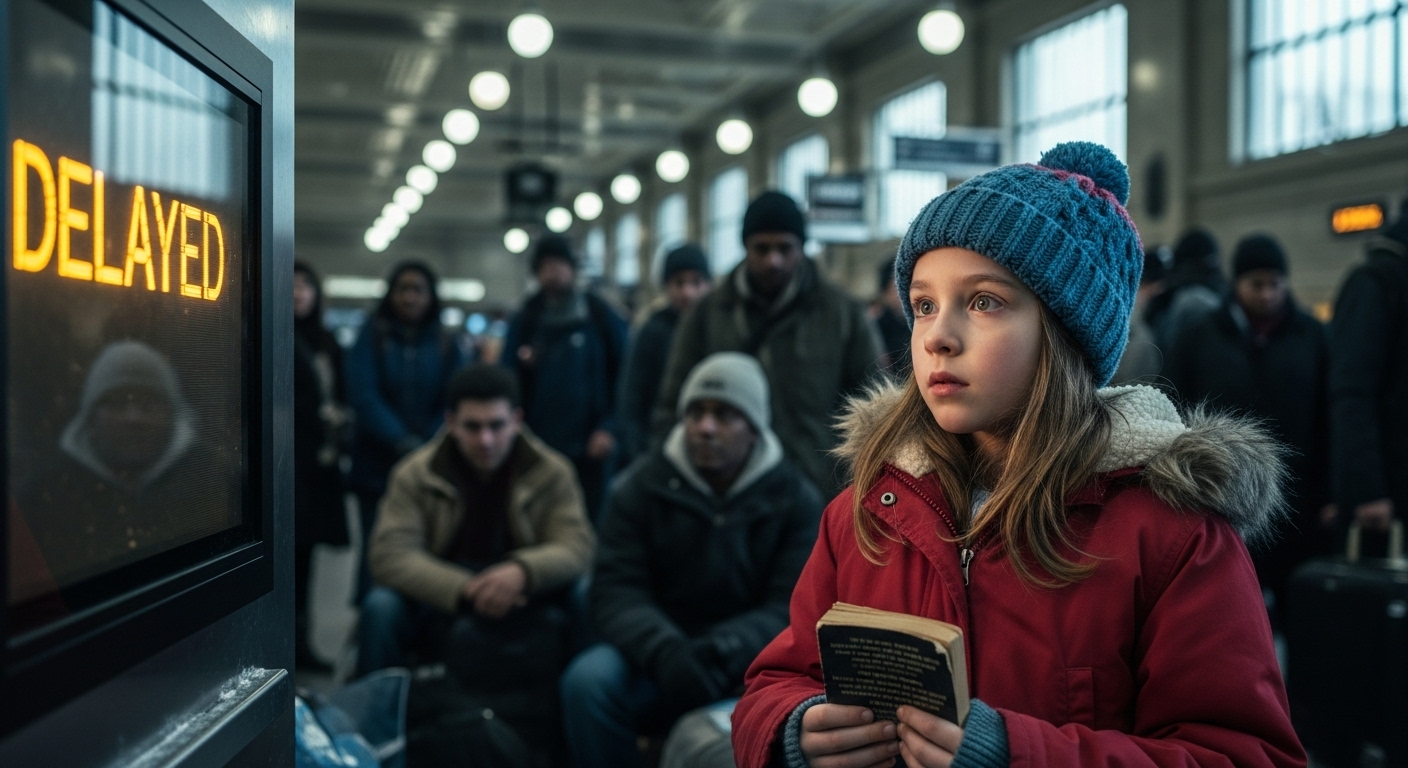
1. THE DELAY: The flickering departures board announces the 27-hour delay. We meet Pippa, Angela, and Mildred trapped in the grim, fluorescent-lit reality of the station. The mood is one of pure frustration.
2. THE REINFORCEMENTS: Uncle Donnie bursts onto the scene, a whirlwind of cheer. He presents his "emergency provisions" and clashes humorously with Mildred’s pessimism, immediately shifting the group's dynamic.
3. THE BUBBLE: The family plays "Crazy Eights" on a suitcase. This sequence establishes their core personalities in action and shows them creating a small, warm haven of inside jokes and laughter, isolated from the miserable crowd.
4. THE GRIND: A montage shows time passing. The station becomes a makeshift camp. The card game ends, books are finished, and hunger sets in. The initial novelty has worn off, replaced by weariness.
5. THE QUEST: Angela announces she's venturing into the blizzard for food. The automatic doors open to reveal a wall of swirling snow, establishing the external threat and raising the stakes.
6. THE FEAR: With her mother gone, Pippa’s anxiety surfaces. She voices her fear that her mom won't come back. The playful atmosphere evaporates, replaced by genuine concern.
7. THE REFRAME: Seeing Pippa's distress, Donnie and Mildred exchange a look. Donnie playfully reframes Angela’s errand as a dangerous "expedition," and Mildred, surprisingly, plays along. They turn their waiting into a "survival mission."
8. THE COMMANDER: Inspired, Pippa’s fear vanishes, replaced by purpose. She embraces the new narrative, takes charge, and announces they need a plan—the "Procurement Protocols." The film ends on her determined face, now the leader of their unlikely adventure.
Visual Style & Tone
The visual style will contrast the cold, impersonal environment of the train station with the warm, intimate bubble the family creates. The station is shot with wide lenses, emphasizing the scale and the family's smallness within it, under the sterile, blue-white glare of fluorescent lights. When focusing on the family, the camera will be closer, using a shallower depth of field to soften the chaotic background and highlight their connection. The brief glimpses outside should be stark and overwhelming—a disorienting swirl of white snow and wind.
The tone is a heartfelt dramedy, blending the situational humor of Planes, Trains and Automobiles with the contained-space character dynamics of The Breakfast Club. It finds the sweet spot between grounded family stress and whimsical, imaginative escape, treating a child's perspective with sincerity. The tonal approach of using imagination to cope with a difficult reality aligns with the spirit of films like Jojo Rabbit, but executed in a light, low-stakes, slice-of-life context.
Share This Treatment


