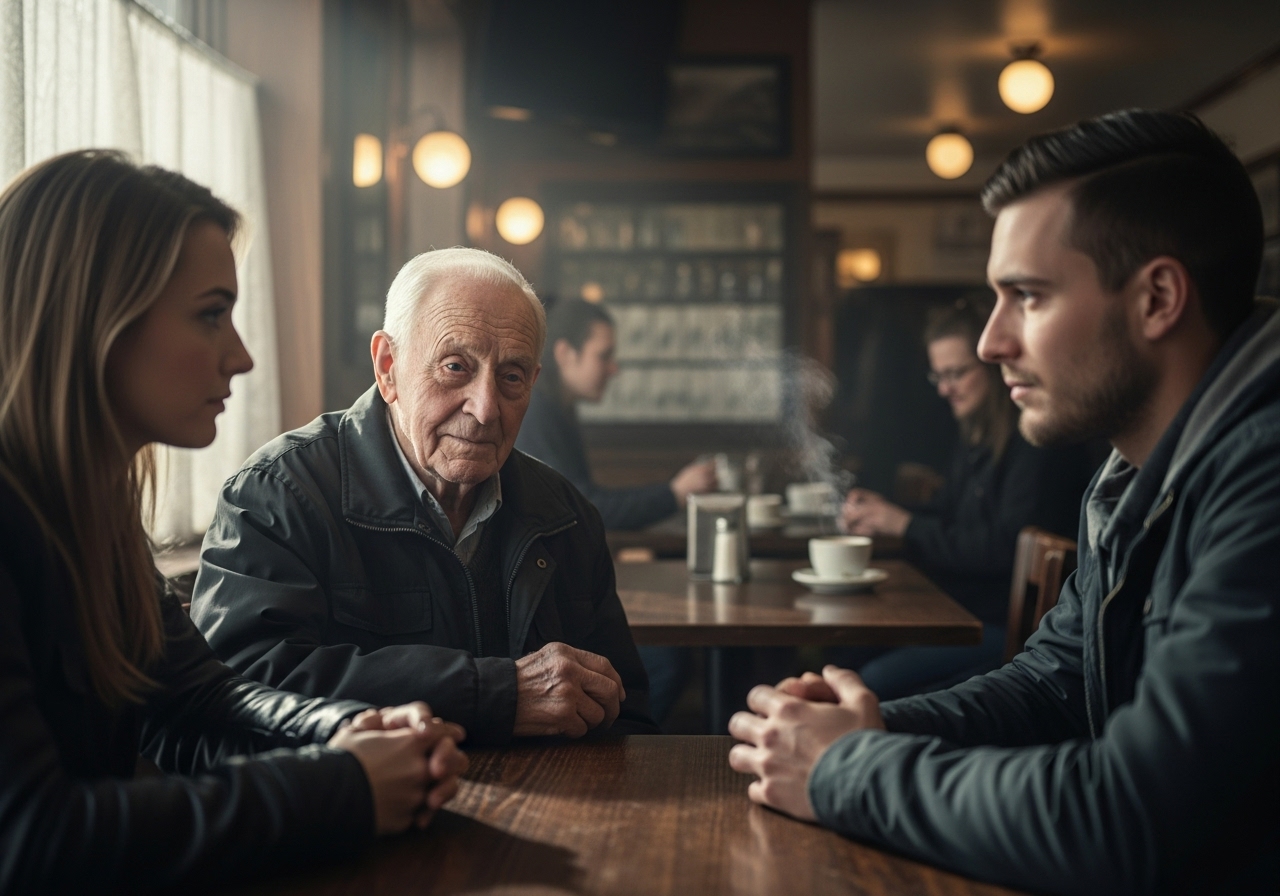
Ephemeral Patterns on the Pane
Format: Short Film / Anthology Episode | Est. Length: 10-12 minutes
Logline
In a quiet, winter-bound café, a solitary older writer observes the subtle, interconnected dramas of strangers—a young couple's fragile negotiation, an elderly woman's silent ritual—and in their unspoken currents, finds a profound reflection of his own past and the resilient beauty of human connection.
Themes
* Unspoken Communication: The profound weight of what is left unsaid, conveyed through small gestures, loaded silences, and the careful selection of words that hide more than they reveal.
* The Observer as Participant: The act of watching is not passive. By observing and interpreting the lives of others, the protagonist actively engages with his own memories, grief, and sense of shared humanity.
* Order Against Chaos: Characters create small, personal rituals and pockets of order (arranging items, cataloging sounds) as a quiet defense against the emotional chaos and existential uncertainty of life.
* Resilience in the Mundane: Extraordinary beauty and profound emotional truths are not found in grand events, but in the quiet, everyday moments and the gritty, understated ways people navigate their lives.
Stakes
At stake is the potential for genuine human connection to be lost to fear, formalism, and the isolating chill of a world where people build walls instead of bridges.
Synopsis
ARTHUR, a writer in his late 60s, sits alone in a sparse Winnipeg café on a bleak winter day. He is a collector of details, observing the mundane sounds and sights around him. His focus lands on a YOUNG COUPLE in their early twenties, separated by a palpable tension across their small table.
Their conversation begins, but it is stilted, overly formal, and emotionally guarded. They speak of a "proposal" and the need for "deliberation," using language that acts as a shield. Arthur, a seasoned observer of human nature, deciphers the vast unspoken anxieties and affections hidden beneath their verbal ballet. A small tremor in the woman's hand is met not with a comforting touch, but with the man's deliberate, noisy tearing of a sugar packet—a gesture of indirect care.
An ELDERLY WOMAN arrives, a familiar fixture. She methodically arranges her belongings on her table: a journal, a pencil case, spectacles. It is a precise, comforting ritual, an act of creating a small sanctuary of order. This reminds Arthur of his own family's past and the comfort found in such small victories against chaos. He recognizes her as another collector, another observer like himself.
A brief moment of disruption—a young barista fumbling with the espresso machine—is met with a faint, knowing smile from the elderly woman. Arthur reflects on the invisible threads connecting everyone in the room: the couple's anxiety, the woman's order, the barista's insecurity, and his own role as a silent witness. The scene triggers a memory of his late wife, Eleanor, who taught him to find the most profound stories in these exact kinds of quiet, ordinary moments.
Fueled by this memory, Arthur watches as the young man finally breaks through his formal armor, his voice softening as he expresses a vulnerable, sincere conviction in their "shared trajectory." In response, the young woman offers a small, genuine smile, a tiny but significant blossoming that closes the emotional chasm between them. As this quiet breakthrough occurs, the elderly woman across the room finally begins to write in her journal. Arthur is left with a renewed sense of gritty optimism, watching the resilient, unspoken patterns of life unfold.
Character Breakdown
* ARTHUR (60s-70s): The protagonist. An observant, contemplative writer. He is melancholic but not bitter, processing the world through a lens of quiet grief for his late wife. He finds meaning and solace in the details of other people's lives.
* Psychological Arc:
* State at start: A detached, melancholic observer, collecting details of others' lives as a way to manage his own quiet loneliness, seeing the world as a series of disconnected, "real" fragments.
* State at end: He rediscovers a sense of shared humanity and quiet optimism, realizing these fragments are part of a larger, interconnected tapestry of resilient love and communication, echoing the wisdom of his late wife.
* THE YOUNG MAN (Early 20s): Stoic, formal, and emotionally guarded. His rigid posture and carefully chosen words are a defense mechanism, masking a deep-seated vulnerability and a sincere desire for connection.
* THE YOUNG WOMAN (Early 20s): Equally guarded, using formality and averted gazes as a shield. Her small, anxious gestures—a tightening grip on her mug, a fleeting glance—betray the emotional turmoil beneath her composed exterior.
* THE ELDERLY WOMAN (70s-80s): A silent, dignified presence. Her methodical, ritualistic behavior suggests a life of discipline and keen observation. She acts as a mirror to Arthur, another "collector of glimpses" who finds her own meaning in watching the world.
Scene Beats
1. THE OBSERVATORY: Arthur sits in the café, absorbing the sensory details—the squeak of shoes, the hum of the fridge. He establishes his role as a quiet observer in a cold, grey world.
2. THE CHASM: He focuses on the Young Couple. We see their emotional distance through their body language before they even speak. A carefully cultivated space exists between them.
3. THE VERBAL BALLET: The couple begins their stilted, overly formal dialogue about a "proposal." Their words are precise, polite, and emotionally sterile. Arthur interprets the subtext.
4. THE SUGAR PACKET: The woman's hand trembles. The man notices. Instead of reaching for her, he reaches for a sugar packet, tearing it open. The small sound is loud in the quiet tension. It's a moment of indirect, clumsy care.
5. THE RITUAL: The Elderly Woman arrives and performs her methodical ritual of arranging her journal, pencils, and glasses. Arthur sees a kindred spirit and is reminded of his grandmother.
6. THREADS OF CONNECTION: A clumsy Barista spills water. The Elderly Woman smiles faintly. Arthur reflects on the invisible threads connecting them all—anxiety, order, inexperience, and observation.
7. MEMORY OF ELEANOR: The scene triggers a warm, poignant memory of his late wife, who believed the greatest stories were found in the mundane. This provides the emotional core for his worldview.
8. THE THAW: The Young Man's facade cracks. He speaks with genuine vulnerability about their future. The Young Woman responds with the film's first genuine smile. The chasm between them shrinks.
9. THE INK FLOWS: As the couple connects, the Elderly Woman finally puts pen to paper, her own observations now ready to be recorded. The café hums on, its quiet dramas witnessed and validated. Arthur watches, a sense of peace settling over him.
Visual Style & Tone
The visual palette is muted and cool, dominated by the greys, whites, and blues of a Winnipeg winter seen through a frosted window. This is punctuated by small, significant splashes of color—the bright hue of the young woman's parka, the rich cream of the journal's pages.
Cinematography will be observational and patient, often using static shots that mirror Arthur's perspective. The focus will be on micro-expressions and small details: the steam rising from a mug, fingers tightening around porcelain, the texture of a scarred wooden table. Shallow depth of field will be used to isolate characters, emphasizing their internal worlds against the blurred backdrop of the café.
The tone is contemplative, melancholic, and deeply empathetic, finding its drama in quiet tension rather than overt action. It aligns with the quiet, observational intimacy of films like Paterson or Aftersun, focusing on the profound emotions found in mundane moments and the understated resilience of the human spirit.
Share This Treatment


