Data Dust and Digital Fire - Project Treatment
Project Overview
Format: Feature film, 105 minutes
Genre: Grounded Sci-Fi / Eco-Thriller
Tone References: Children of Men (for its "boots on the ground," documentary-style immersion into a systemic crisis), Dark Waters (for its methodical, David-vs-Goliath takedown of corporate malfeasance), and Arrival (for its cerebral tone and focus on communication as the central challenge).
Target Audience: Fans of A24's character-driven genre films, audiences of prestige eco-thrillers, and viewers who appreciate science fiction that serves as a potent social commentary.
Logline: A detached journalist sent to document a "sustainable" tech initiative in a remote northern town must team up with a skeptical local leader to expose a catastrophic environmental cover-up when the project's flagship technology begins to violently fail.
Visual Language & Cinematic Style
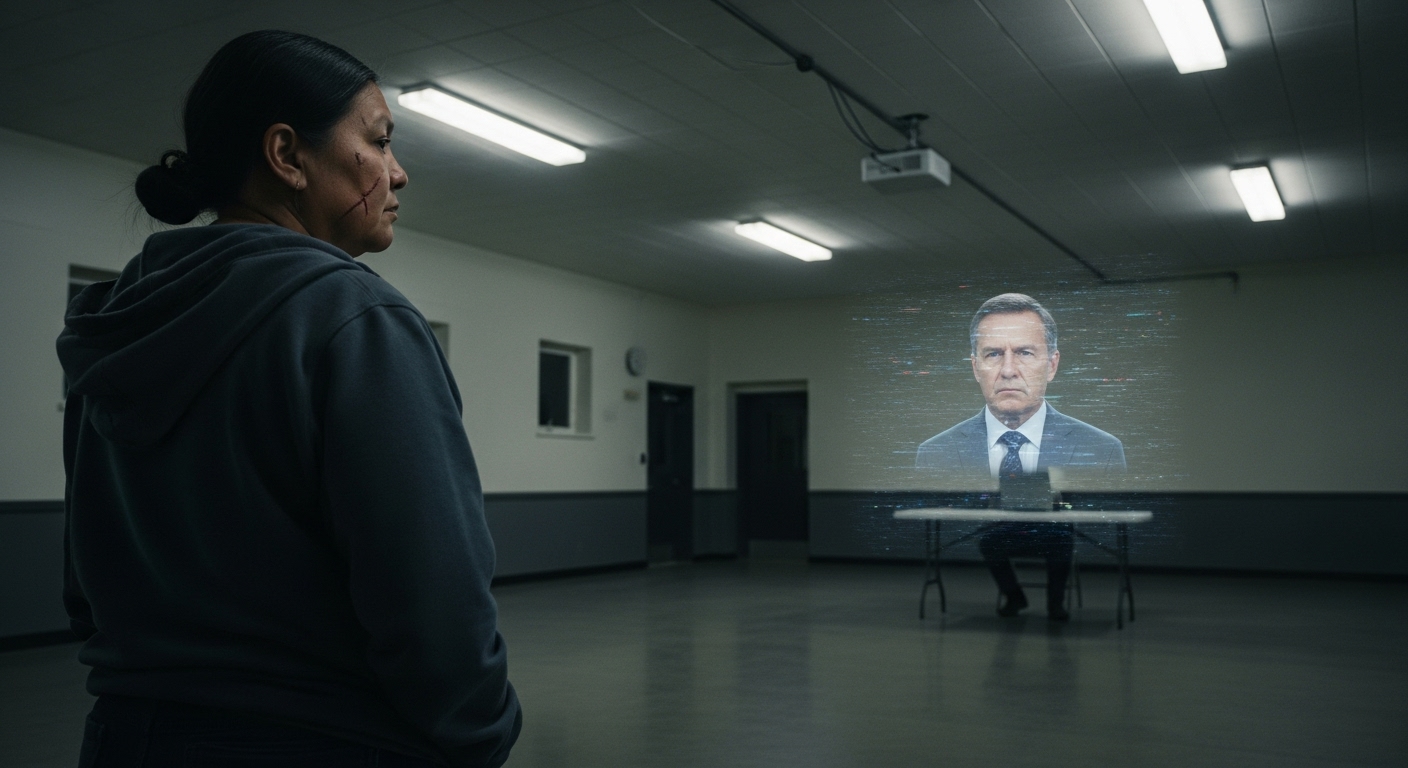
The film's visual identity is built on a stark dichotomy. The corporate world of Project Aurora is presented through clean, static, and symmetrical compositions—cool blues, sterile whites, and the unblemished gloss of Kenmore's Toronto headquarters. This is contrasted with the handheld, intimate, and observational camerawork that defines Steven's perspective in the Northern community. Here, the palette is earthy and tactile: the deep greens of the boreal forest, the rust of aging machinery, the warm umber of human skin. The oppressive summer humidity will be made tangible through lens diffusion and a constant sheen of sweat on the characters, making the air feel thick and heavy. The "Digital Hearth" itself is a source of unnatural, flickering cyan light that pollutes the natural warmth of the community hall, its glitches rendered as jarring, pixelated corruptions of this artificial glow. Space functions as a character; the vast, unforgiving landscape dwarfs the fragile, failing technology meant to tame it, creating a constant visual tension between the organic and the synthetic.
Tone & Mood
The tone is one of slow-burn, atmospheric dread. It is a quiet film that builds tension not through overt action, but through the accumulation of unsettling details: the whine of failing electronics, the insistent buzz of flies in the humid air, the subtle signs of environmental decay. The mood is steeped in a palpable weariness, embodied by Nadia and the community, a bone-deep fatigue from fighting a battle of attrition against an invisible, indifferent corporate power. This simmering tension is punctuated by moments of sharp, tragicomic satire, primarily through Director Kenmore's corporate doublespeak, which sounds utterly absurd when juxtaposed with the grim reality on the ground. The emotional rhythm is a gradual tightening of a knot in the stomach, as a minor technical annoyance escalates into a full-blown existential threat, forcing characters to move from quiet resignation to desperate action.
Themes & Cinematic Expression
The central theme is the conflict between technological solutionism and genuine sustainability. This is expressed cinematically through the failure of the "Digital Hearth." Sound design will contrast the hollow, digitized voice of Kenmore with the rich, ambient sounds of the natural world and the warmth of human voices in a shared space. The film explores a form of digital colonialism, where technology is imposed upon a community not to empower it, but to control it, extract data, and create a dependency. This is visualized through the motif of screens and projections—holograms, datapad readouts, wrist-links—that consistently fail to capture or serve the tangible reality they claim to represent. Ultimately, the story champions the theme of connection over connectivity; the climax will visualize this by weaponizing the corporation's network to broadcast a raw, human truth, proving that the most powerful tool is not the technology itself, but the testimony it can be forced to carry.
Character Arcs
Steven
Steven begins as a professional observer, a cynical but disengaged journalist for the Bureau of Inter-Regional Development. His defining trait is his practiced objectivity, a shield he uses to keep the messy realities of his assignments at arm's length. His flaw is his passivity; he believes his only role is to document, not to intervene. The catastrophic failure of the geothermal conduit and the corporate cover-up that follows forces him out of his neutral corner. Confronted with a life-or-death situation and inspired by Nadia’s quiet resilience, his arc is a journey from detached chronicler to committed advocate. He must risk his career and his safety to shed his objectivity and fight for the truth, realizing that true journalism is not just about observing the world, but taking a stand to protect it.
Nadia
Nadia is the community’s de facto coordinator and its weary conscience. Grounded, practical, and deeply connected to her people and their land, she has seen countless corporate promises come and go. Her strength is her unwavering pragmatism, but her flaw is a deep-seated resignation; she believes the fight against a behemoth like Project Aurora is ultimately futile, and her resistance has been worn down to a sharp, sardonic wit. Meeting Steven, an outsider from the very system that oppresses her community, forces her to overcome her mistrust. Her arc is about the rekindling of hope and the transition from quiet, passive resistance to active, strategic defiance. She provides the crucial local knowledge and moral clarity, while Steven provides the tools to amplify her voice to the world.
Director Kenmore
Director Kenmore is the holographic face of Project Aurora and the film’s primary antagonist. He is not a mustache-twirling villain, but a true believer in his own data-driven ideology. From his pristine Toronto office, he views the world through spreadsheets and predictive models, utterly disconnected from the human cost of his initiatives. His flaw is his profound intellectual arrogance and his inability to see past the corporate lexicon he espouses. As the crisis escalates, his arc is one of escalating denial and moral compromise. He moves from dismissing Nadia’s concerns as anecdotal to actively suppressing evidence and intimidating witnesses, all to protect the "integrity" of the project and his belief in a sterile, efficient, and wholly inhuman version of progress.
Detailed Narrative Treatment
Act I
We are introduced to STEVEN, a journalist for a quasi-governmental oversight body, as he arrives in a remote Northern community. He's here to write a neutral report on Project Aurora’s "Sustainable Northern Futures" initiative. We see the stark reality: a town with crumbling infrastructure now adorned with glossy, often-malfunctioning tech. The centerpiece is the "Digital Hearth" in the community hall, a holographic projector meant for art and connection that mostly displays corporate logos. Steven meets NADIA, the pragmatic local coordinator who views him with weary suspicion. She articulates the community's real needs—reliable internet for school, a repaired community center—which are ignored in favor of flashy, useless projects. The inciting incident is the chapter provided: the Digital Hearth suffers a catastrophic glitch during a holographic call with DIRECTOR KENMORE. The glitch reveals a far more serious problem—a "containment breach" in the subterranean geothermal conduit that powers the project, causing a spike in airborne particulates. This isn't just a tech failure; it's an imminent environmental hazard.
Act II
Steven's journalistic curiosity turns to alarm. He and a reluctant Nadia investigate the source of the breach, discovering that the geothermal conduit is leaking toxic coolant into the local water table, something Kenmore's remote diagnostics are conveniently ignoring. As they secretly gather evidence—water samples, system logs—Kenmore, alerted to their snooping from his Toronto HQ, begins to actively obstruct them. He dispatches a corporate "technician" who is clearly a security operative, cuts off their network access, and uses his influence to have Steven’s superiors warn him off the story. The environmental effects worsen; the town's precious few crops begin to wither, and a child falls ill with an unexplainable sickness. The midpoint arrives when Steven and Nadia find the smoking gun: an internal memo on a forgotten local server, proving Aurora knew the conduit design was unstable but chose it to cut costs. The "All Is Lost" moment hits hard when the corporate operative corners them, confiscates their evidence, and frames Nadia for sabotaging the project. Steven is officially recalled, his career threatened, and Nadia is left to face the consequences alone as the conduit's internal temperature climbs toward a critical, explosive failure.
Act III
Defying his recall order, Steven returns. He managed to save one crucial piece of evidence—the damning memo—on his ocular implant's encrypted storage. He and Nadia reconcile their mistrust, realizing they are each other's only hope. They rally the community Elders and hatch a desperate plan: to use the enemy's weapon against them. During a scheduled, region-wide corporate broadcast from Kenmore, they stage a physical community gathering around the failing Digital Hearth. Using Nadia's intimate knowledge of the town's physical network and Steven's hacking skills, they hijack the signal. The climax is a tense, cross-cut sequence: in Toronto, Kenmore delivers his sanitized speech, while in the community hall, Nadia and Steven fight to upload their evidence. They succeed. Instead of Kenmore's face, the entire Northern network sees the toxic memo and hears Nadia's powerful, unscripted testimony about the true cost of Project Aurora's "progress." The broadcast goes viral. In the aftermath, the cover-up is exposed, government agencies are forced to intervene, and the immediate disaster is averted. Kenmore is disgraced. The final scene shows the community, months later, gathered around a real bonfire. The Digital Hearth projector sits dark and inert in the corner of the hall. Steven, having published the full story, watches with Nadia as they begin the long, difficult process of rebuilding, this time on their own terms.
Episode/Scene Beat Sheet (Source Material)
1. Timestamp: Steven notes the time (20:37) as the Digital Hearth, a holographic projector, begins to convulse.
2. Observation: As a journalist, Steven activates his ocular implant to record the glitch—a stuttering caribou hologram dissolving into static and yellow light.
3. Enter Nadia: Nadia, the practical local coordinator, enters from an adjacent office, immediately identifying the malfunction with weary familiarity.
4. Diagnosis: Nadia calmly speculates the cause is a failing surge suppressor or grid link, her tone laced with fatigue.
5. Confrontation of Purpose: Steven states his official purpose—documenting the event for his report. Nadia counters with dry sarcasm about the "robust digital infrastructure" promised by the corporation.
6. Hologram Appears: The glitching light resolves into the holographic image of Director Kenmore, the corporate head from Toronto.
7. Corporate Spin: Kenmore delivers pre-rehearsed corporate speech about community capacity, addressing Nadia and Steven directly. He dismisses the glitch as "minor perturbations" and "growing pains of innovation."
8. Nadia's Rebuttal: Nadia calmly but firmly pushes back, contrasting the "noble concept" of the Digital Hearth with the practical realities: inconsistent bandwidth and the community's need for tangible infrastructure and services (education, health, a physical arts space) over virtual ones.
9. Kenmore's Doublespeak: Kenmore deflects with a barrage of corporate buzzwords (e-learning, telemedicine, SDG-11, leapfrogging), arguing digital solutions are more efficient and have a lower carbon footprint.
10. Escalation: Nadia forcefully interjects, arguing his "leapfrog" lands them in a chasm of unreliable tech and underfunded real-world needs, emphasizing that a digital hearth cannot replicate the warmth of a literal one.
11. Corporate Irritation: Kenmore's facade briefly cracks, showing irritation. He dismisses her concerns as "polemics" and insists his data models prove the efficacy of his strategy, attempting to end the conversation by pushing data packets to their devices.
12. The System Fails: A deep, guttural thrum rises from beneath the floor. Kenmore's hologram dissolves into pixelated chaos, his voice cutting out.
13. The Real Danger: The hall's air quality sensor begins flashing an urgent orange. Steven's wrist-link confirms a spike in unknown air particulates.
14. The Revelation: Nadia identifies the true cause: not a simple glitch, but a containment breach in the subterranean geothermal energy conduit. She reveals she had previously warned the corporation about this exact risk.
15. The Turning Point: The thrum intensifies. As warning lights flash red, Steven realizes he is no longer documenting a simple tech failure, but the beginning of a major, man-made disaster.
Creative Statement
Data Dust and Digital Fire is a story for our precise moment. In an era where "disruption" and "innovation" are lauded as inherent virtues, this film serves as a grounded, cautionary tale about the human cost of top-down technological solutionism. It interrogates who truly benefits from progress and gives voice to those often rendered invisible by data models and corporate boardrooms. By stripping away the gloss of high-concept sci-fi, we aim to create an intimate, character-driven thriller that feels less like a vision of a distant future and more like a headline from five years from now. This is a story about the fight for truth in a post-truth world, and about the quiet, enduring power of a community that refuses to be erased by the very technology meant to "connect" it. It is a plea for a more humane, sustainable, and genuinely connected future.
Audience Relevance
Contemporary audiences are keenly aware of the growing power of Big Tech and deeply concerned with issues of corporate accountability and climate change. Data Dust and Digital Fire taps directly into this zeitgeist. It presents a conflict that feels both universal and urgently specific: the struggle of a local community against an indifferent global corporation. The film’s themes of digital colonialism, environmental justice, and the search for authentic connection in a virtual world will resonate strongly with viewers who question the narratives sold to them by powerful institutions. By rooting its sci-fi premise in a deeply human story of resilience and defiance, the film offers not just a thrilling narrative, but a powerful, cathartic story about speaking truth to power that will linger with audiences long after the credits roll.
Share This Treatment


