A Summer's Oar, A Year's Reckoning
Format: Short Film / Anthology Episode | Est. Length: 10-12 minutes
Logline
In the near future of 2025, a cynical ten-year-old boy must navigate his dramatic partner and his own anxieties about a digitally saturated world during a grueling summer camp canoe race, ultimately discovering the profound value of a purely analog struggle.
Themes
* Analog vs. Digital: The tension between tangible, physical experiences (muscle burn, splashing water) and the encroaching world of digital perfection, simulation, and constant connectivity.
* Childhood Authenticity vs. Adult Abstraction: The contrast between a child's immediate, concrete goals (win the race, get to the snack bar) and the complex, often intangible anxieties of the adult world (the gig economy, digital assets, carbon footprints).
* The Value of Imperfect Effort: The story champions the beauty of a difficult, unglamorous struggle. True satisfaction is found not in a flawless victory, but in perseverance, shared exhaustion, and the simple rewards that follow.
Stakes
At stake is the protagonist's ability to find genuine meaning and connection in a physical challenge, risking complete disillusionment in a world increasingly dominated by digital perfection and abstract adult anxieties.
Synopsis
On the placid surface of Lake Wabanaki in 2025, ten-year-old LENNY is trapped in a canoe with his wildly theatrical partner, SAMUEL, moments before the start of the annual summer regatta. Lenny, an old soul, is already weary of a world where even a canoe race is just another piece of content to be micro-streamed from wrist-mounted dataviewers. He observes his perfectly composed rivals, Liam and Chloe, and the subtle yet pervasive influence of technology with a quiet cynicism, feeling disconnected from it all.
The race begins with a jolt of raw, physical effort. Samuel channels his dramatic energy into ferocious paddling, and for a moment, Lenny is silenced, lost in the simple, burning rhythm of paddle, pull, breathe. But as the initial adrenaline fades and the ache sets in, his mind drifts back to the paradoxes of his world—the "algorithm-driven economies" and "passive income streams" his parents stress over, the empty eco-slogans of the camp counsellors. He contrasts these abstract worries with the undeniable reality of his screaming muscles and the sun on his neck.
At a treacherous bend known as "Widow's Corner," a hidden current nearly capsizes them. The crisis forces Lenny out of his head and into the moment, yelling commands at a panicked Samuel. They fight to regain control, their paddling frantic and messy. This struggle against a real, physical force is the peak of their ordeal, a chaotic battle far removed from the clean, optimized performance of their rivals.
Exhausted and trailing, they enter the final stretch. The promise of the camp snack bar becomes their primal motivation. United by a desperate, shared goal, they find a powerful synchronicity and surge across the finish line—not first, but a respectable fourth. In the quiet aftermath, drifting on the water, the sounds of the world muffled by exhaustion, Lenny experiences a moment of profound peace. Watching a dragonfly, he feels a connection to its simple, unburdened existence. The race wasn't about winning; it was about the struggle itself. The story concludes as the two tired boys paddle towards the shore, the promise of hot fries a tangible and deeply satisfying reward for their very real, very analog effort.
Character Breakdown
* LENNY (10): The narrator. Introspective, observant, and prematurely weary. Lenny processes the world through a filter of quiet skepticism, noticing the contradictions and absurdities of his hyper-connected 2025 reality. He craves authenticity but is surrounded by what feels like performance and simulation.
* Psychological Arc: Lenny begins the story feeling alienated and overwhelmed, his internal monologue a cynical commentary on the digital noise around him. Through the grueling physical reality of the race, he is forced out of his head and into his body. He ends the story grounded and present, having found a moment of genuine peace and clarity not in victory, but in the shared, imperfect, and purely analog struggle.
* SAMUEL (10): Lenny's canoe partner. A whirlwind of dramatic energy and theatrical pronouncements ("My core muscles, they quiver!"). He is the physical and emotional foil to Lenny's cerebral nature, turning his nervousness and excitement into an outward performance. Beneath the flair, however, is a deep well of determination.
* LIAM & CHLOE (10-11): The rivals. The picture of modern perfection. Their canoe is sleek, their strokes are synchronized, and their composure is unshakable. They represent the "optimized," flawless ideal that Lenny finds both intimidating and alienating.
Scene Beats
1. THE STARTING LINE: Lenny and Samuel wait in their canoe, The Wanderer. Lenny internally bemoans Samuel’s pre-race theatrics and the digital saturation of his peers. He observes his "digitally perfect" rivals, Liam and Chloe, feeling a sense of dread.
2. THE GUN: The race begins. A chaotic explosion of energy. The initial physical shock silences Lenny's thoughts, forcing him into the raw moment of competition. Samuel, for all his talk, proves to be a powerful paddler.
3. THE MIDDLE GRIND: The long, arduous middle section. As physical fatigue sets in, Lenny’s mind wanders. He reflects on the abstract anxieties of the adult world (gig economy, digital assets) and contrasts them with the immediate, undeniable pain in his shoulders and back. He sees his rivals pulling ahead, effortlessly.
4. CRISIS AT WIDOW'S CORNER: They hit a choppy patch of water. The canoe bucks, and Samuel loses rhythm. A moment of panic. Lenny is forced to take command, yelling instructions to keep them from veering off course. They fight the current together, their effort messy but effective.
5. THE FINAL PUSH: Exhaustion is total. Samuel, seeing the finish line, rallies them with a final dramatic cry—for the snack bar. This simple, tangible goal gives them a last burst of energy. They find a desperate rhythm, paddling in near-perfect sync for the first time.
6. THE FINISH & THE DRIFT: They cross the line in fourth place. The world goes quiet. They drift, chests heaving, paddles resting. In the silence and exhaustion, Lenny watches a dragonfly and feels a profound sense of peace and connection to the simple, physical world. He realizes the value was in the effort, not the outcome. The promise of fries from the shore is the perfect, simple reward.
Visual Style & Tone
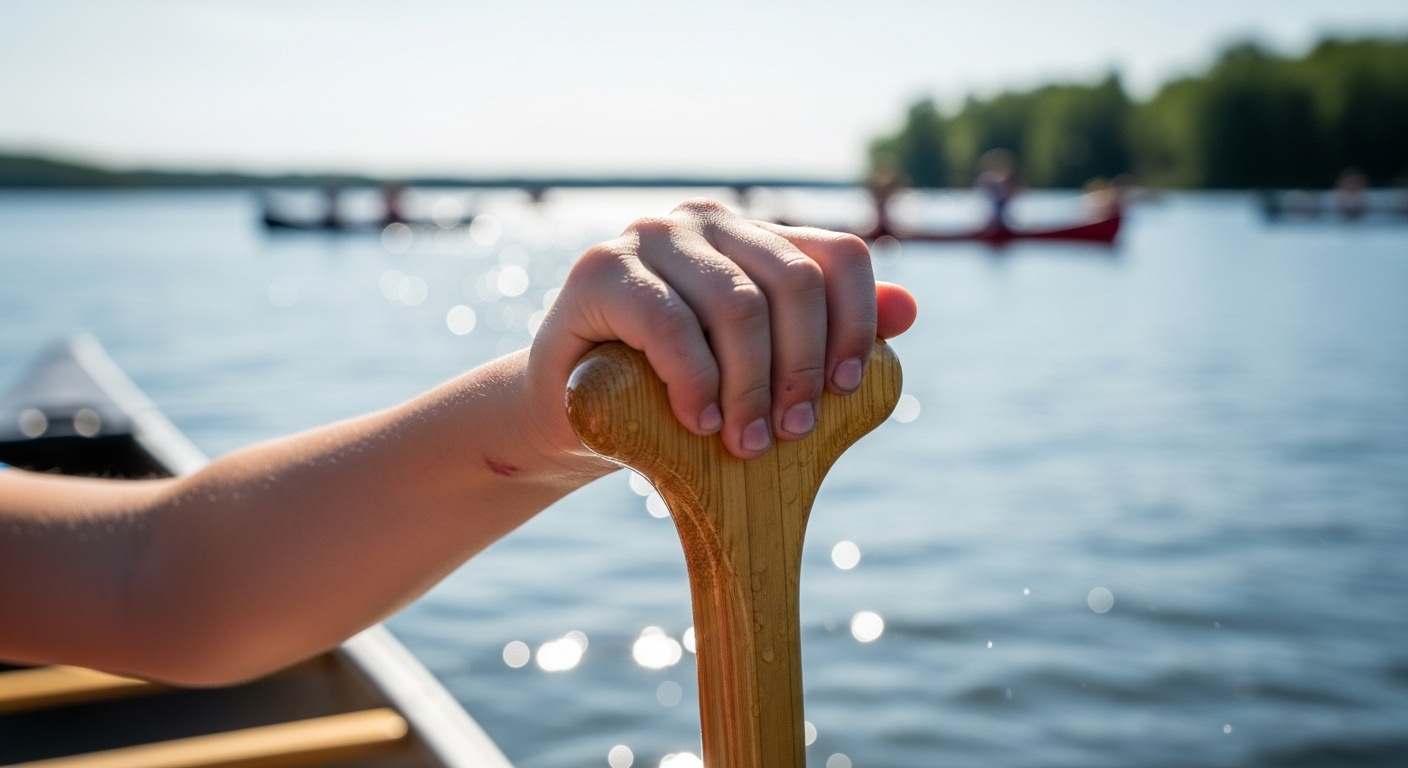
The visual style is naturalistic and grounded, emphasizing the textures of the analog world: the grain of the wooden paddle, the glitter of sun on the water's surface, the sweat on the boys' faces. This is contrasted with the clean, unobtrusive lines of near-future tech, like the sleek dataviewers on wrists and the modern materials of the rival canoe. The camera will be intimate and subjective, often locked in the boat with Lenny, capturing his perspective and the claustrophobic effort of the race.
The tone is contemplative, nostalgic, and gently satirical, blending the coming-of-age warmth of a film like Stand By Me with a subtle, critical eye towards technology's influence. It aligns with the thematic inquiries of a lighter Black Mirror episode or the humanist concerns found in the works of Ray Bradbury, questioning what is lost when authentic human experience is mediated by technology.
Share This Treatment


