A Summer of Synthetic Solutions
Format: Short Film / Anthology Episode | Est. Length: 10-12 minutes
Logline
At the launch of a seemingly absurd corporate solution to homelessness, a cynical photojournalist uncovers a sinister bio-hazardous secret hiding in plain sight beneath a veneer of civic pride and synthetic turf.
Themes
* Appearance vs. Reality: The stark contrast between the pristine, futuristic marketing of a social solution and the grimy, dangerous truth it conceals.
* Corporate Deception: The use of polished PR, scientific-sounding jargon, and manufactured cheerfulness to mask incompetence, greed, and potentially lethal negligence.
* The Banality of Evil: How catastrophic dangers can be packaged and presented as mundane, bureaucratic initiatives, managed by ordinary people just doing their jobs.
* Manufactured Solutions: A critique of superficial, technology-driven fixes for deep-rooted human problems, highlighting their inherent absurdity and potential for harm.
Stakes
The public's safety and the journalist's career are at risk as he uncovers a potentially lethal biohazard being deceptively packaged as a humanitarian solution for the city's most vulnerable.
Synopsis
On a sweltering summer day, jaded photojournalist SANDY is assigned to cover the launch of the ‘Eco-Comfort Pod’ initiative, a supposed high-tech solution to urban homelessness. The event, held on a lurid patch of artificial turf, is a masterclass in corporate and political absurdity, led by the pompous COUNCILLOR RODGERS and a representative from the slick ‘Future Living Solutions’ corporation. Sandy's initial cynicism is reinforced by the scene: plastic smiles, sagging banners, and egg-shaped pods baking under the relentless sun.
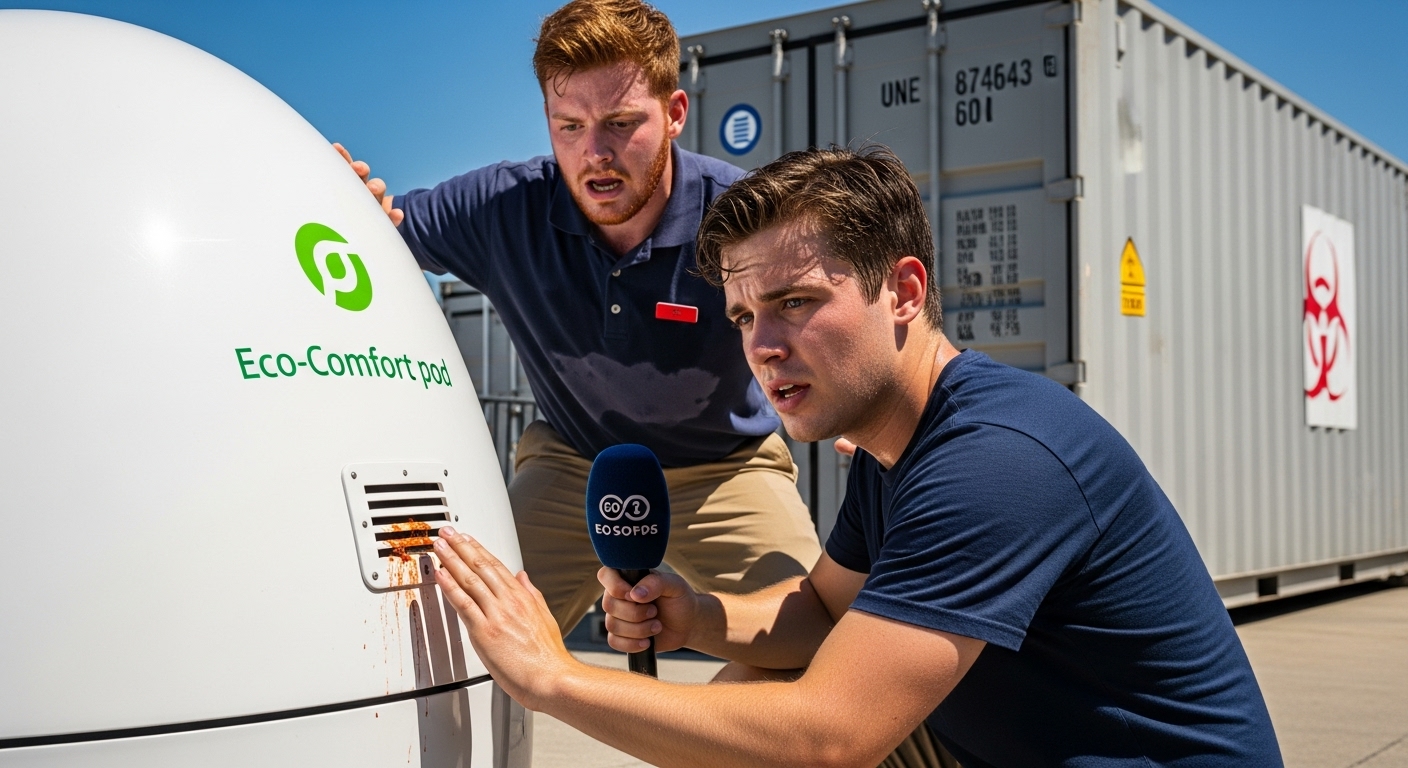
His suspicions deepen after a brief exchange with ELIZA HARDING, a fellow reporter, who reveals the pods' exorbitant price tag. When Sandy tries to inspect one of the pods up close, he is intercepted by TODD, an unnervingly cheerful and manic PR intern. Todd uses a barrage of corporate doublespeak and physical obstruction to prevent Sandy from getting a clear look inside, citing nonsensical reasons like "maintaining atmospheric equilibrium." During the encounter, Sandy notices a strange chemical smell, a low whirring sound from a vent, and a disturbing patch of dried, reddish-brown residue on the pod's pristine white shell.
Todd's desperation to control the situation escalates, his polished façade cracking under the heat and Sandy's persistent questions. Sensing a real story beyond simple graft, Sandy creates a diversion and investigates a large, humming refrigerated shipping container located just outside the event perimeter. Todd panics, frantically trying to stop him. The hum is a deep, industrial thrum, and the container is expelling waves of warm, chemical-smelling air. As he gets closer, Sandy discovers a faded biohazard label warning of a Level 4 Pathogen Risk. He confronts the terrified Todd with the evidence, just as a low, siren-like wail echoes from within the container, confirming his worst fears. The "eco-pods" are not a solution; they are part of a horrifying, dangerous cover-up.
Character Breakdown
* SANDY (40s): A weary, cynical photojournalist for a local paper. He's sharp, observant, and professionally detached, viewing the world through a lens of grim realism. His cynicism is a defense mechanism born from years of covering hollow political promises.
* Psychological Arc: Sandy begins the story jaded and disengaged, expecting only mundane corruption. He ends the story in a state of genuine alarm and renewed purpose, his journalistic instincts reignited by the discovery of a truth far more dangerous and bizarre than he could have imagined.
* TODD (20s): A PR intern for ‘Future Living Solutions.’ He is a walking embodiment of corporate doublespeak—initially energetic, impeccably dressed, and armed with a smile that never reaches his eyes. His manic cheerfulness is a thin shell for deep-seated anxiety and fear.
* ELIZA HARDING (40s): A sharp, world-weary investigative reporter. She is pragmatic and unimpressed by spectacle, serving as a cynical sounding board who confirms Sandy's initial suspicions and hints at a deeper, pre-existing investigation.
* COUNCILLOR RODGERS (60s): A self-important local politician. He is more concerned with photo-ops and buzzwords like 'synergistic community uplift' than the actual impact of his policies. He is the oblivious, smiling face of the civic machine.
Scene Beats
1. THE SYNTHETIC LAUNCH: Sandy arrives at the press event. The oppressive heat, fake grass, and plastic smiles establish the artificial and absurd atmosphere. Councillor Rodgers delivers a speech full of empty jargon.
2. THE PRICE OF ABSURDITY: Sandy connects with Eliza, who reveals the pods cost eighty thousand dollars each. His suspicion shifts from incompetence to active grift.
3. POKING THE PLASTIC EGG: Sandy tries to inspect a pod. He is intercepted by Todd, the PR intern, who blocks his access with a manic smile and nonsensical corporate excuses.
4. CLUES IN THE HEAT: While being stonewalled by Todd, Sandy notices key details: a faint, cloying chemical smell from a vent, a low humming sound, and a dried, reddish-brown stain at the pod's base. Todd's composure begins to visibly crack.
5. THE HUMMING SECRET: Sandy creates a diversion to investigate a large, humming refrigerated container on the edge of the site. Todd's panic escalates as he scrambles to stop him, his PR mask completely melting away.
6. THE REVEAL: Sandy reaches the container and finds the faded warning label: "Prototype Bio-Waste Containment: Level 4 Pathogen Risk." He confronts the terrified Todd. A low, haunting wail from inside the container confirms the horrifying truth.
Visual Style & Tone
The visual style will be grounded but hyper-real, emphasizing the oppressive summer heat. Cinematography will use high-contrast, sun-bleached palettes, making the lurid green of the fake turf and the sterile white of the pods feel unnatural and hostile. The camera will employ sweaty close-ups and a slightly shaky, handheld feel to mirror Sandy's journalistic perspective and growing unease.
The tone begins as a dark, satirical comedy, mocking corporate culture and political ineptitude. As Sandy uncovers more clues, the tone will shift, slowly building tension and paranoia, culminating in a final reveal that pushes the story into the realm of sci-fi horror. The sound design will be crucial, contrasting the cheerful PR speeches with the unsettling, low-frequency hum that grows progressively louder throughout the story.
Tonal Comparisons: Aligns with the satirical dread of Black Mirror, the corporate critique of Severance, and the slow-burn paranoia of a modern conspiracy thriller.
Share This Treatment


