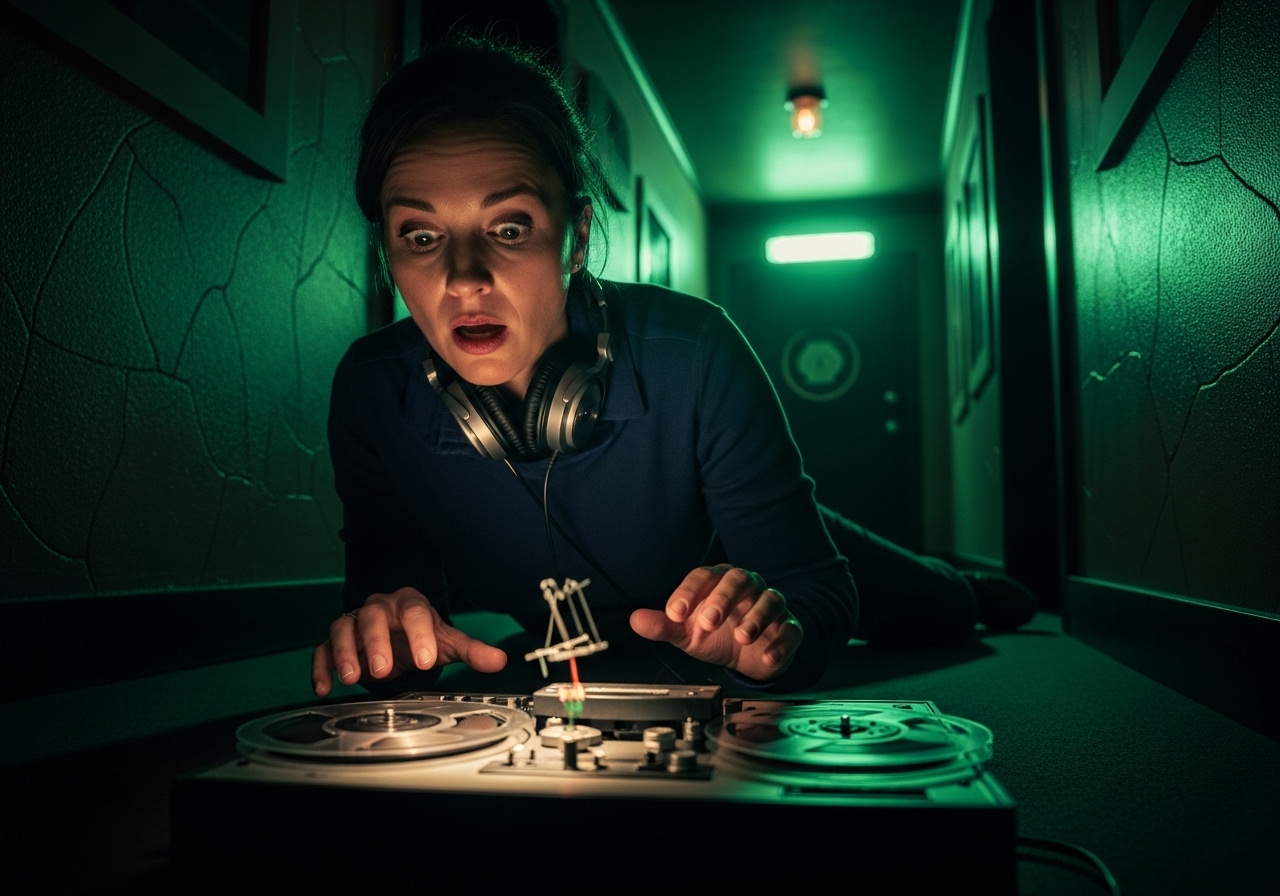
A Frequency No One Owns
Format: Short Film / Anthology Episode | Est. Length: 10-12 minutes
Logline
A detached paranormal audio expert investigating a strange funhouse discovers it isn't haunted by ghosts, but by an overwhelming archive of pure joy that threatens to absorb her scientific objectivity and her very self.
Themes
* Objectivity vs. Subjectivity: The tension between a scientist's need for empirical data and the overwhelming power of a purely emotional, subjective experience.
* The Nature of Memory: An exploration of whether powerful emotions can be imprinted on a location, creating a shared, external memory that blurs the lines of individual identity.
* The Uncanny Valley of Joy: The unsettling and terrifying concept that an excess of a positive emotion, like happiness, can be just as consuming and destructive as a negative one.
* Analog vs. Psychic: The contrast between technology designed to capture reality (Jae's tape deck) and a place that organically absorbs and replays the raw essence of life itself.
Stakes
At stake is Jae's scientific objectivity and her very sense of self, which risk being permanently absorbed into the funhouse's euphoric, chaotic chorus.
Synopsis
JAE, a meticulous audio investigator who trusts the "magnetic honesty" of her vintage reel-to-reel equipment, is hired to investigate a simple walk-through funhouse. The owner, SAL, reports that visitors exit in a state of hysterical laughter, and the phenomenon interferes with radio signals.
Setting up her gear, Jae isolates a strange, structured frequency beneath the ambient hum. Through her headphones, she hears an impossible soundscape: a live-sounding, complex tapestry of laughter from countless individuals across different eras. Her instruments confirm there are no speakers; the sound is acousmatic, emanating from the building's structure.
As she ventures deeper, she encounters a room filled with hanging rubber tassels. Brushing against one sends a jolt through her—not of electricity, but of pure, unadulterated sensation: the giddy terror of a child on a swing. She clinically dictates the "psychogenic contamination" into her recorder, but knows the feeling was not her own memory.
Forcing herself to continue, she comes to a corridor lined with coarse horsehair. The laughter is louder here. Compelled by scientific rigor, she presses her palm against the wall. The world dissolves. She is instantly immersed in a vivid, sensory memory of a seven-year-old's birthday party, experiencing the overwhelming love and ecstatic joy of the child whose memory it is.
Snatching her hand back, she returns to the dark corridor, gasping, with tears of joy streaming down her face. She has her breakthrough: the funhouse is a psychic capacitor. It has absorbed and stored every moment of happiness from every person who has ever passed through, replaying it in a constant, chaotic symphony. It is the opposite of a haunting—an archive of pure life.
The realization triggers an involuntary giggle. It feels foreign. She tries to stifle it, but more laughter bubbles up, pushing past her hand. Her carefully constructed objectivity dissolves as she is unwillingly integrated into the chorus. She watches the needle on her tape deck's VU meter thrash violently into the red, clipping with each new peal of her own—and not her own—uncontrollable laughter.
Character Breakdown
JAE (30s): A brilliant and methodical audio phenomenologist. She is precise, clinical, and emotionally guarded, placing her faith in objective data and the tangible truth of her analog equipment. She approaches the world as a series of frequencies to be measured and understood, creating a professional barrier between herself and the unexplained phenomena she studies.
* Psychological Arc:
* State at Start: A detached, scientific observer who believes all phenomena can be captured, categorized, and explained. She maintains a strict separation between herself as the analyst and the subject of her investigation.
* State at End: Her scientific detachment is completely shattered. She is overcome and absorbed by the very phenomenon she was studying, transitioning from an objective observer to an active participant in the funhouse's chorus, her identity dissolving into a shared, ecstatic experience.
Scene Beats
1. THE SETUP: Jae arrives at the cheap, unassuming funhouse. She sets up her vintage reel-to-reel deck and parabolic mic, her movements precise and practiced. She identifies a chaotic, structured waveform superimposed over the building's electrical hum.
2. THE CHORUS: Jae puts on her headphones and is immediately immersed in an impossible symphony of live, layered laughter. It's not a recording; it's a complex, acousmatic tapestry of pure joy.
3. FIRST CONTACT: Jae enters a corridor of hanging rubber tassels. As one brushes her skin, she experiences a sudden, intense flash of physical joy—a memory of being on a swing—that is not her own. She is shaken but records it clinically.
4. FULL IMMERSION: Hesitantly, Jae touches a wall lined with coarse horsehair. She is plunged into a full sensory memory of a child's birthday party. She feels the child's overwhelming happiness and love for their mother. The experience is profoundly real and emotional.
5. THE EUREKA MOMENT: Jae stumbles back into the corridor, gasping, tears of joy on her face. She understands. The building isn't haunted; it's a psychic battery, storing and replaying decades of pure happiness.
6. THE ABSORPTION: A giggle escapes Jae's lips. It feels alien. She tries to suppress it, but the laughter overtakes her, bubbling up uncontrollably. She watches the VU meter on her recorder slam into the red, capturing her own assimilation into the frequency no one owns.
Visual Style & Tone
The visual style will create a stark contrast between Jae's world and the funhouse's influence. Her equipment is presented with clean, macro shots—gleaming chrome, spinning reels, the warm glow of vacuum tubes. This clinical precision is set against the dark, decaying, and deeply textured environment of the funhouse: peeling paint, gritty floors, and strange tactile surfaces. Lighting will be low-key and atmospheric, punctuated by the sharp, diagnostic lights from her gear. The memory sequence will break this style completely, shot with the warm, over-saturated, and slightly unstable look of vintage 8mm film.
The tone is one of mounting psychological dread and uncanny mystery. It avoids jump scares in favor of a slow-burn, atmospheric unease that questions the nature of self and emotion. It aligns with the high-concept, psychological unease of Black Mirror, the sensory-driven mystery of Arrival, and the eerie, analog-focused aesthetic of films like Berberian Sound Studio.
Share This Treatment


