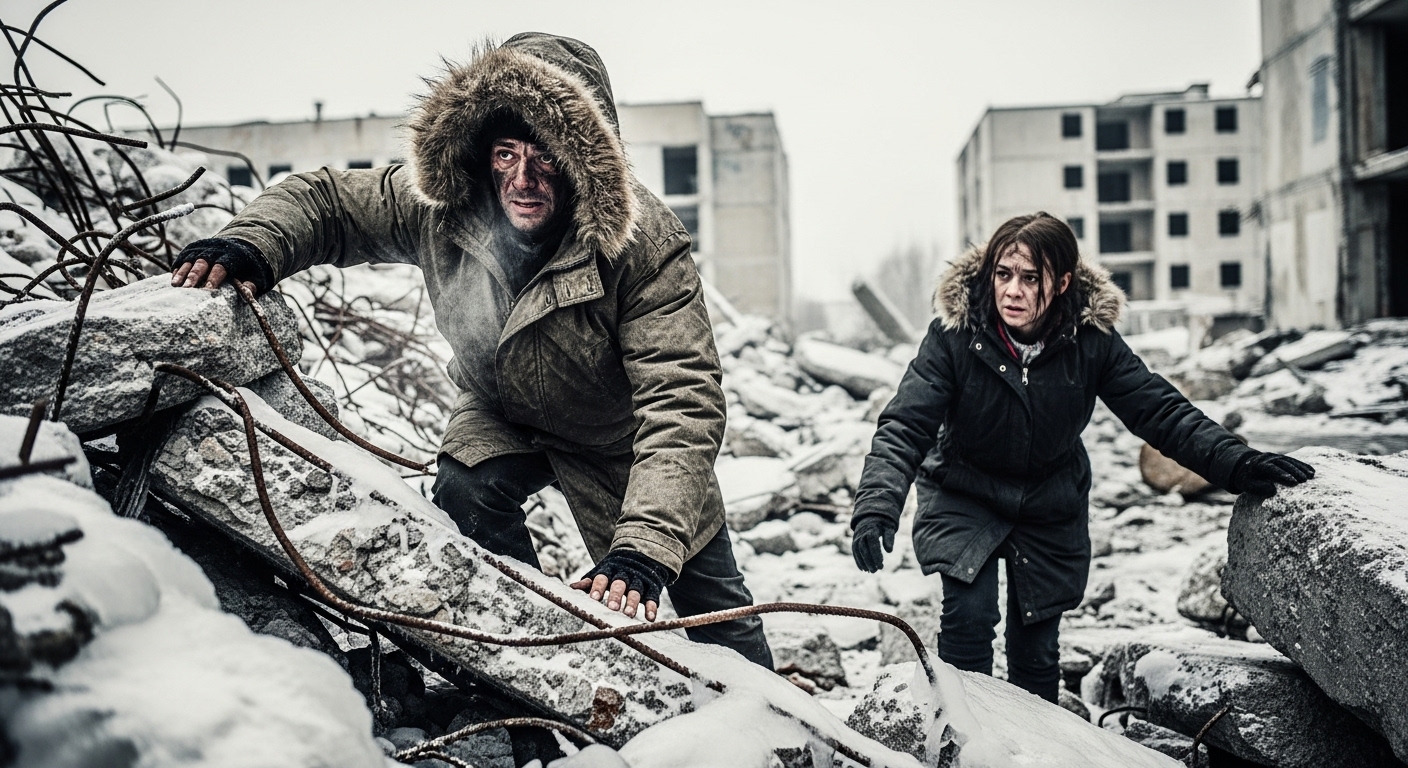
A Bitter Ascent Through Ice - Narrative Breakdown
Project Overview
Format: Single Chapter / Scene Breakdown
Genre: Psychological Drama / Disaster Survival
Logline: In the immediate aftermath of a city-wide collapse, a cynical man, Carson, is forced into a reluctant and tense alliance with a pragmatic survivor, Denise, as they navigate the treacherous, frozen underworld of their ruined city.
Visual Language & Atmosphere
The atmosphere is overwhelmingly oppressive, defined by a bone-chilling cold that is a physical, life-draining presence. The visual world is a claustrophobic labyrinth of industrial decay: jagged shards of rebar, groaning concrete, and rust-eaten metal. Light is a scarce and unreliable commodity; the environment is plunged into near-total darkness, punctuated only by the sporadic flicker of failing emergency lights that cast long, distorted, phantom-like shadows, and the single, focused beam of Denise's headlamp. The setting is an active antagonist, a symphony of threatening sounds—the groan of shifting earth, dripping water, the shriek of protesting metal—and visceral sensations, from the metallic taste of fear to the acrid smell of static from dead machinery. It is a dying world, a frozen, collapsing underworld where every surface is slick with ice or coated in grime, and the air itself is stale and burns the lungs.
Character Dynamics
The narrative is driven by the tense, evolving dynamic between its two protagonists, forged in the crucible of immediate catastrophe.
* CARSON: The point-of-view character, Carson is in a state of shock and adrenal fatigue. His primary coping mechanism is a bitter, intellectual sarcasm, a flimsy shield against the primal fear threatening to overwhelm him. Initially, he is defined by his physical weakness and his resentment towards Denise, whom he instantly hates for her cold detachment. His journey within this chapter is one of reluctant dependency, as his survival instinct forces him to cede control to Denise, transforming his cynicism into a grudging respect for her sheer competence.
* DENISE: Denise is a portrait of radical pragmatism. Her emotional state is rigorously suppressed, her focus narrowed to the immediate, life-or-death tasks of navigation and survival. Her blunt, seemingly cruel remarks ("If you fall, I’m not waiting") are not born of malice but of a severe and necessary triage of energy and risk. She is hyper-competent, possessing pre-existing knowledge of their subterranean environment and a plan for escape, embodied by the map she carries. She is the engine of their forward momentum, a figure of unnerving control in the midst of total chaos.
* THEIR DYNAMIC: Their relationship begins with pure antagonism and is born of absolute necessity. In the claustrophobic tunnels, the power dynamic is stark: Denise leads with knowledge and purpose, while Carson follows out of desperation. The initial friction gradually evolves as they are forced into physical cooperation, such as opening the heavy hatch. The turning point is the shared revelation that they are going the "wrong way." This mutual doom dissolves their antagonism into a fragile, necessary alliance, recalibrating their bond from one of coercion to one of shared, grim purpose.
Narrative Treatment
In the immediate aftermath of a catastrophic structural collapse, CARSON stumbles through the freezing, dust-choked ruins of a building. The cold is a physical entity, and the structure groans around him, threatening imminent failure. He is driven by a primal need to reach a service tunnel opening, his only apparent way out.
His clumsy progress is interrupted by a raspy voice. DENISE, a woman he vaguely recalls from moments before the disaster, stands silhouetted by a flickering emergency light. Her face is smudged with soot, and she regards his near-fall with a look of detached, clinical assessment, perhaps even amusement. Carson, exhausted and terrified, hates her instantly.
After a terse, sarcastic exchange, Denise bluntly informs him that he will slow them down and that if he falls, she won't wait. She moves past him with an efficient, deliberate gait and they descend into the oppressive darkness of the service tunnel. The cold deepens, and the claustrophobic space amplifies every sound, making the silence between them heavy. Carson follows the lone beacon of her headlamp, his mind reeling from the absurdity of his predicament.
Their path is abruptly blocked by a massive cave-in of track and concrete. As Carson's despair sets in, Denise ignores his sarcasm and reveals her knowledge of the tunnels, stating there is a maintenance hatch two levels up, further back. It becomes clear she has a plan. Resigned, Carson follows her back the way they came.
The ascent is a grueling, painful scramble up a vertical mess of icy conduit and rusted pipes. Denise moves with precision while Carson struggles, his body screaming in protest. At the rust-eaten hatch, Denise's impatience is palpable. She struggles with a stubborn bolt and curtly orders Carson to help. For a moment, they push together, a brief instance of shared strain. With a shriek of metal, the hatch gives way.
They emerge into a derelict upper-level service corridor, the air still freezing but drier. Dust and ice crystals crunch under their boots. Carson, seeking to reclaim some control, sarcastically asks where the "grand tour" is headed next. Denise pauses, her light falling on a faded sign pointing to 'Surface Access - East'. Her jaw tightens.
She delivers the devastating news: east is not ideal. It leads toward the industrial sector and the river, where the bridge is gone. All the official evacuation points were west. They have been going the "wrong way." Carson lets out a bitter, defeated laugh. Denise counters sharply that it wasn't fate, but the physics of the collapse that blocked their path back. Going back is impossible.
Staring into their shared dead end, Carson's sarcasm fades into weary resignation. He asks what alternative is left. In response, Denise pulls a folded, grime-stained map from her jacket. She reveals a new, longer, and riskier plan: to navigate through the old financial district to find a stable river crossing further north. The map, and the plan it represents, solidifies their fragile alliance, offering a single, desperate path forward through the frozen heart of the dead city.
Scene Beat Sheet
1. Struggle and Fear: In a collapsing structure, Carson stumbles, tasting fear and feeling the deep cold.
2. The Pragmatist Appears: Denise emerges from the gloom, her first words a sardonic assessment of Carson's clumsiness.
3. An Alliance of Necessity: A tense introduction establishes their dynamic: Carson's sarcasm meets Denise's blunt declaration that she won't wait for him if he falls.
4. Descent into Darkness: They enter the claustrophobic service tunnel, the oppressive silence and cold amplifying Carson's sense of dread.
5. The Dead End: Their path is completely blocked by a cave-in, seemingly ending their escape.
6. A Glimmer of Hope: Denise reveals her knowledge of the tunnels and an alternate route via a maintenance hatch.
7. The Bitter Ascent: A physically grueling climb tests Carson's limits, contrasting with Denise's relentless competence.
8. Forced Cooperation: At the hatch, they must work together, a brief moment of shared physical strain breaking the tension.
9. A New Purgatory: They emerge into a higher, derelict corridor, a liminal space that is not yet safety.
10. The Revelation: Denise reveals they are heading "the wrong way," away from all designated safe zones and toward an impassable river.
11. Shared Doom: Carson's cynical despair is met by Denise's grim acceptance; retreat is not an option.
12. The New Path: Denise unveils a map, proposing a new, high-risk plan and cementing their partnership on a shared, forward-moving purpose.
Thematic Context
This narrative is a stark exploration of survivalism, stripping away social artifice to expose the primal drives of its characters. The central theme is the tension between intellectual detachment and practical resilience. Carson, whose mind defaults to abstract concepts like "poor urban planning" and sarcasm, finds his worldview useless against the visceral reality of collapse. In contrast, Denise embodies radical pragmatism; her knowledge of the physical world is the only currency that matters. Their forced interdependence becomes a crucible for change, challenging Carson's cynicism and hinting at the humanity beneath Denise's hardened exterior.
The setting itself functions as a primary antagonist, with the oppressive cold and claustrophobic, failing infrastructure mirroring the characters' internal states of fear and despair. The descent into the subway's "abandoned arteries" serves as a modern katabasis—a journey into an underworld not of myth, but of concrete and iron, a testament to the hubris of a fallen technological society. Symbolically, Denise's map represents foresight, planning, and the fragile hope of a navigable path through chaos, standing in direct opposition to Carson's aimless, reactive state. The story's conflict is not one of good versus evil, but of pragmatic survival versus a collapse into despair, framing the birth of a reluctant, vital human bond as the only meaningful defiance against an indifferent apocalypse.
Share This Treatment


