Office of the Unblinking Eye
The air conditioning whirred with an almost aggressive efficiency, a stark contrast to the thick August humidity clinging to the city outside. Inside Eva’s office at the Collective Arts Centre, the silence felt stretched, taut. Dust motes, usually so visible in the morning light, were absent, banished by meticulous cleaning. Everything was too clean, too still, awaiting the inevitable storm.
"It's… not ideal," Eva started, her voice a little too light, a little too careful. She shifted in her ergonomically correct chair, the faint squeak of synthetic leather a sharp counterpoint to the drone of the air purifier. Outside, the summer sun beat down on the pavement, a brutal, unforgiving heat that still managed to seep through the triple-glazed windows. She pictured the heat shimmer rising from the asphalt, the smell of hot refuse and exhaust fumes. In here, it was all sterile cool.
Candice, draped against the far wall like a forgotten coat, didn't move. Her paint-splattered overalls, a permanent uniform, seemed to absorb the muted light. She had an intensity about her, a stillness that Eva found both fascinating and deeply inconvenient. A bead of sweat, despite the chilled air, tracked a slow path down Eva’s temple, tickling her eyebrow.
"Ideal for whom, exactly?" Candice finally said, her voice low, a rasp of gravel over silk. She didn’t look at Eva, her gaze fixed on a small, almost invisible crack in the plaster. A moth, fat and grey, bumped clumsily against the windowpane, its futile attempts echoing the conversation yet to come.
Eva cleared her throat. "For the Collective Arts Centre. For the future of—"
"The future of palatable art, you mean?" Candice interrupted, her eyes finally snapping to Eva’s. They were a startling, icy blue, holding an almost childlike innocence that belied their sharp edges.
Eva picked up a ceramic mug, already cold, and traced the rim. "It's about sustainability, Candice. About maintaining the relationships that allow us to even have a space for artists like you." The words tasted like ash, forced and rehearsed. She hated how hollow they sounded, even to her own ears. Her internal monologue, a chaotic mess of budget spreadsheets and patron lists, felt miles away from the pure, unyielding conviction in Candice's stare. She could hear the hum of the old server rack from the other office, a constant, low thrum beneath everything.
Candice pushed off the wall, a fluid, unhurried motion. She walked towards the desk, stopping a few feet short, her hands tucked deep into her pockets. Her movements were economic, every gesture deliberate. Eva noted a faint smear of cobalt blue paint near Candice's left earlobe, a small detail a camera might overlook, but one that screamed 'artist' louder than any manifesto.
"'A Guide to Palatable Dissent'," Candice recited, a ghost of a smile playing on her lips. "That's what the piece is called. It’s not a suggestion, Eva. It’s a critique. A commentary on exactly what we're discussing right now." She paused, her gaze sweeping over the polished desk, the framed awards on the wall, the carefully curated blandness of the executive office. "How much dissent is acceptable, before it becomes… unpalatable? Before the purse strings tighten?" Her voice held no anger, only a quiet, brutal dissection.
Eva’s shoulders tightened. She felt the slight rasp of her linen blazer against her skin, a minor discomfort. "We've had… feedback. Significant feedback, Candice. From the board. From some of our most consistent benefactors." Eva chose her words carefully, trying to inject a sense of shared problem into the air, rather than placing blame. She knew it was a futile exercise, a dance of diplomacy Candice had no interest in learning.
"Feedback," Candice repeated, a humourless chuckle escaping her lips. "Is that what we're calling censorship these days? Focus groups for what constitutes 'art'? Should I start taking polls for my next installation? See if the colour palette aligns with market trends?"
"That's not fair," Eva said, a little more sharply than she intended. She winced. Keep it calm. Keep it professional. "You know the Collective. You know our mission. We've always championed challenging art. We took a risk on this entire exhibit—"
"A risk that's suddenly too heavy to bear, now that the risk-takers are feeling the heat?" Candice interrupted again. She leaned forward slightly, her face inches from Eva’s, not aggressive, but impossibly direct. "What exactly is the complaint, Eva? Be specific. Is it the shredded corporate reports? The projected images of redacted documents? The very real, very public emails detailing ethical breaches?"
Eva's heart hammered against her ribs. This was it. The uncomfortable truth, dragged out into the cool, sterile light. "It's the names, Candice. The specific company names. The individuals implicated. It’s… too close to home for some." She watched Candice's expression, searching for a crack, a flicker of understanding. There was nothing. Just that unnerving, unblinking clarity.
"It’s truth, Eva. Not 'too close to home.' It’s reality. Those companies, those individuals, they fund this gallery. And they’re terrified of having their practices illuminated by something as simple as light and shredded paper." Candice gestured vaguely towards the main gallery space, where her exhibit currently resided.
Eva stood up, walking to the window. The heat outside looked like a living thing, shimmering over the rooftops. "They've threatened to pull their funding. All of it. Not just for this exhibit, but for the next fiscal year. The children's programme, the artist residency, the community outreach… all of it." She didn’t turn around, couldn't bear to see the effect of her words, couldn't bear to see Candice's face. The hum of the air conditioning seemed to get louder, almost an accusation.
---
The Unspoken Ultimatum
"And you expect me to… what?" Candice’s voice was softer now, almost conversational, but it sliced through the air with surgical precision. "To redact my own work? To censor myself for the sake of their comfort? Is that the new artistic standard? Comfort over truth?"
Eva turned, her hands clasped tightly behind her back. "I don't expect you to do anything you don't believe in, Candice. But I have a responsibility here. To the staff, to the community, to the other artists who rely on this space. We operate on razor-thin margins. Without that funding… there is no Collective. There is no space for anyone to make their art, palatable or otherwise."
Candice was silent for a long moment, her gaze dropping to the floor. Eva watched her, noting the slight tremor in Candice’s lower lip, a tiny, almost imperceptible betrayal of emotion. A faint clatter came from the street below, a bin being emptied, a mundane intrusion into their high-stakes deadlock. Eva wondered if Candice could hear it too, if it grounded her at all.
"So, the choice is mine then?" Candice finally asked, lifting her eyes again. "My integrity, or everyone else’s… opportunity?" The question hung in the air, heavy and loaded, a bitter pill that Eva had no choice but to offer.
"It’s not a choice I want to put on you," Eva admitted, her voice cracking slightly. She felt a sudden, irrational urge to kick the leg of her desk, just to feel something sharp. "But the board is meeting again tomorrow morning. And they need a solution. A demonstrable effort to… mitigate the situation."
Candice let out a long, slow breath. "What kind of mitigation are we talking about, Eva? A tastefully worded disclaimer? A little black bar over the offending names?"
"They want the problematic elements removed entirely. Replaced. Or the entire piece pulled." Eva watched the words land, each one a hammer blow. Her stomach churned. She felt a familiar burn of shame, of compromise. Her own artistic dreams, long since shelved, felt like a distant, accusing whisper.
Candice walked back to the wall, running a hand over the smooth plaster. "Removed. Replaced. Or pulled." She repeated the words as if tasting them, finding them rancid. "And if I refuse?"
"Then… the exhibit ends. Immediately. And, I'm sorry to say, our relationship with you, and with the artist community, would be… severely impacted." Eva’s voice was barely a whisper. This was the part she dreaded the most. The threat. The cold, hard reality of commercial pressure crushing artistic freedom. Her fingers ached to rub the bridge of her nose, a familiar habit, but she held them still, a silent plea for composure.
Candice spun around, her eyes alight with a dangerous, unfamiliar fire. "Severely impacted? You mean I’d be blacklisted. Discredited. Made an example of. All for telling the truth." She took a step towards Eva, then another. "But what if… what if there's more to tell? What if 'A Guide to Palatable Dissent' has a sequel?"
Eva frowned, confused. "What are you talking about?"
Candice reached into her deep overalls pocket and pulled out a small, tarnished silver locket, the kind a child might wear. She popped it open with a precise click. Inside, on a tiny, almost microscopic chip, was a string of glowing blue characters, impossible to discern with the naked eye. The air felt suddenly colder, thicker. A chill snaked up Eva's spine, despite the oppressive summer heat.
"The original, unredacted data," Candice said, her voice dropping to an even lower, more dangerous register. "Not just corporate reports. Personal communications. Internal memos. Everything they tried to bury. And I’ve already sent it. Not to a journalist, not to a gallery. To everyone. To anyone who asked. Including every single one of your 'benefactors'."
Eva felt the blood drain from her face. Her breath hitched, caught somewhere in her throat. The carefully constructed world of compromise and negotiation, the delicate balance of art and commerce, shattered into a thousand jagged pieces around her. The air conditioning continued its relentless hum, a cold, uncaring witness to the sudden, irreversible shift in power. She stared at Candice, at the tiny, glowing chip, and knew, with a bone-deep certainty, that everything had just changed. Not just for the Collective, but for her, and for the entire landscape of art in the city.
"You… you what?" Eva managed, the words barely a breath. Her hand instinctively reached for the desk, gripping the polished wood, trying to anchor herself as the room seemed to tilt.
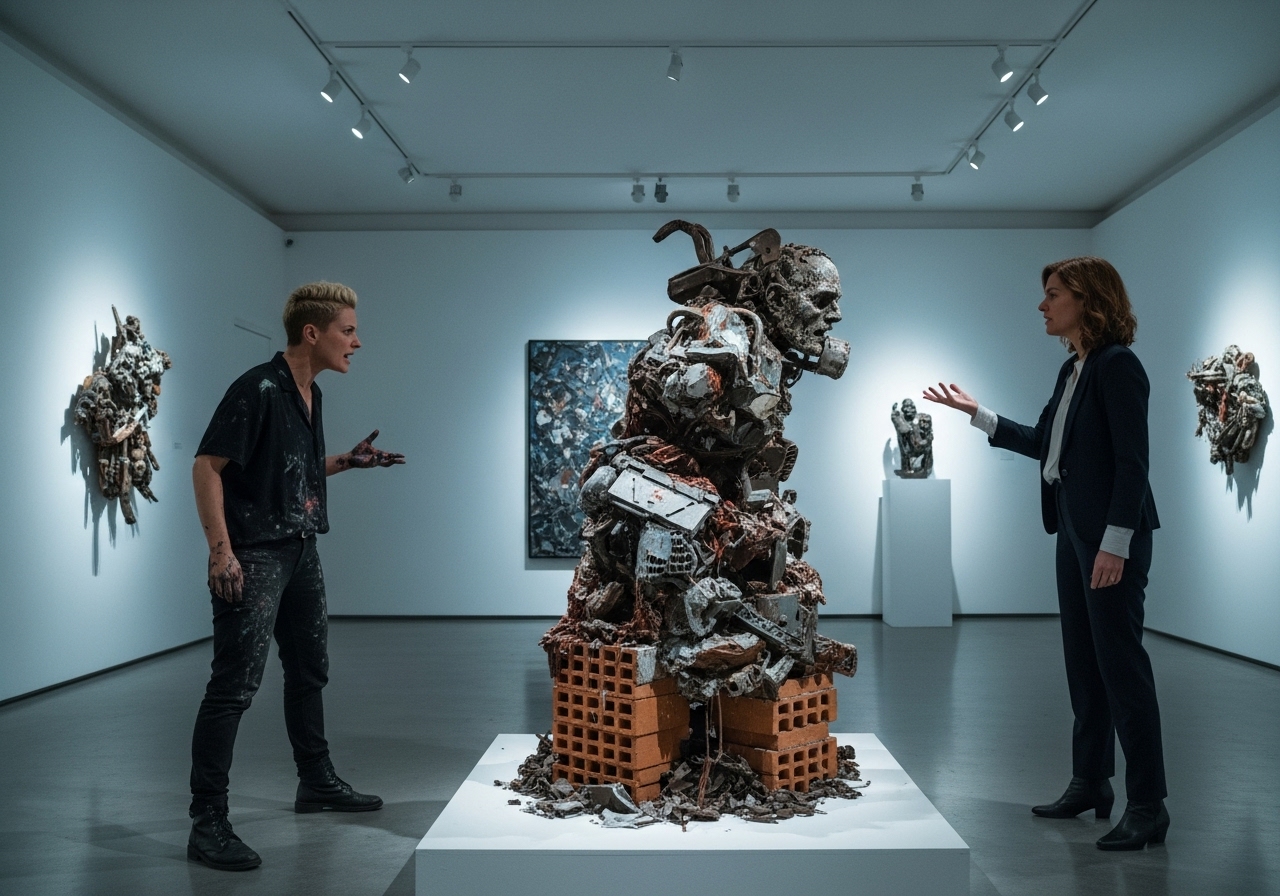
Eva stared at the small, glowing chip, her mind racing through the catastrophic implications. Candice had not just refused to compromise; she had detonated the very foundation of their precarious existence, leaving Eva scrambling to comprehend the fallout of a truth too raw to be palatable, for anyone.
Share This Story


