A Draught in the Studio
The old warehouse studio, a cavernous space of exposed brick and high, grimy windows, hums with the uneven thrum of various artistic endeavours. Dust motes dance in the weak autumn light filtering through the panes, illuminating a disorganised landscape of canvases, half-formed sculptures, and forgotten instruments. The air, thick with the scent of turpentine, clay, and damp concrete, offers little warmth against the encroaching chill.
Josey traced the rough edge of her pallet knife over the smear of ochre on the canvas, a smear that had been there, stubbornly, for three days. It looked like a bruise on otherwise pristine linen. Every brushstroke felt like pulling teeth, every mixed colour a betrayal of some unarticulated vision. The approaching autumn showcase, meant to revitalise the collective’s flagging funds, felt less like an opportunity and more like a looming, public humiliation.
The chill of the warehouse seeped into her bones, despite the fraying wool cardigan she’d pilfered from Mike’s lost-and-found box. It still smelled faintly of patchouli and stale coffee. She hunched over, trying to coax something, anything, from the canvas, but it just stared back, blank and judgmental.
“Still wrestling with your inner demons, Josey?” Mike’s voice cut through the silence, rich with a familiar blend of genuine curiosity and veiled amusement. He leaned against the doorway of her partitioned space, a guitar case propped beside him like a silent sentinel. His hair, perpetually in need of a trim, fell over one eye, and a faint smudge of graphite marked his cheek. He always looked like he’d just emerged from a particularly intense jam session, even if it was only ten in the morning.
She didn’t look up. “Something like that. More like my outer block. It’s a very robust, unyielding sort of block.” She scraped at the ochre again, a desperate, futile gesture. “What’s… stupid?”
“The whole thing, really.” He pushed off the doorframe, letting the worn wood creak a protest. “This show. The lease. Us pretending we’re all going to magically pull a masterpiece out of our collective arses and save the day.” He walked over, picked up a stray, hardened paint tube, and squeezed it, watching a tiny, dried pellet of cerulean flake off. “It’s all just… whatever. And then you look up…” He gestured vaguely at her canvas. “And it’s still just… ochre.”
“Helpful, Mike. Truly.” She finally glanced at him, her brow furrowed. His eyes, usually dancing with a restless energy, were shadowed today. Something was off. “What’s really bothering you?”
He shrugged, a dismissive flick of his shoulders. “Nothing a good riff can’t fix.” He dropped the paint tube with a clatter and walked towards his own space, the faint echo of Sharon’s hammer-on-metal from the far end of the warehouse momentarily drowning out his footsteps. Mike, like a dog, preferred to suffer alone, or at least, pretend to.
Josey sighed, pushing a hand through her already messy bun. The collective had been their home, their identity, for years. They’d built it from the ground up, scrounging for materials, sharing meals, arguing about art and politics until the early hours. Now, the landlord’s terse letters about the expiring lease felt like a ticking bomb, and their grand plan – a showcase to attract a benefactor – felt increasingly like a delusion.
---
Echoes of Dread
The rhythmic CLANG CLANG CLANG from Sharon’s corner was a constant, percussive reminder of tangible progress, a stark contrast to Josey’s stagnant canvas. Sharon worked with metal, welding raw steel into elegant, brutalist forms. Her pieces were sharp, angular, unapologetically themselves. Josey often envied that clarity.
A door slammed with unexpected force, making Josey jump. Candice. No one else announced their arrival with such dramatic flair. She burst into Josey’s space, her usually vibrant clothes a whirlwind of clashing patterns – today, it was a neon orange tracksuit paired with a sequined cowboy hat. She was clutching a tablet like it held the secrets to the universe, her eyes wide, a manic grin splitting her face.
“You guys! You will not believe what I’ve found!” Candice practically vibrated with suppressed energy. She didn’t wait for a response, launching into a breathless monologue. “Okay, so I’ve been digging, right? And everyone’s talking about this new cultural fund, ‘The Archway Collective.’ Very hush-hush, very exclusive. But get this – they’re looking for a flagship project. Something… groundbreaking.”
Mike reappeared at the entrance of his studio, a half-tuned guitar in hand. “Groundbreaking usually means ‘cheap and easily exploitable’ in their world, Candice.” His fingers plucked a discordant chord.
“No, no, Mike, you don’t understand! This is different. They’re tied to… get this… Horizon Developments.” Candice practically sang the name, her voice laced with triumph. Horizon Developments was the real estate conglomerate that owned half the city’s industrial land, including, as fate would have it, their very own warehouse.
Sharon emerged from her alcove, wiping a smudge of grease from her forehead with the back of a gloved hand. The hammer she carried looked like an extension of her arm. “Horizon Developments? The ones who’ve been trying to evict us for six months so they can put up another block of unaffordable condos?” Her voice was level, but the set of her jaw was tight.
“Exactly!” Candice beamed, missing the irony entirely. “Think of it! They own the building. We provide the artistic street cred. It’s symbiotic! They want to rebrand their image, be seen as patrons of the arts, not just… well, not just developers. And we… we get funding! Real funding! Enough to buy this place, even!” She held up the tablet, the screen displaying a slick, minimalist logo. “And they want to meet. Tomorrow.”
Josey felt a cold knot tighten in her stomach. “Horizon Developments wants to fund us? That sounds… too good to be true. What’s the catch?” She remembered the eviction notices, the subtle pressure to vacate, the rising property taxes. This wasn’t benevolence; this was a manoeuvre.
Candice waved a dismissive hand. “Small stuff. They want… input. On the direction of the art, you know? To align with their ‘vision of urban renewal.’” She made air quotes around the last phrase, but her enthusiasm remained undimmed. “It’s marketing, really. But think of the resources! A proper gallery space, promotion, even a commission for the whole collective for their new downtown project!”
Mike scoffed. “So, we become the corporate mascots. The ‘hip, edgy’ artists who validate their gentrification projects. No thanks. My music isn’t for sale, not like that.” He returned to his guitar, plucking out a mournful blues riff.
Sharon set her hammer down with a soft thud that still resonated through the concrete floor. “Candice, have you actually read the fine print? What kind of ‘input’ are we talking about? We’re an arts collective, not an advertising agency.”
“Oh, it’s nothing major,” Candice insisted, though a flicker of uncertainty crossed her face. “Just… a few guidelines. Like, they want ‘uplifting themes,’ ‘community engagement,’ ‘architectural resonance.’ You know, positive stuff.”
“‘Architectural resonance’ means ‘paint pretty pictures of our buildings,’ doesn’t it?” Josey muttered, the ochre smear on her canvas suddenly feeling heavier, more oppressive. Her own artistic struggle paled in comparison to this potential moral compromise.
---
A Shifting Foundation
The air in the studio, usually thick with creative chaos, now hung heavy with unspoken tension. Mike’s blues riff grew louder, more insistent, a defiant counterpoint to Candice’s optimism. Sharon had crossed her arms, her gaze fixed on Candice with an intensity that could melt steel. Josey felt caught in the middle, the anchor of their small, disparate family, now being pulled in opposing directions.
“Think about it, Josey,” Candice pressed, turning her full, earnest gaze on her. “This could be everything. We’re losing the space, remember? This is our shot. Not just to save it, but to actually thrive. Imagine… proper heating! New equipment! A permanent home!” Her voice was laced with a desperate yearning, a vision of stability that was hard to argue against.
Josey looked at the half-finished canvas. Could she paint an “uplifting theme” for Horizon Developments? Could she make her art “architecturally resonant” without losing the raw, messy truth of it? Her fingers, stained with paint, clenched into a fist. This collective, this ramshackle haven, had always been about unfiltered expression, about pushing boundaries, not fitting into corporate moulds.
“And if they don’t like what we produce?” Sharon’s voice was dangerously quiet. “If they decide our ‘vision’ isn’t ‘aligned’ with theirs? Do we get cut off? Do we lose the space anyway, but this time, with our integrity compromised?”
Candice’s smile faltered. “They wouldn’t… I mean, they want us! They picked us!”
“They picked our image, Candice,” Mike interjected, his voice sharp, finally setting down his guitar. “The struggling artists, authentic and edgy, perfect for their quarterly report. We’d be a prop, a facade. You think they care about our art? They care about the narrative we give them.”
“So we just… starve, then?” Candice retorted, her voice cracking slightly, the initial exuberance fading into a brittle defensiveness. “We just let the landlord kick us out? Is that the ‘integrity’ you’re so proud of, Sharon? Poverty as a creative statement?”
The harshness of her words hung in the air, a raw, undeniable truth. They were struggling. The collective was barely afloat. The dream of independent art was constantly battling the reality of rent and utility bills. Josey knew this intimately, staring at the ochre that felt so meaningless in the face of such stark choices. She felt a familiar burn behind her eyes. This was more than just art; it was their lives, their community, their only hope against being swallowed by the city’s relentless development.
“It’s not about poverty, Candice, it’s about freedom,” Sharon countered, her voice now edged with a weary patience. “Once you let someone else dictate your brushstrokes, your notes, your forms… it stops being yours. It stops being art. It becomes something else.”
Josey looked from Candice’s hopeful, desperate face to Sharon’s grim determination, then to Mike’s cynical resignation. Her gaze fell back to her canvas, the ochre still staring. She imagined painting something bright, something 'uplifting' for Horizon Developments, a vibrant cityscape devoid of grit and struggle. The thought made her stomach churn. But the alternative… the slow, inevitable dissolution of everything they’d built, watching this place become another glass tower…
A cold gust of wind rattled the high windows, bringing with it the scent of wet leaves and distant woodsmoke. The collective, once a bastion of shared ideals, felt fragile, fractured. Josey knew, with a certainty that chilled her more than the autumn air, that whatever decision they made now, it would change everything. The ochre on her canvas, the symbol of her creative block, suddenly seemed to represent a deeper, more fundamental stain, one that threatened to bleed through the very fabric of their artistic lives, leaving them irrevocably marked, for better or for worse.
She picked up a clean brush, her hand trembling slightly, and dipped it, not into ochre, but into a stark, unforgiving black. What she would paint next, she still didn’t know, but the choice, she realised, was hers alone to make. And the weight of it was immense, a heavy, silent burden that pressed down on her with the finality of a closing door.
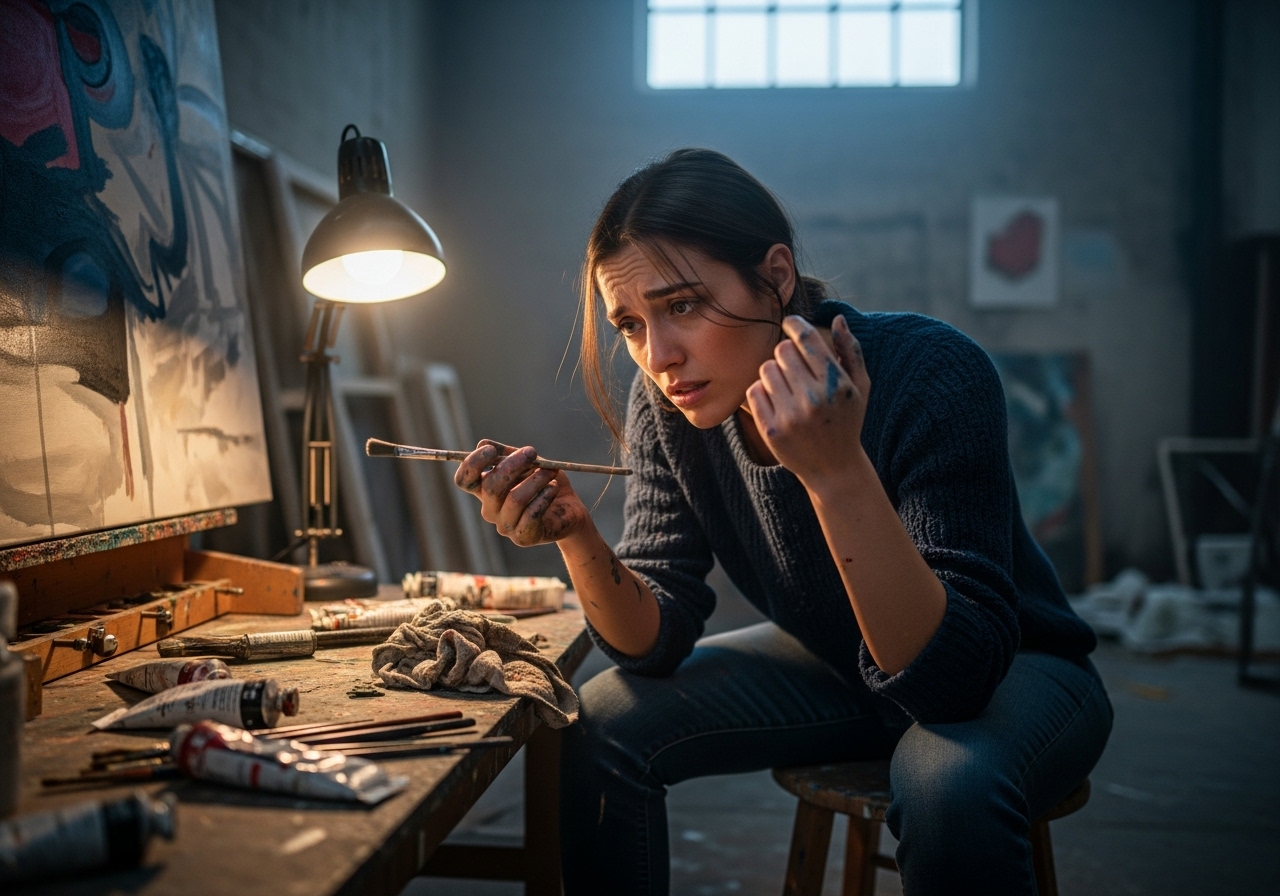
Josey stood before her canvas, a single brushstroke of black challenging the oppressive ochre, knowing that her next artistic decision might not just define her own work, but the very soul and future of the entire collective. The silence of the studio throbbed with the unspoken question: would they sell their vision, or fight for its untainted heart, even if it meant their demise?
Share This Story


