Introduction
"The Late Shortcut" presents a microcosm of a relationship under pressure, using the catalyst of a mundane roadside disaster to excavate the deeply buried emotional architecture between its two protagonists. The narrative is a tightly focused study in the profound misinterpretations that arise from silence, and the terror that often masquerades as anger.
Thematic, Genre & Narrative Analysis
At its core, this chapter is a character-driven piece that navigates the complex terrain of masculine intimacy, communication, and vulnerability. It operates within the genre of contemporary realism, perhaps with romantic undertones, where the external plot—a truck crashing and getting a flat tire—serves primarily as a crucible for the internal emotional conflict. The overarching theme is the dangerous gap between perception and reality in a relationship, particularly when one partner adopts a stoic, protective role and the other internalizes a narrative of inadequacy. The story critiques a form of masculinity where control and competence are performed at the expense of emotional expression, revealing the immense psychological toll such a performance takes.
The narrative voice is a close third-person perspective, tethered almost exclusively to Casey’s consciousness. This perceptual limitation is the story's central mechanical genius. The reader experiences the events through Casey's filter of guilt and anxiety; we feel his teeth rattle, we see Liam’s knuckles bleach white, and most importantly, we interpret Liam’s silence as Casey does—as cold, controlled fury. The narrator does not tell us Liam is scared; it shows us Casey believing Liam is angry. This creates a powerful dramatic irony, as the reader may suspect Liam's stoicism is a mask long before Casey does. The moral dimension of the story emerges from this breakdown in communication, suggesting that true care is not just about physical protection but about emotional transparency. It posits that the most damaging assumptions are the ones we make about the people we love, and that salvation lies in the courageous, terrifying act of speaking one's fear aloud.
Character Deep Dive
Liam
Psychological State: In the immediate aftermath of the accident, Liam is in a state of acute stress response, but his reaction is one of rigid suppression rather than overt panic. His locked hands, corded forearms, and set jaw are physical manifestations of a monumental effort to maintain control over both the vehicle and his own internal state. His flat, controlled voice is not a sign of calm but of a dam holding back a flood of adrenaline, anger, and terror. This self-imposed stoicism is a defense mechanism, a desperate attempt to be "Liam-the-adult" in a situation where his more volatile impulses ("Liam-who-punches-drywall") are threatening to surface. His silence is a symptom of being emotionally overwhelmed, unable to process his fear for Casey's safety while simultaneously managing the physical crisis.
Mental Health Assessment: Liam’s behavior suggests a man who struggles with emotional regulation, particularly concerning anger and fear. The reference to punching drywall indicates a history of maladaptive coping mechanisms for intense emotions. His current stoicism is a learned, and perhaps fragile, counter-response to this volatility. He appears to carry a heavy burden of responsibility, especially for Casey, which manifests as a kind of hyper-vigilance. While his competence is a source of strength, it also isolates him, forcing him into a protector role that prevents him from expressing his own vulnerability, creating a cycle of silent suffering and potential misunderstanding.
Motivations & Drivers: Liam's primary, surface-level motivation is to solve the immediate problem: secure the scene, assess the damage, and fix the truck. This practical drive is a way to channel his anxiety into productive action. However, his deeper, core motivation is the protection of Casey. Every action he takes, from telling Casey to stay in the cab to his efficient work in the rain, is filtered through this lens. He is not driven by annoyance over the truck, but by a profound fear of Casey's potential for self-harm, which he perceives as a form of recklessness. His ultimate goal is not just to get back on the road, but to restore a sense of safety for and around the person he loves.
Hopes & Fears: Liam’s deepest fear, stated with shattering clarity at the chapter's climax, is losing Casey. This is not an abstract anxiety; it is a visceral, immediate terror that paralyzes him when he sees Casey slip and fall near the unstable truck. This fear is the root of his anger—it is a fear-based rage directed at the perceived threat to Casey's life. His hope, therefore, is simply for Casey's continued existence and safety. He hopes to be an effective protector, to be strong enough to keep Casey from harm, but he fears that his own emotional limitations and Casey’s perceived carelessness create a constantly dangerous combination.
Casey
Psychological State: Casey is trapped in a vortex of guilt, anxiety, and profound self-deprecation. From the moment of the crash, his internal monologue is a litany of self-blame. He immediately frames the event as his fault, a narrative that is reinforced by his perception of his own uselessness, symbolized by his "clean, soft, ink-stained" hands compared to Liam's capable ones. His psychological state is one of heightened emotional distress, where every neutral action from Liam is interpreted through the lens of his own inadequacy. This leads to a defensive posture; his snapping at Liam ("I'm not useless") is a desperate cry against the judgment he has already passed on himself.
Mental Health Assessment: Casey exhibits symptoms consistent with an anxiety disorder and low self-esteem. He engages in "catastrophizing," assuming the worst possible interpretation of events and Liam's feelings. His need for external validation is palpable; he begs Liam to yell at him because an explicit, angry reaction would be easier to process than the terrifying ambiguity of Liam's silence, which his mind fills with disgust and disappointment. This pattern suggests a history of feeling like a burden, and his identity seems precariously hinged on Liam's approval. His resilience is low in this moment, as his coping mechanism is to spiral into self-blame rather than engage in practical problem-solving.
Motivations & Drivers: Casey's immediate motivation is to atone for his perceived mistake. He wants to help change the tire not just to be useful, but to alleviate the crushing weight of his guilt. By "fixing" the problem, he hopes to fix his own status in Liam's eyes. His deeper driver is the desire to be seen as an equal, a partner rather than a "liability." He wants to dismantle the dynamic where Liam is the capable protector and he is the fragile person who needs protecting. Spilling the lug nuts is devastating because it confirms his worst fear: that his attempts to help only make things worse.
Hopes & Fears: Casey’s core hope is to be loved and valued by Liam, not as a project or a responsibility, but as a competent individual. He hopes to contribute meaningfully and to earn the respect he feels he lacks. His most profound fear is rejection. Specifically, he fears seeing disgust in Liam's eyes, a look that would confirm his own internal narrative that he is a "screw-up" who ruins everything. This fear of being fundamentally unwanted is what fuels his panic and his desperate, clumsy attempts to redeem himself in the mud.
Emotional Architecture
The chapter constructs its emotional landscape with meticulous precision, moving from a sudden, violent shock to a suffocating tension, and finally to a cathartic release. The initial crack of the pothole is a physical jolt that immediately establishes a high-stakes atmosphere. This physical chaos is quickly replaced by an emotional one, contained within the ringing silence of the cab. The narrative masterfully uses sound—the aggressive wipers, the "obscene" jingle of keys—to amplify the oppressive quiet between the characters. The emotional temperature rises steadily, stoked by Casey’s internal monologue of guilt and his misreading of Liam’s controlled state.
The tension becomes almost unbearable through the contrast between Liam's rigid calm and Casey's spiraling anxiety. Liam's short, clipped commands—"Stay here"—act as pressure valves being tightened, increasing the internal force. The spilling of the lug nuts is the narrative and emotional catalyst, the precise moment the pressure becomes too great. The subsequent confrontation is an explosion, a necessary and violent release of all the pent-up fear and misunderstanding. The shouting match serves to lance the boil of unspoken feelings, finally allowing the raw truth of Liam's terror to emerge. This climax allows for a rapid de-escalation, leading to the final emotional state: a fragile, warm intimacy, where the kiss is not just a romantic gesture but an act of mutual anchoring after a storm.
Spatial & Environmental Psychology
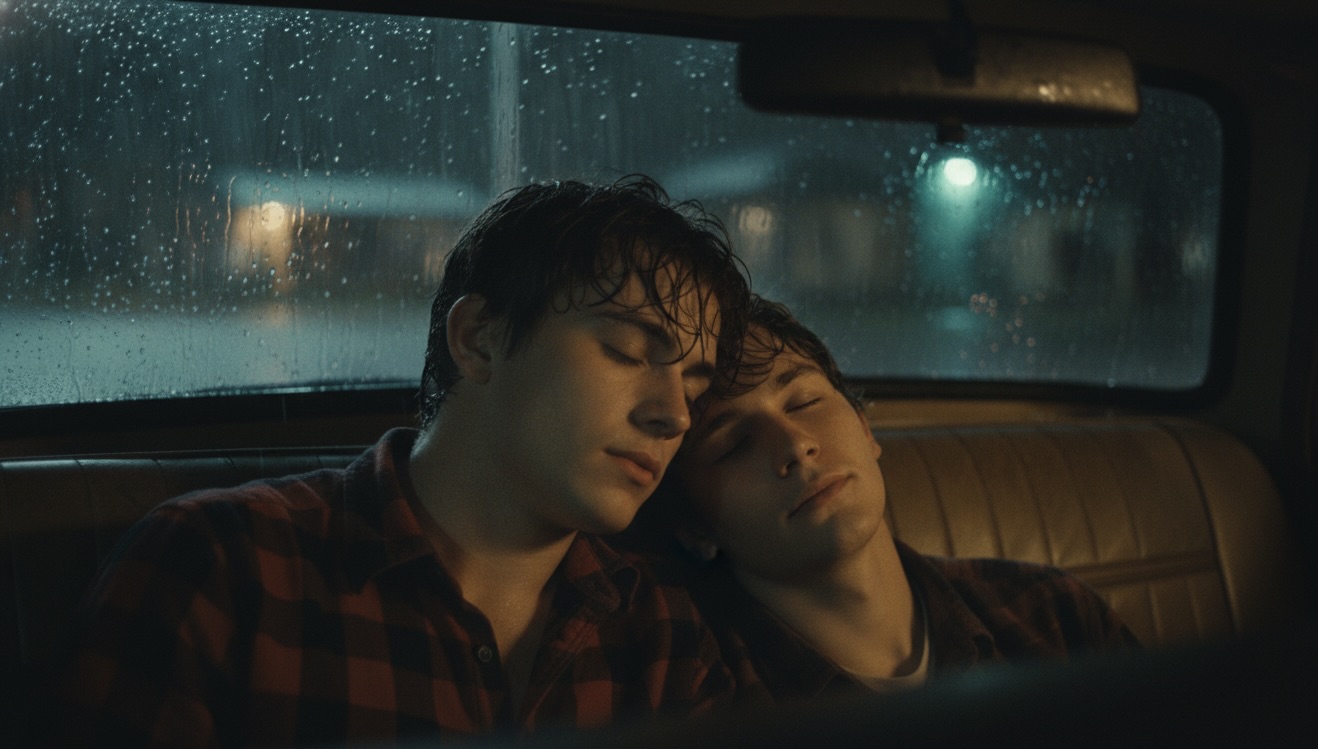
The setting in "The Late Shortcut" is not a passive backdrop but an active participant in the story's psychological drama. The truck cab functions as a powerful symbol of the relationship itself: a small, intimate space that can be either a sanctuary or a pressure cooker. Initially, it is a shared space, but after the crash, it becomes a container for unspoken tension, with the fogging windows physically representing the lack of clarity between the two men. When Liam leaves, the cab transforms into a cage for Casey, amplifying his feelings of isolation and guilt. In the end, draped with the wool blanket, it becomes a "cocoon," a private, protected world where emotional honesty is finally possible.
The external environment—a deluge of freezing rain, sucking mud, and a desolate back road—is a direct reflection of the characters' internal chaos. The storm mirrors the emotional turmoil, and the physical struggle against the elements is a metaphor for their fight to navigate their own complex feelings. The mud is a physical manifestation of their predicament: it is messy, difficult to escape, and threatens to pull them under. By stepping out into this hostile environment, both characters engage in a physical struggle that eventually forces their internal one to the surface. The very name of the road, a "shortcut," becomes ironic, suggesting that the easy path—in relationships as in travel—is often the one that leads directly into crisis.
Aesthetic, Stylistic, & Symbolic Mechanics
The author's craft is evident in the deliberate use of sensory language and powerful symbolism to convey emotional depth. The prose is visceral and immediate, grounding the psychological tension in physical sensation. The story opens with a sound that vibrates "straight up through the floorboards and into Casey’s teeth," immediately implicating the reader in the physical shock. This attention to sensory detail continues throughout, from the "damp asphalt and pine rot" smell of the air to the taste of the kiss, described not romantically but with a raw realism as "rain and copper and stale coffee." This stylistic choice prevents the story from becoming overly sentimental, rooting its emotional climax in a messy, tangible reality.
Symbolism is woven deeply into the narrative fabric. The disabled truck, listing sadly in the mud, is a clear metaphor for their relationship at its breaking point—functional, but damaged and stuck. The contrast between Liam's "rough, scarred hands" and Casey's "soft, ink-stained" ones is a potent visual shorthand for their perceived roles and Casey's feelings of inadequacy. The spilled lug nuts are the most crucial symbol; they are small, easily lost, yet essential components. Their loss represents the moment Casey believes he has irrevocably broken things, yet Liam's revelation that he had already secured enough of them underscores the central theme: the situation was never as hopeless as Casey’s anxiety-ridden perspective made it seem.
Cultural & Intertextual Context
"The Late Shortcut" situates itself within a contemporary exploration of masculinity that seeks to deconstruct traditional archetypes. Liam embodies the "strong, silent type," a figure lionized in much of Western culture, from the cinematic cowboy to the stoic family man. However, the story subverts this archetype by exposing the immense vulnerability and fear that such a rigid persona conceals. It argues that this form of masculinity is not only emotionally stunting for the man performing it but also deeply damaging to his relationships. Casey, with his artistic sensibility and emotional transparency, represents a softer masculinity that is often culturally coded as weak or ineffectual, a perception he has clearly internalized.
The narrative employs the well-established literary trope of "forced proximity," using the broken-down truck to trap the characters together until they are forced to confront their issues. This structure has echoes in countless stories, but here it is used with psychological acuity to strip away social masks. Furthermore, the story resonates with a lineage of literature that explores intense, fraught relationships in isolated, often harsh, rural settings. It shares a certain atmospheric DNA with works that contrast the ruggedness of the landscape with the fragility of the human heart, suggesting that it is only in such stripped-down environments, away from the distractions of the world, that a profound and difficult truth can finally be spoken.
Reader Reflection: What Lingers
What lingers long after reading this chapter is not the drama of the crash, but the profound quiet of its resolution. The emotional afterimage is one of immense relief and a fragile, newfound warmth. The story leaves the reader contemplating the devastating power of assumption. It provokes a self-examination of all the times we have projected our own insecurities onto the silence of others, interpreting a lack of words as condemnation when it might have been fear, exhaustion, or simply a struggle to find the right ones.
The central question that remains is how this raw, vulnerable honesty will alter the dynamic between Liam and Casey moving forward. The crisis has broken something open, but the patterns of a relationship are deeply ingrained. The narrative doesn't resolve their future; it simply delivers them to a new beginning, a place of truth forged in mud and rain. It reshapes a reader's understanding of strength, locating it not in Liam's physical competence or stoicism, but in his final, trembling admission: "I can't lose you." This confession, a statement of absolute dependence, is presented as the most courageous act of all.
Conclusion
In the end, "The Late Shortcut" is not a story about a broken truck, but about a broken silence. The physical accident serves as the necessary catalyst for an emotional breakthrough, demonstrating that sometimes the only way forward is to become completely, hopelessly stuck. Its narrative journey suggests that the most perilous shortcuts are the emotional ones we take to avoid vulnerability. The apocalypse of the moment—the shredded tire, the lost nuts, the freezing rain—is less an ending than a moment of radical, transformative recognition for its characters and a resonant lesson for its reader.
Share This Analysis


