Introduction
"Beneath the Scarlet Canopy" presents a finely wrought portrait of adolescent ennui and the quiet desperation for transcendent experience. The chapter functions as an exploration of the psychological landscape where the mundane realities of suburban life collide with the boundless territories of a youthful imagination.
Thematic, Genre & Narrative Analysis
The chapter operates within the coming-of-age genre, using a slice-of-life framework to explore profound existential themes. Its central tension is the conflict between stasis and movement, between the suffocating familiarity of the known world and the terrifying, thrilling promise of the unknown. The narrative is driven by a deep-seated desire for escape, not merely from the physical chore of raking leaves, but from a perceived destiny of monotonous repetition. This is a story about the search for meaning in a world that feels drained of it, where even the sky looks "tired." The narrative voice, belonging to Toby, is a crucial element in establishing this mood. We are confined to his perception, experiencing his world through a lens of melancholic self-awareness and dramatic hyperbole. His reliability is purely emotional; what he feels is true, even if his description of the backyard as a prison is an exaggeration. This limited perspective makes the arrival of an external catalyst not just an event in the plot, but a fundamental shift in the consciousness of the story itself. The unsaid elements—the nature of the boys' deeper relationship, the history of their friendship—create a rich subtext that gives their simple interactions significant weight. Morally, the chapter subtly questions the virtue of domestic duty when it stifles the human spirit. Toby's abandonment of his chore is not presented as delinquency, but as a necessary act of self-preservation, a choice to pursue a moment of potential wonder over the certainty of completing a meaningless task.
Character Deep Dive
The narrative is built upon the psychological interplay between its two central figures, Toby and Oliver, who represent opposing but complementary modes of being. Their dynamic forms the core of the chapter's emotional and narrative momentum.
Toby
Psychological State: Toby exists in a state of acute existential dissatisfaction, a condition common in adolescence where the world feels both overwhelmingly large and constrictingly small. His internal monologue reveals a mind that is simultaneously imaginative and cynical, capable of dreaming up hot air balloons while also sarcastically cataloging his own "existential dread." He is trapped in a feedback loop of observation and negative interpretation; the squirrel's chitter is a "critique," the stubborn leaf "mocked" him. This constant personification of his environment indicates a deep sense of being watched and judged by a world that seems to conspire in his entrapment. His emotional state is volatile, swinging from dramatic, fog-producing sighs of despair to a "hopeful flutter" of the heart at the slightest possibility of change, revealing a powerful underlying wellspring of hope that his cynicism has not managed to extinguish.
Mental Health Assessment: From a clinical perspective, Toby exhibits symptoms consistent with situational depression or dysthymia, characterized by a pervasive low mood, anhedonia (the inability to feel pleasure from normally enjoyable activities), and feelings of hopelessness. His self-deprecating humor and intellectualization of his misery ("the lost civilisation of Toby") are sophisticated coping mechanisms used to manage and distance himself from the raw pain of his boredom. However, his imaginative capacity and his immediate, positive response to social connection with Oliver suggest a high degree of psychological resilience. He is not fundamentally broken, but rather a sensitive individual struggling with the developmental task of finding his place and purpose in a world he perceives as mundane.
Motivations & Drivers: Toby's primary motivation is escape. This desire is not merely for a change of scenery but for a change in his state of being. He wants to be transported from a world of passive obligation to one of active discovery. The map with "Here Be Dragons" is a potent symbol for this drive; he craves a world where mystery is still possible, where not everything has been explained, sanitized, and fenced in. Oliver's arrival provides a tangible, immediate focus for this abstract longing. The vague promise of "something" is enough to override his inertia, demonstrating that his deepest driver is not just to be elsewhere, but to share an experience that validates his belief that there is more to the world than meets the eye.
Hopes & Fears: At his core, Toby hopes for confirmation that his life is not as small as it feels. He hopes that the world contains genuine magic, mystery, and adventure just beyond the borders of his perception. His fantasy of the hot air balloon is a hope for agency and radical freedom. Conversely, his greatest fear is insignificance—the fear that his entire existence will be defined by the "never-ending cycle of the same old, brown stuff." He is terrified of being "swallowed by the mundane," much like the stone he tosses into the leaf pile. This fear is amplified by a social anxiety, a mortification at the thought of his immense longing being exposed and judged, which is why he cannot look at Oliver directly after his friend provides the very lifeline he was desperate for.
Oliver
Psychological State: In stark contrast to Toby, Oliver presents a psychological state of calm, grounded presence. He is a character of observation rather than internal monologue, his interiority conveyed through posture, gesture, and spare, deliberate speech. His patience and quiet curiosity suggest a mind that is comfortable with stillness and silence, unlike Toby's, which buzzes with a "chaotic swarm" of thoughts. His presence is described as a "warm blanket," indicating that he provides a sense of safety and regulation for Toby's more anxious temperament. He seems to exist in a more direct relationship with the physical world, noticing a piece of bark or a crushed can not as a symbol of decay or meaninglessness, but as a thing in itself, a potential starting point for action.
Mental Health Assessment: Oliver appears to be an emotionally well-regulated and secure individual. His economy of speech and movement points to a deep-seated self-confidence; he does not need to perform or over-explain himself. His ability to appear at precisely the moment Toby is spiraling suggests a high degree of empathy and social intuition. He understands his friend's needs without requiring an explicit declaration. This quiet strength and stability make him a grounding force. There are no textual indicators of any significant mental health struggles; instead, he projects a sense of purpose and centeredness that serves as an anchor for the narrative and for Toby.
Motivations & Drivers: Oliver's motivation in this chapter is simple and direct: to share a discovery. He is driven by curiosity and the implicit desire for companionship in adventure. His actions are not born of desperation, like Toby's, but from a place of active engagement with his environment. He saw "something," and his natural impulse was to investigate it with his friend. This suggests that his primary driver is connection and shared experience. He does not offer a grand escape plan, but a small, concrete step into the unknown, understanding that this is a more powerful and achievable catalyst for change than a fantasy of a hot air balloon.
Hopes & Fears: Oliver's hopes and fears are much less transparent than Toby's, as we are not privy to his thoughts. We can infer his hopes through his actions: he hopes to explore, to discover, and to share that discovery. His hope is invested in the tangible world and the potential it holds. The fleeting touch of his hand against Toby's could suggest a hope for a deeper connection, a moment of shared, unspoken understanding. His fears remain entirely submerged in the text, which is part of his power as a character. He embodies a kind of fearless presence, making him the ideal guide to lead Toby away from his own anxieties and into the world.
Emotional Architecture
The chapter's emotional architecture is meticulously constructed, guiding the reader from a state of oppressive melancholy to one of thrilling anticipation. The narrative begins at a low emotional ebb, steeped in Toby’s languor. The pacing is slow, mirroring the drudgery of his task, and the sensory details are muted—brown leaves, grey fences, a tired sky. The author uses Toby’s internal monologue to build a palpable sense of confinement, with each sigh and cynical thought adding another layer to the emotional weight. The arrival of Oliver marks a critical inflection point. The narrative’s pacing deliberately slows further, creating a moment of charged stillness. The focus shifts from Toby’s chaotic inner world to the quiet, external details of Oliver’s presence—the tilt of his head, the crunch of leaves under his sneakers. This shift in focus calms the emotional turbulence, replacing anxiety with a gentle curiosity. The emotional temperature begins to rise with Oliver’s two simple words: "Saw something." This phrase acts as a narrative defibrillator, jolting both Toby and the reader. The tension builds not through action, but through dialogue and suggestion, culminating in the unspoken question hanging between the boys. The fleeting, physical contact—a hand brushing against another—provides a small but powerful release of this built-up energy, a spark of warmth and connection that solidifies their pact. The final paragraphs see the emotional tone lift completely into one of promise and forward momentum, the crisp air no longer a cage but a possibility.
Spatial & Environmental Psychology
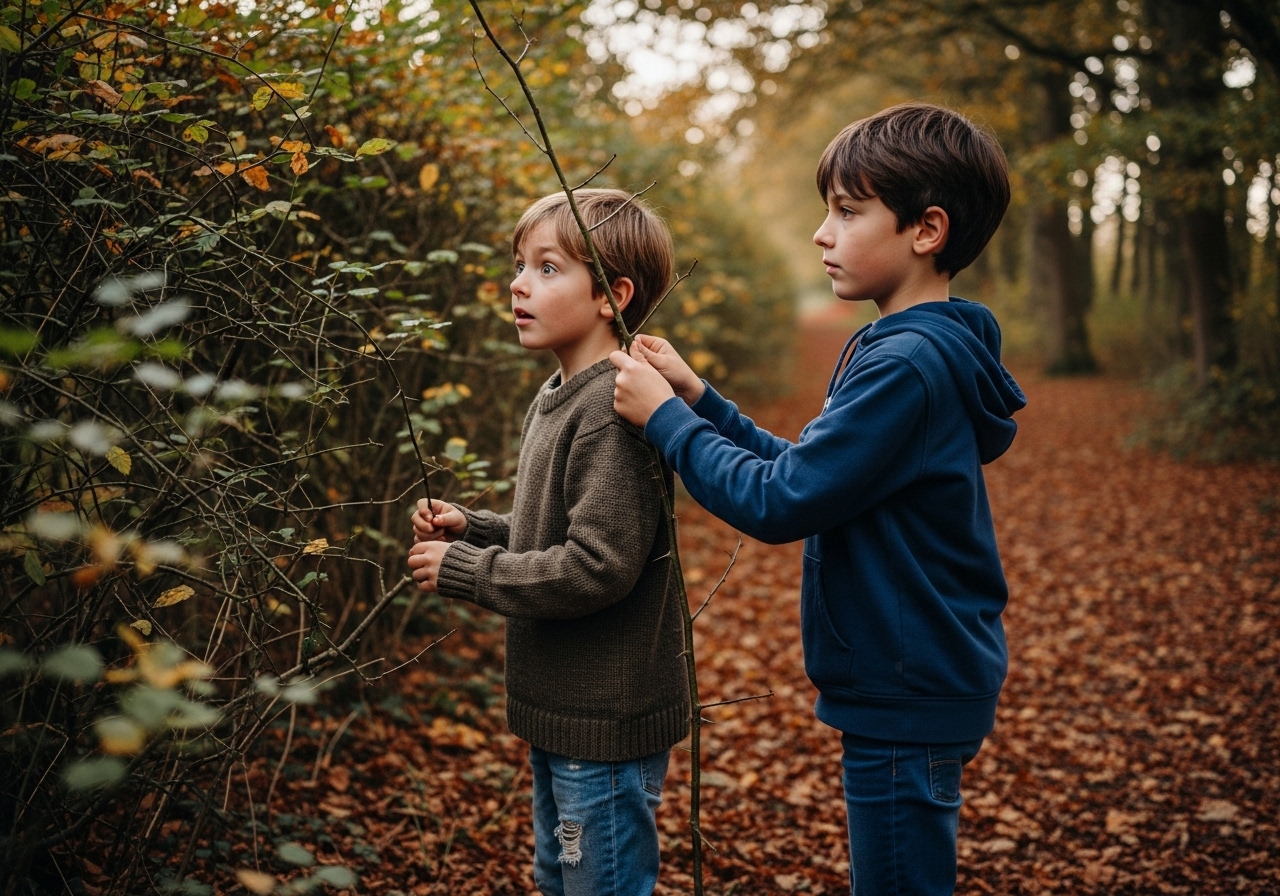
The physical spaces in the chapter are not mere backdrops; they are potent extensions of the characters' psychological states. Toby's backyard is a carefully rendered psychological prison. The "never-ending cycle" of leaves mirrors his internal feeling of being trapped in a loop of meaningless activity. The fence is a stark, physical manifestation of his confinement, a boundary separating his manicured, predictable world from the "dark, tangled" woods that represent the wildness and mystery he craves. The yard is a space of domestic obligation, a tamed and ordered environment that stands in direct opposition to his chaotic and imaginative inner life. In contrast, the "liminal space" on the other side of the hawthorn hedge represents a crucial psychological threshold. It is neither the sanitized suburbia of the yard nor the deep wilderness of the woods, but a neglected in-between zone. Stepping into this space is a symbolic act of transgression, of leaving the known world behind. The uneven ground, the prickling thorns, and the faded soda can are all details that signify a world less controlled and more authentic. This environment reflects the boys' transition from a state of passive boredom to one of active exploration. As they move deeper and the trees form a canopy, the space becomes more enclosed yet feels more expansive, symbolizing a journey inward as much as outward—a plunge into a shared, secret world of their own making.
Aesthetic, Stylistic, & Symbolic Mechanics
The author’s craft is evident in the precise and evocative prose, which uses sensory detail and symbolic imagery to construct the chapter's mood and meaning. The style is grounded in a realism that makes Toby’s imaginative flights feel all the more poignant. Sentence rhythms mirror Toby's state of mind; in the beginning, they are laden with clauses that reflect his weary, rambling thoughts, but they become shorter and more declarative as his focus shifts to Oliver and the promise of adventure. Diction is carefully chosen, with words like "skeletal," "weary," and "mundane" painting a portrait of decay and stagnation, which is then pierced by the sudden energy of words like "flutter," "jolt," and "spark." Several key symbols anchor the chapter’s themes. The single, "deep crimson" oak leaf clinging to the maple tree is a powerful symbol of defiance and spirit, everything Toby feels he lacks. It represents a refusal to succumb to the inevitable cycle of falling and decay. The rake is an extension of his servitude, a "reluctant companion" in his drudgery. The hawthorn hedge serves as the classic archetypal barrier between the ordinary world and the world of adventure, a thorny passage that must be navigated to begin the quest. Finally, Oliver's minimalist speech—"Saw something"—functions as a symbolic key, a piece of language that unlocks the narrative and propels it into a new, more mysterious territory.
Cultural & Intertextual Context
This chapter is deeply rooted in the cultural and literary archetype of the American suburban coming-of-age story. It echoes the thematic concerns of works like Stephen King's "The Body" (adapted as the film Stand by Me), where the oppressive boredom of small-town life serves as the crucible for a formative journey into the wilderness. The dynamic between the introspective, anxious narrator (Toby) and the quiet, confident leader (Oliver) is a classic pairing in this genre, representing the two halves of a single adolescent consciousness grappling with the world. The reference to old maps where "Here Be Dragons" places Toby's personal longing within a grand historical context of exploration and the human desire to chart the unknown. This intertextual link elevates his backyard ennui from a personal complaint to a universal human experience. Furthermore, the woods as a space of transformation and testing is a motif that stretches back through fairy tales and mythology, from Hansel and Gretel to the epic quests of folklore. The chapter taps into this rich cultural vein, suggesting that the journey to the old mill is not just a walk in the woods, but a small, modern iteration of an ancient, archetypal quest.
Reader Reflection: What Lingers
What lingers long after reading this chapter is not the plot, but the palpable feeling of a threshold being crossed. The narrative leaves the reader in a state of suspended anticipation, sharing in Toby's sudden, buoyant hope. The story masterfully captures that specific, electric moment in youth when the world cracks open and reveals a hidden path. The "something" at the old mill remains a tantalizing mystery, forcing the reader to inhabit the space of pure potential alongside the characters. The chapter doesn't resolve Toby's existential dread, but it suggests a powerful antidote: shared curiosity and the courage to step off the concrete path. The emotional afterimage is one of quiet exhilaration, a reminder of the profound power of a single, transformative moment and the friend who helps you see it. It leaves one contemplating the fences in one's own life and wondering what might lie just on the other side, waiting to be noticed.
Conclusion
In the end, "Beneath the Scarlet Canopy" is not a story about escaping a place, but about re-enchanting it. It is a narrative about perception, demonstrating how the most mundane landscape can be transformed into a realm of infinite possibility through a simple shift in focus. The chapter’s power lies in its quiet intimacy, capturing the precise moment when adolescent despair is transfigured into hopeful purpose by the catalyst of friendship and the promise of a shared secret. It is a testament to the idea that the greatest adventures often begin not with a grand departure, but with a whisper from just beyond the fence.
Share This Analysis


