Introduction
"A Filament Glows in the Gloom" presents a psychological tapestry woven from the disparate threads of four solitary lives on the cusp of a modern Christmas season. What follows is an exploration of the chapter's thematic architecture, examining how it uses the festive backdrop to explore profound states of alienation, anxiety, and the fragile search for authentic meaning.
Thematic, Genre & Narrative Analysis
This chapter operates within the genre of psychological realism, using the encroaching holiday season as a crucible for its characters' internal struggles. The overarching theme is the profound disconnect between mandated seasonal cheer and the complex, often melancholic, realities of individual lives. The narrative voice, a close third-person that shifts between four distinct consciousnesses, masterfully constructs a sense of shared isolation. Though the characters are strangers, their experiences rhyme, creating a polyphonic portrait of a city's quiet anxieties. The narrator is limited to each character's immediate perceptions, revealing their unique blind spots and preoccupations; Marcus sees the city as an abstract grid from his perch, while Liam experiences it as a series of economic obstacles. This perceptual fragmentation underscores their solitude. The story poses an existential question: in a world saturated with manufactured sentiment, how does one locate genuine warmth or meaning? The narrative suggests that true feeling resides not in the grand, commercialized gestures, but in the small, private moments of observation, memory, and sacrifice—the "phantom limb ache," the longing for proper chai, the calculation for a child's chocolate Santa. The chapter's conclusion, however, pivots subtly, introducing a note of uncanny dread that suggests the story may be expanding beyond realism into a more speculative or folk-horror territory, where the true "deeper winter" is not merely meteorological but something far more ancient and unsettling.
Character Deep Dive
The power of the chapter resides in its intimate and empathetic rendering of its four central figures, each navigating the season from a place of profound internal conflict. Their individual journeys form the emotional core of the narrative.
Marcus
His psychological state is one of profound detachment and melancholic resignation. He exists as an observer, separated from the flow of life by the cold glass of his fifth-floor window. This separation provides a "thin peace," a defense against a pain he cannot fully articulate but feels as a "phantom limb ache." The detail of his lukewarm tea tasting "like nothing" is a potent signifier of anhedonia, a diminished ability to experience pleasure that often accompanies a depressive state. He is suspended in a kind of emotional twilight, where the quiet is not peaceful but an "echo chamber" for his own stillness.
His overall mental health appears fragile, suggesting a long-term struggle with what might be diagnosed as persistent depressive disorder, exacerbated by seasonal triggers. His primary coping mechanism is withdrawal, transforming his apartment into a sanctuary that also functions as a self-imposed prison. The memories of boisterous past Christmases are not comforting but serve as painful reminders of a warmth that is no longer present. His resilience is low; the peace he cultivates is "easily pierced," indicating that his emotional defenses are brittle and his solitude is less a choice than a retreat from the overwhelming pain of engagement.
In this chapter, his motivation is primarily passive: to endure. He does not seek connection or joy but rather the absence of pain. He watches the bus and wonders where others are going, not with longing, but with the detached curiosity of a naturalist observing a different species. His deeper driver is the management of loss. By refusing to participate in the "performance" of the season, he attempts to control the inevitable pangs of memory and grief that it evokes.
His hopes are modest, almost non-existent; he hopes for the continuation of his quiet, uneventful existence. His fears, however, are more potent. He fears the sharp, intrusive nature of memory and emotion. He is not afraid of being alone, but of being reminded of what it felt like not to be. The haphazardly lit tree across the street, a "small defiance," represents the very thing he fears: a fragile, imperfect, yet persistent flicker of hope that threatens to illuminate the true depth of his own gloom.
Priya
She is in a state of acute psychological overwhelm, caught in the crosscurrents of academic pressure and familial expectation. Her mind is a "chaotic tangle" of thermodynamics and saccharine Christmas carols, a perfect metaphor for the dissonance between her internal reality and the external demands placed upon her. The mall food court, a space of manufactured jollity and sensory overload, is the external manifestation of her inner turmoil. She is exhausted by the performance required of her—the need to be both a diligent student and a "cheerfully festive" daughter.
Her mental health is clearly strained, exhibiting classic symptoms of academic burnout and high-functioning anxiety. The pressure to succeed is immense, and the holiday season, rather than offering respite, adds another layer of social and emotional obligation. Her desire to escape to a "quiet corner" with "proper chai" reveals a deep need for authenticity and peace in a world that feels increasingly artificial. Her coping mechanism is a form of mental withdrawal, her eyes drifting from her textbook as her mind seeks refuge from the relentless stimuli.
Her immediate motivation is to find a moment of genuine peace, to escape the performance. The text from her study group, "Are you coming?", is an intrusion, another demand on her depleted resources. Her deeper driver is a yearning to reconnect with a more authentic version of herself and her feelings. The memory of the "uncomplicated joy" of a childhood Christmas represents a state of being she feels has been lost to the "general grind of adulting."
Priya hopes to reclaim a sense of innocent belief and warmth, to feel something real amidst the manufactured emotions of the season. Her greatest fear is that she has lost this capacity forever, that she will be permanently trapped in a cycle of performance, unable to meet the endless expectations without sacrificing her own well-being. She fears that the person she is becoming—stressed, tired, and cynical—is an irreversible departure from the person she once was and wishes to be again.
Liam
Liam's psychological state is defined by a pervasive and grinding anxiety, rooted entirely in his financial precarity. The supermarket, a space of abundance for some, is for him a landscape of difficult choices and constant calculation. Every item, from potatoes to a frozen turkey, is weighed not just in his hand but against the competing needs of his family—rent, car tires, and the intangible but powerful desire for his daughter's happiness. He moves through the world with his "knuckles white," a physical manifestation of his tightly controlled stress.
His mental health is under significant duress due to chronic financial strain, a condition that the holidays severely exacerbate. The season transforms everyday economic pressures into a measure of his worth as a father and provider, leading to a "dull ache" of inadequacy. His resilience is sourced directly from his love for his family. The thought of his daughter Maya's joy is the singular force that allows him to push through the guilt and stress. This focus provides him with a purpose that transcends the grim arithmetic of his budget.
His primary motivation is to fulfill his role as a provider and to create a moment of pure, magical happiness for his child. The chocolate Santa becomes a potent symbol of this goal—a small, affordable luxury that can deliver an outsized emotional payoff. His deeper driver is the need to shield his children from the harsh realities he faces daily, to preserve their innocence and joy even at the cost of his own peace of mind.
Liam's hope is beautifully simple and profoundly moving: he hopes to witness the "flicker of pure, unadulterated joy" on his daughter's face. This single image is his emotional anchor. His corresponding fear is failure. He fears that his financial limitations will translate into a tangible disappointment for his family, that he will be unable to provide the kind of holiday he believes they deserve. The laughing couple with their overflowing basket of gourmet foods is a painful mirror reflecting his own perceived shortcomings.
Isabella
Isabella’s psychological state is one of artistic contemplation and heightened sensitivity. Unlike Marcus, her observation is an active, creative process. She sits in the cold not to withdraw, but to engage, sketching to capture the "deeper truth" in the "bizarre juxtaposition" of industrial grit and festive tinsel. She is attuned to the paradoxes of her environment, finding a "resilient beauty" in the artificial lights on the skeletal iron tree.
Her mental health appears robust, characterized by a capacity for finding meaning and beauty in her surroundings. However, her artistic sensitivity seems to bleed into a kind of preternatural intuition. The chapter's final paragraphs document a significant shift in her perception, from aesthetic appreciation to a "vague unease" and a "strange, cold pull." This suggests she is either exceptionally perceptive of a subtle atmospheric change or potentially vulnerable to a more ominous, paranoid interpretation of reality.
Her motivation is to see beyond the surface, to understand and capture the essence of her city at this specific moment in time. She is driven by a creative and philosophical curiosity about how meaning is constructed, how something "real" can be "born from something entirely fabricated." She seeks the authentic spirit layered beneath the artifice.
Initially, her hopes are artistic—to successfully render the scene before her. By the end of her section, however, a new and unsettling fear begins to crystallize. She grows afraid of an unknown, unseen force, something "far older, far more potent" than the festive cheer. Her fear is not personal in the way of the other characters; it is vast, elemental, and existential. She fears that the collective preparations of the city are not for Christmas, but for some other, more ancient and powerful event, a "rhythm beneath the ice, waiting."
Emotional Architecture
The chapter constructs its emotional landscape with meticulous care, building a pervasive atmosphere of quiet melancholy punctuated by moments of sharp anxiety and, finally, a turn towards uncanny dread. The emotional temperature is kept deliberately low and steady through the first three sections. This is achieved through sensory details that connote lack or insufficiency: Marcus’s "lukewarm tea," Priya’s "bitter" coffee, the "damp" air of the produce aisle. The pacing is slow and meditative, mirroring the internal, ruminative states of the characters. The narrative withholds catharsis, instead allowing feelings of loneliness, stress, and inadequacy to settle and steep, transferring this low-grade ache to the reader. The emotional architecture invites empathy through shared vulnerability rather than dramatic events. The shift occurs with Isabella. Her section begins with the same contemplative tone but gradually builds a sense of unease. The emotion transitions from the personal and psychological to the atmospheric and existential. The "bruised violet" sky, the "skeletal" tree, and the final image of the "ancient cold" raise the emotional stakes, transforming the quiet sadness of the preceding sections into a foundation for a looming, undefined horror. The chapter’s emotional power lies in this final, masterful pivot from the familiar pains of modern life to the suggestion of a far greater, more primal threat.
Spatial & Environmental Psychology
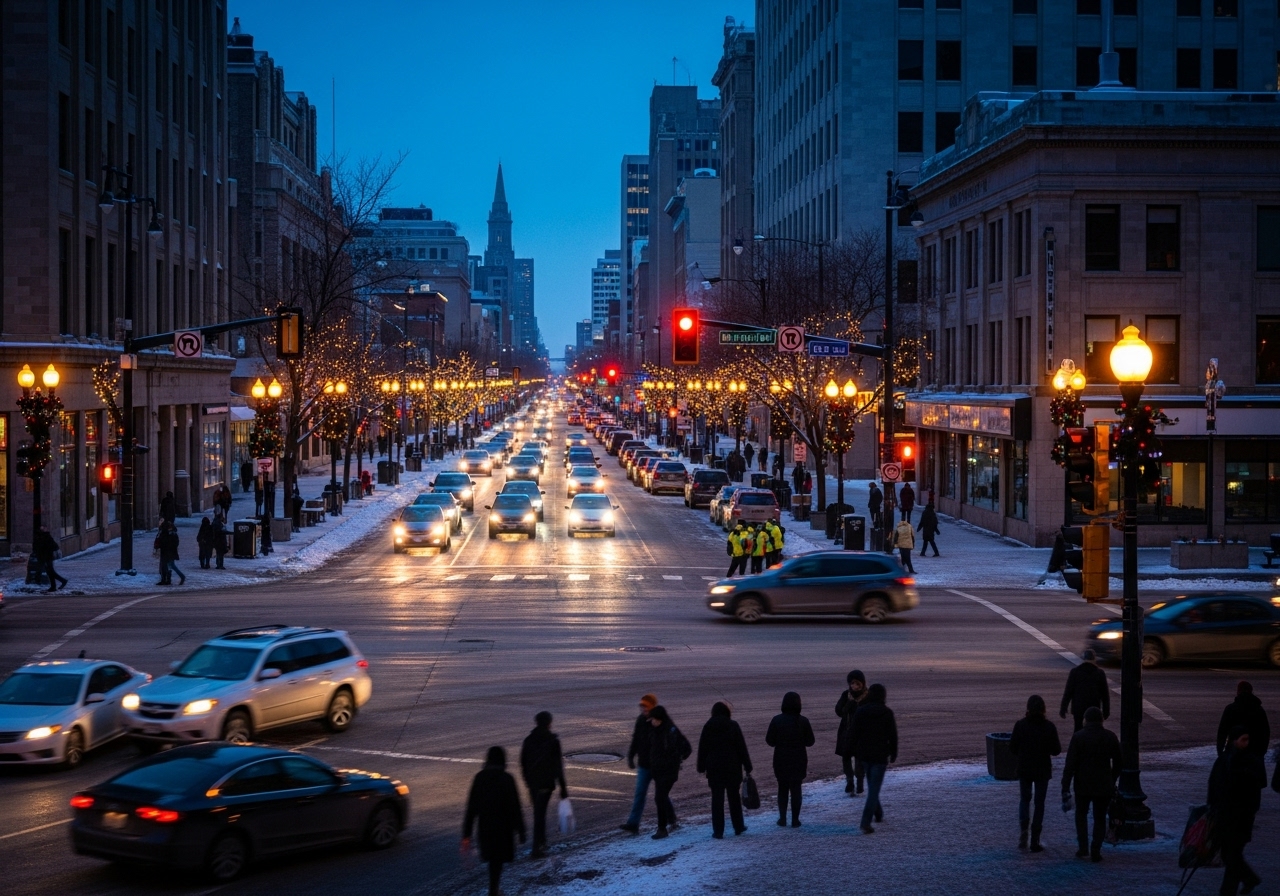
The physical spaces in this chapter are not mere backdrops; they are active extensions of the characters' inner worlds, reflecting and amplifying their psychological states. Marcus's fifth-floor apartment is a literal ivory tower of isolation. Its height provides him with a detached, god-like perspective on the city, but also reinforces his complete separation from the life teeming below. The windowpane is a crucial boundary, a membrane between his sterile interior and the messy, vibrant world he observes but cannot join. In stark contrast, Priya is immersed in the St. Vital Centre food court, a non-space of pure commercial transaction and sensory overload. The cacophony of noise, glitter, and forced cheer mirrors her own internal chaos and the overwhelming pressure she feels. It is a space designed to promote consumption, not contemplation, and it actively works against her desire for quiet authenticity. For Liam, the Superstore is an arena of economic combat. The aisles represent a gauntlet of temptations and trade-offs, where every choice is fraught with financial anxiety. The "pyramids of clementines" and "icy sarcophagi" of frozen turkeys are not just products but symbols of an abundance that is just out of his reach, intensifying his feelings of inadequacy. Finally, Isabella's Old Market Square is a liminal space where history, industry, and artifice collide. The "skeletal iron tree"—an industrial object adorned with ephemeral light—perfectly encapsulates the chapter's central theme. This environment, a blend of the permanent and the transient, the real and the fabricated, becomes the perfect stage for her perception to slide from the aesthetic to the uncanny, as if the history etched into the old brick buildings is finally beginning to stir.
Aesthetic, Stylistic, & Symbolic Mechanics
The prose of "A Filament Glows in the Gloom" is characterized by a precise and evocative restraint that mirrors the muted emotional states of its characters. The sentence rhythm is often contemplative, favoring complex sentences that follow the winding paths of internal thought, yet it can become short and sharp to punctuate a moment of anxiety, as with Liam's mental calculations. The diction is carefully chosen to create a consistent mood of melancholy and unease, with words like "muted," "succumbing," "haphazard," "phantom," and "skeletal" recurring in different contexts. This creates a subtle web of shared feeling that connects the disparate narrative threads. The central symbol, suggested by the title, is the fragile light against a vast darkness. This motif is repeated in various forms: the burnt-out bulbs on the coffee shop tree, the "fleeting glimpse" of the warm bus interior, the "warm white lights" on the cold iron tree, and the "flicker of pure, unadulterated joy" Liam seeks for his daughter. Each is a small point of luminescence, a "filament" threatened by the encroaching gloom of winter, loneliness, poverty, or a more elemental darkness. The recurring motif of lukewarm or bitter beverages serves as a potent symbol for the lack of satisfaction and vitality in the characters' lives, a constant reminder of a deeper thirst that cannot be quenched. The final image of the lights being "insufficient against the raw, ancient cold" brings the central symbolic tension to its climax, suggesting that the small human attempts at creating warmth may not be enough to hold back the coming dark.
Cultural & Intertextual Context
The chapter situates itself firmly within a literary tradition that interrogates the commercialization and social pressures of the Christmas holiday in the Western world. It echoes the quiet desperation found in the works of authors like Raymond Carver, where characters are trapped by economic and emotional circumstance, their inner lives rendered in spare, telling detail. The critique of "manufactured jollity" is a familiar cultural trope, yet the story revitalizes it by focusing on the specific, granular anxieties of its diverse characters rather than making a broad, satirical statement. The specific setting of Winnipeg is crucial. As a city known for its extreme winters and geographic isolation, it becomes an archetypal landscape for exploring themes of endurance, resilience, and the psychological weight of a long, dark season. The narrative's final turn, with Isabella's growing sense of dread, pulls from a different context entirely: that of folk horror and the weird tale. This evokes a sense of place-based animism, where the "frost-hardened earth" and the "ancient cold of the land" possess a consciousness and agency of their own. This blending of genres—moving from stark psychological realism to hints of the supernatural—recalls contemporary authors who blur such lines to explore modern anxieties, suggesting that our deepest fears are not just psychological but are tied to the land we inhabit and the histories we have forgotten.
Reader Reflection: What Lingers
What lingers long after reading this chapter is a profound sense of shared, silent humanity. The narrative masterfully connects four solitary individuals not through plot, but through a resonant emotional frequency. The reader is left with the quiet ache of Marcus's loneliness, the thrumming stress of Priya's obligations, the constant, low-grade panic of Liam's finances, and the final, chilling unease of Isabella's vision. The story does not resolve these tensions but allows them to hang in the cold December air, creating a powerful impression of the vast, unseen emotional life of a city. The most significant lingering question is the nature of the shift Isabella perceives. Is it a metaphor for a collective seasonal depression, a societal anxiety reaching a tipping point? Or is the narrative gesturing towards a literal, supernatural event? The ambiguity is the source of its power. The chapter reshapes a reader's perception of the festive season, encouraging a look beyond the glittering surfaces to the complex, often sorrowful, human realities humming just beneath. It is a reminder that for many, the brightest season is also the darkest, and that the world holds its breath for more reasons than just festive anticipation.
Conclusion
In the end, "A Filament Glows in the Gloom" is not a story about the coming of Christmas, but about the friction between internal reality and external performance. Its power lies in its quiet, empathetic observation of the small, private struggles that the noise of the season so often drowns out. The filament of the title is the fragile, individual consciousness of each character, glowing tenuously against the overwhelming gloom of personal history, societal pressure, and, perhaps, a darkness far more ancient than any holiday. The chapter is less a prelude to celebration than a moment of unsettling recognition, suggesting that the true heart of winter is not about light and cheer, but about what stirs in the encroaching cold.
Share This Analysis


