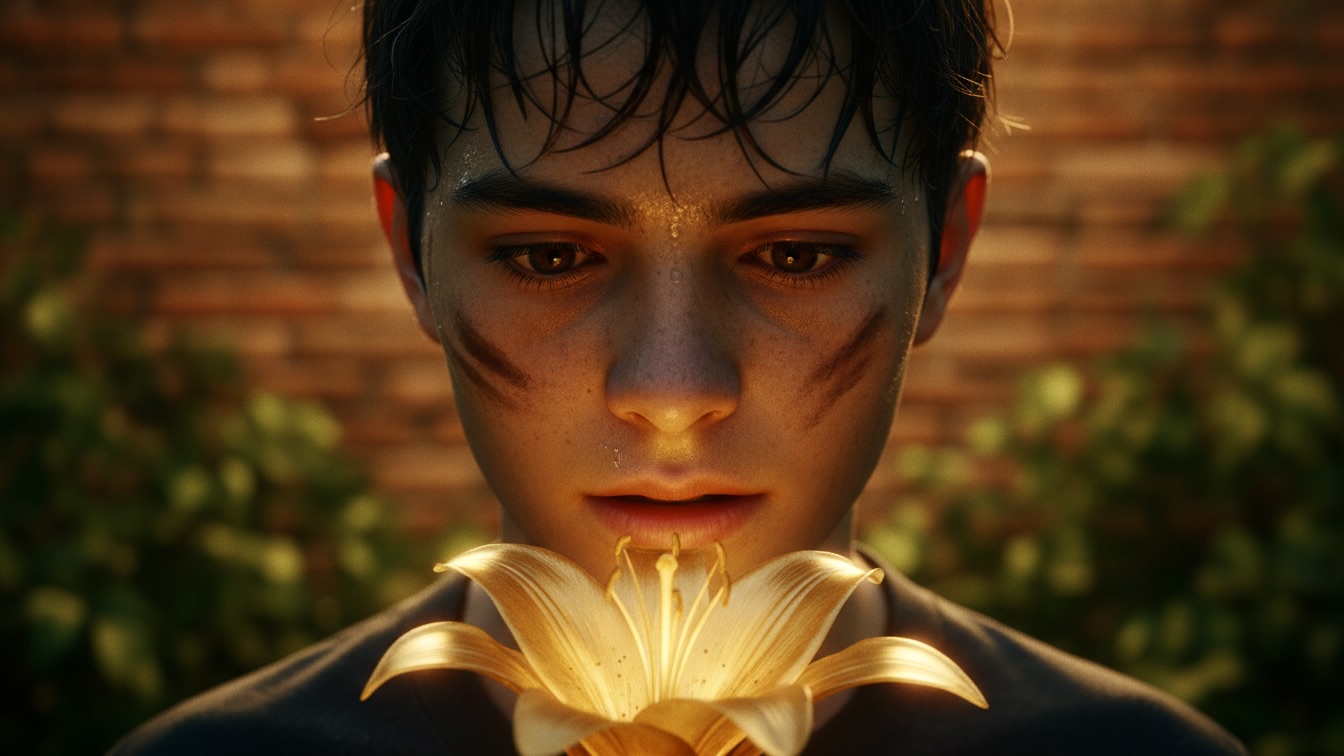
Format: Short Film / Anthology Episode | Est. Length: 10-12 minutes
Imagine a world where urban decay isn't just a social issue but a sentient, parasitic force known as "The Rot," and small pockets of magic—like the Hollow Garden—are the only lungs the city has left. This episode serves as a window into a broader anthology series where teenagers across a sprawling, oppressive metropolis discover that their emotional honesty is the literal fuel for the city's hidden supernatural ecosystems. As the characters navigate the pressures of late-stage adolescence, they realize that their internal mental health directly dictates the survival of the last green spaces on Earth.
In the middle of a record-breaking heatwave, three teenagers must get a magic flower to bloom for a grant application photo before the five o'clock deadline, but the garden is reacting to their hidden anxieties. The air is thick as soup, the water is cut off, and the plants are turning a bruised, metallic purple that signals an imminent collapse.
Three teenagers must reconcile their fractured friendship to save a magical urban garden from a parasitic force of decay. If they cannot achieve emotional honesty, the garden will die, and their only sanctuary from a harsh city will be lost forever.
The primary theme explores the intersection of environmentalism and mental health, suggesting that the health of our surroundings is a direct reflection of our internal emotional states. It posits that "professionalism" and the pressure to succeed can become a toxic barrier to genuine connection, which is the only true defense against cynicism.
The secondary theme focuses on the concept of "Urban Magic," where the supernatural is not found in ancient forests but in the cracks of the concrete. It highlights the resilience of youth and the idea that vulnerability is a form of power capable of purifying a corrupted environment.
For Daniel, the stakes are his identity as a leader and the survival of the arts collective; for Sam, failure means being sent to a windowless coding camp; for Mia, it represents the loss of her final connection to the city before a forced move. Ultimately, the survival of the Hollow Garden—a literal source of life-giving oxygen in a choked city—hangs in the balance of their ability to be vulnerable. If the garden fails, they lose their only safe haven and the proof that they can create something meaningful in a world that expects them to fail.
The external conflict is the oppressive heatwave and "The Rot," a physical manifestation of urban decay that feeds on negativity and stress. Internally, the characters struggle with the pressure of looming adulthood, financial instability, and the fear of failure, which causes them to lash out at each other rather than support one another. The "system"—represented by the grant committee and the city's water restrictions—acts as a secondary, impersonal antagonist that forces the characters into a high-pressure "professional" mold that stifles the very magic they are trying to protect.
Under a punishing July sun, Daniel, Sam, and Mia struggle to save the wilting Pulse-Lilies in their hidden urban garden before a crucial grant deadline passes. As the heat intensifies and the water supply fails, the trio’s suppressed personal anxieties—impending poverty, forced relocation, and academic pressure—begin to manifest as "The Rot," a dark sludge that threatens to consume the garden. Daniel’s attempt to manage the situation through rigid professionalism only worsens the decay, as the plants mirror the group's internal fractures.
Realizing that the garden feeds on their emotional state, the group abandons their "managerial" roles and engages in a raw, honest confrontation about their fears. This collective vulnerability triggers a supernatural response from the garden, restoring the water flow and causing the lilies to bloom in a spectacular display of golden light. Although they successfully submit the grant and repel the initial infection, a final discovery suggests that the Rot is evolving, setting the stage for a larger battle against the city's encroaching darkness.
Daniel: The self-appointed "manager" of the garden who masks his fear of being ordinary with a rigid, drill-sergeant persona. He views the garden as a resume-builder rather than a living entity, causing a disconnect that nearly kills the plants. By the end, he sheds his professional facade to admit his incompetence, shifting from a controlling leader to a vulnerable friend who understands that the team is the foundation, not the paperwork.
Sam: A high-strung tech-wizard who uses his tablet as a shield against the reality of his parents' expectations. He is terrified of a future trapped in a windowless basement, and his frantic energy acts as a conductor for the garden's stress. He begins as a vibrating mess and ends as a grounded participant who finds strength in physical labor and the shared silence of the bloom.
Mia: The emotional anchor of the group who recognizes the garden’s sentient nature but is paralyzed by her own family’s financial crisis. She is the first to realize that the "professional" approach is a scam and that the group’s legitimacy comes from their care for one another. She evolves from a quiet observer to the catalyst for the group’s collective confession, proving that emotional honesty is a survival skill.
Beat 1: The episode opens in the sweltering Hollow Garden where Daniel frantically tends to wilting Pulse-Lilies while Sam panics over a failing Wi-Fi signal and a looming 5:00 PM grant deadline. Mia warns them that the plants are absorbing their collective stress, but Daniel dismisses her, focusing instead on the dry copper spigot and the stifling, "soup-like" air. The tension peaks as the characters begin snapping at each other, their individual pressures boiling over in the oppressive heat as the lilies turn a bruised, toxic purple.
Beat 2: Mia forces the group to sit in the dirt and stop "fixing" things, leading to a series of raw confessions about their personal lives and fears regarding the future. As they admit to their struggles with poverty, parental pressure, and the fear of failure, the garden reacts to their honesty by finally releasing a torrent of crystalline water from the broken spigot. The trio revels in the miraculous, cold overflow, and the Pulse-Lilies begin to bloom in a radiant, golden light that clears the city's smog and provides a surge of pure oxygen.
Beat 3: The celebration is cut short when "The Rot"—a dark, oily manifestation of urban decay—erupts from the soil to choke the lilies in response to a sudden spike in Daniel's lingering anxiety. Daniel realizes they must use their newfound emotional connection as a shield, leading the group in a final, desperate round of even deeper truths to repel the shadows with a wave of silvery light. The episode ends with the grant submitted and the garden saved, though a final shot reveals a single black drop of Rot inside a new, white lily, hinting that the battle for the city's soul has only just begun.
The episode begins with a claustrophobic, high-anxiety atmosphere that mirrors the physical heat and the characters' internal repression. It transitions into a moment of cathartic relief during the water sequence, where the mood becomes briefly whimsical and celebratory. This is followed by a sharp descent into horror-tinged tension as the Rot attacks, before finally settling into a state of "exhausted hope," leaving the audience with a sense of hard-won peace tempered by the reality of ongoing struggle.
In a full season, the Hollow Garden would serve as the central hub for an underground network of "Green-Speakers" fighting the spread of the Rot across the city. Each episode would focus on a different urban location—a subway tunnel, a rooftop, an abandoned mall—where the environment reacts to the emotional health of the local community. The season-long narrative would track Daniel, Sam, and Mia as they investigate the source of the Rot, eventually discovering that it is being manufactured by a corporate entity that profits from the city's despair.
The thematic escalation would move from personal honesty to community action, as the trio recruits other teenagers to protect these magical pockets. The season finale would involve a massive "Bloom" event intended to purify the city's air, requiring a level of collective vulnerability that puts the characters' lives at risk. The overarching story explores the transition from individual survival to the responsibility of stewardship in a dying world.
The visual style should utilize high-contrast lighting to emphasize the oppressive heat, with a desaturated, dusty palette for the city that shifts into vibrant, bioluminescent golds and silvers when the garden blooms. Handheld camerawork should capture the initial frantic energy and the "claustrophobia" of the high-rises, transitioning to steady, wide shots as the characters find their center. The "Rot" should be depicted as a viscous, light-absorbing shadow that contrasts sharply with the translucent, glass-like texture of the Pulse-Lilies.
The tone is a blend of gritty urban realism and ethereal magical realism, similar to the "grounded wonder" found in films like Beasts of the Southern Wild or Pan’s Labyrinth. It should feel contemporary and urgent, using the supernatural elements not as a spectacle, but as a metaphor for the characters' internal lives. Tonal comparables include the "magical mundane" energy of Atlanta and the high-stakes teen camaraderie of Stranger Things.
This project targets the Young Adult (YA) and New Adult demographic (ages 16-25), specifically viewers interested in "solarpunk" aesthetics, environmental activism, and character-driven supernatural dramas. It appeals to audiences who enjoy stories about found families, the struggle for authenticity in a digital age, and the intersection of modern urban life with ancient, hidden magic.
The narrative follows a rapid, real-time progression to maximize the "ticking clock" tension of the 5:00 PM deadline. The first half is a slow-burn build-up of environmental and interpersonal pressure, using the heat as a physical weight to slow the characters' movements. The second half accelerates into a high-stakes climax as the Rot appears, with the final minutes providing a quiet, reflective denouement that allows the audience to breathe along with the characters.
The "Pulse-Lilies" and "The Rot" require a mix of practical puppetry and high-end CGI to ensure the supernatural elements feel grounded in the physical world. The lilies should have a physical presence that vibrates or hums, while the Rot’s movement should be fluid and unsettling, requiring careful integration with the practical soil and plants.
The water sequence from the copper spigot should be filmed with practical high-pressure rigs to achieve the "torrent" effect described in the text. Using specialized lighting within the water stream can simulate the "internal light" of the magical spring, reducing the reliance on post-production effects and enhancing the actors' interaction with the environment.


