Format: Short Film / Anthology Episode | Est. Length: 10-12 minutes
Imagine a world where the internal becomes external—a town called Somberville where dreams leak into reality, leaving physical residue on the floorboards. This story serves as a standalone entry in an anthology series titled Somberville Manifest, which explores the psychological manifestations of a community under pressure, where the prestigious "Dream Weaver Academy" serves as both a beacon of hope and a source of crushing, literal nightmares. Each episode follows a different resident as their subconscious leaks into the streets, forcing them to confront the physical consequences of their repressed emotions.
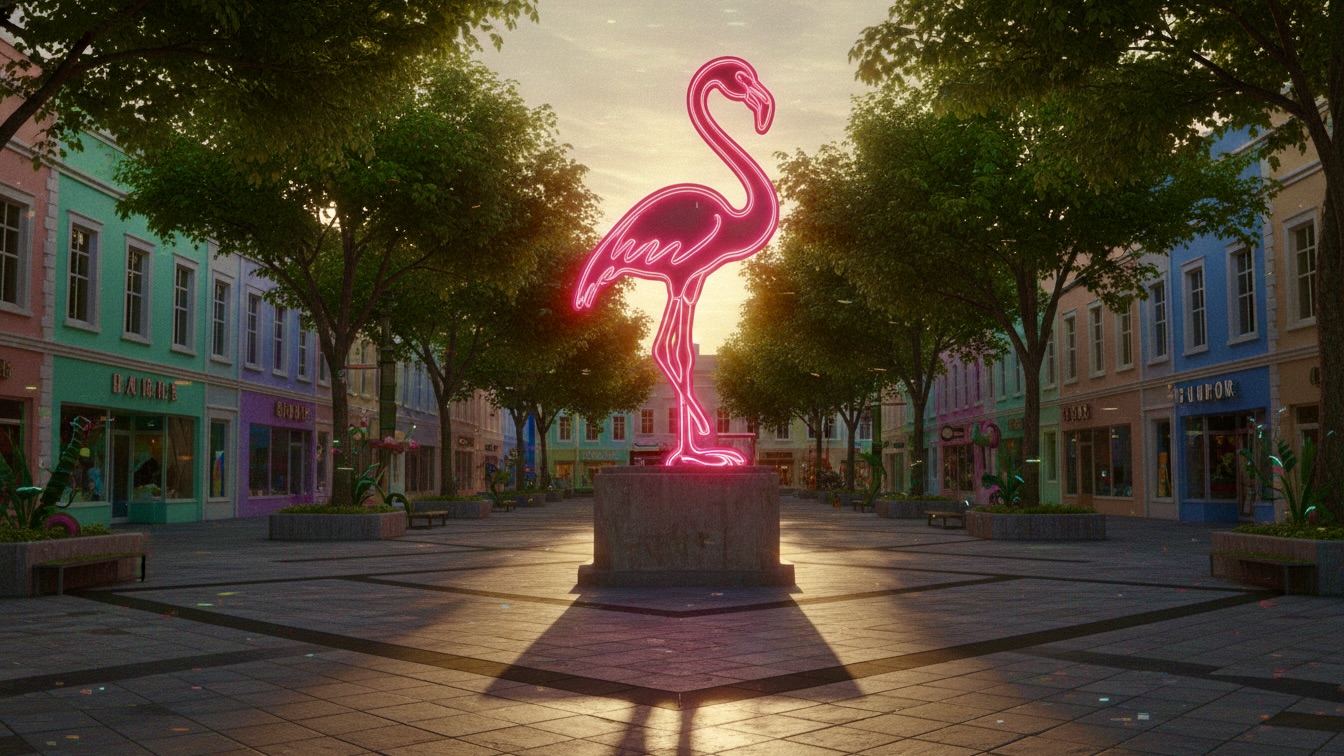
Peter wakes up with a "nightmare hangover" to find her bedroom floor covered in glowing pink glass shards and the town's thirty-foot neon mascot, Pinky the Flamingo, missing from its pedestal.
When a high-achieving student’s anxiety manifests as a shadow monster that steals the town’s massive neon mascot, she must recover the bird before the police discover her subconscious is a thief. Failure means losing her future at the prestigious Dream Weaver Academy and remaining trapped in a town where nightmares leave physical scars.
The primary theme is the physical manifestation of repressed anxiety and the high cost of perfectionism. It explores how internal pressure, if left unaddressed, can become a destructive external force that impacts not just the individual, but the entire community, suggesting that mental health is a public reality rather than a private secret.
The second theme focuses on self-acceptance and the integration of the "shadow self." Peter’s journey is not about defeating her monster, but acknowledging it as a part of her identity, moving from a state of shameful concealment to one of radical honesty.
For Peter, the stakes are existential; being caught means being blacklisted from the Dream Weaver Academy and spending her life in a dead-end job, forever branded by her "feral" subconscious. For Toby, the stakes are psychological, as his very identity and joy are at risk when the Shadow begins "eating" his memories to fuel its own existence.
The external conflict is a race against time as Peter and Toby attempt to hide evidence from the relentless Detective Marbles while tracking a minivan-sized shadow through a dangerous ravine. Internally, Peter battles her own perfectionism and the shame of her manifestation, viewing her anxiety as a criminal element rather than a symptom of her stress. The Shadow acts as the primary antagonist, a mirror of Peter’s own fear that lashes out when threatened, creating a cycle of panic that fuels its power.
Peter, a straight-A student in the surreal town of Somberville, discovers that her repressed stress regarding her Academy applications has manifested as a massive shadow that stole the town’s thirty-foot neon flamingo. Enlisting her friend Toby, she attempts to cover up the crime, but they are quickly cornered by Detective Marbles, whose "literal train of thought" head-piece signals he is close to the truth. Fleeing to the "Alley of Discarded Figments," they find the Shadow clutching the bird for comfort, but the encounter turns tragic when the Shadow rips a core memory from Toby, leaving him hollow.
Realizing the Shadow is a reflection of her own terror, Peter stops fighting and leads the creature to the town square for a public confession. By embracing the Shadow instead of suppressing it, she absorbs the manifestation back into herself, restoring the flamingo and Toby’s memories. Though she faces community service and the scrutiny of Detective Marbles, Peter finds a new sense of internal peace, though a final chilling image suggests her psychological journey has only just begun.
Peter: A high-strung, straight-A student driven by the fear of failure and the weight of parental expectations. At the start, she is a master of repression, viewing her mental health as a hurdle to be cleared; by the end, she achieves a state of radical honesty, accepting her anxiety as a permanent, integrated part of her identity.
Toby: Peter’s loyal, high-energy best friend who serves as the emotional anchor and comic relief. He begins as a nervous but supportive sidekick and undergoes a harrowing transformation into a "hollow boy" after his joy is stolen, eventually being restored but forever changed by the experience of losing his "spark."
Detective Marbles: A weary, cynical investigator whose bald head features a miniature steam train that tracks his cognitive process. He represents the relentless pressure of the law and the town’s intolerance for "unruly" manifestations, serving as the ticking clock that forces Peter to confront her shadow.
Peter wakes to a "nightmare hangover" and finds glowing pink neon shards littering her floor, realizing with horror that the town’s giant flamingo mascot is missing. She calls Toby in a panic, demanding he bring heavy-duty trash bags to help hide the evidence of her subconscious felony. They frantically clean the room and establish a flimsy alibi involving video games and pizza toppings to prepare for the inevitable investigation.
Detective Marbles arrives at Peter's door, his head-train chugging aggressively as he questions the pair about their whereabouts during the theft. The tension peaks when Marbles catches them in a lie about their pizza order, revealing he has already checked with the local delivery driver. He leaves with a dire warning, sensing the "static" of Peter's manifestation and promising to return with a warrant if the bird isn't found.
Peter and Toby descend into the Alley of Discarded Figments, a surreal dump for forgotten dreams, where they find the Shadow clutching the neon bird like a security blanket. When Toby tries to protect Peter by threatening the creature with a flashlight, the Shadow lunges and rips a golden orb of memory from his chest. Toby collapses into a catatonic state, forcing Peter to realize that her aggression toward her own fear is what makes it dangerous to those she loves.
Peter drags a hollowed-out Toby and the trailing Shadow back to the crowded town square, where the Mayor is mid-speech regarding the theft. Instead of hiding, she climbs the pedestal and publicly admits her overwhelming fear of the future and the pressure of the Academy. This act of vulnerability causes the Shadow to soften and merge back into her, restoring the flamingo to its rightful place and returning Toby’s stolen memory.
The town celebrates the return of Pinky, and Marbles begrudgingly agrees to community service instead of jail time, acknowledging Peter's bravery. Peter returns home, feeling a new sense of groundedness and quiet in her mind for the first time all summer. The episode ends on a chilling note as Peter looks in the mirror and sees the silhouette of Marbles' train beginning to circle her own shadow's head, suggesting her anxiety has found a new, more permanent form.
The story follows a trajectory of escalating panic and "cold" adrenaline, moving from the frantic energy of a cover-up to the somber horror of the ravine. The climax offers a cathartic release through public vulnerability, shifting the mood from isolation to community connection. The final scene undercuts this resolution with a lingering sense of dread, suggesting that while the immediate crisis is over, the burden of "manifesting" is a lifelong condition in Somberville.
In a full season, Peter’s journey would involve her navigating the Dream Weaver Academy, where she discovers that the elite students all harbor even more dangerous, sophisticated manifestations. The overarching narrative would explore a conspiracy within the Academy to "harvest" these figments for industrial use, turning the students' anxieties into a literal power source for the town’s infrastructure.
As the season progresses, Peter would learn to weaponize her integrated shadow to protect her friends, eventually leading to a revolution against the Academy’s board of directors. The thematic escalation would move from personal mental health management to a critique of how society exploits the labor and trauma of the youth, ending with the literal dismantling of the Academy.
The visual style is "Neon-Noir meets Amblin-esque Americana," characterized by high-contrast lighting and a saturated color palette dominated by hot pinks and deep inky blacks. The town of Somberville should look like a postcard from the 1980s that has been left out in the rain, featuring practical effects for the "leaking" dreams to give them a tactile, messy reality.
Tonal influences include the surrealist suburban dread of Blue Velvet mixed with the whimsical but dark manifestation rules of It Follows. The camera work should be steady and claustrophobic during Peter’s panic attacks, opening up into wide, sweeping shots only when the flamingo is restored, emphasizing the return of light and space to the square.
This content is aimed at the Young Adult (16-24) and New Adult (18-30) demographics, specifically those who enjoy "low fantasy" or "magical realism" that serves as a metaphor for contemporary mental health struggles. It appeals to fans of anthology series like Black Mirror or Tales from the Loop, offering a blend of genre thrills and emotional resonance.
The pacing is brisk and relentless, mimicking the sensation of an anxiety attack. The first act is a fast-paced "heist in reverse" as they hide the glass, the second act is a tense interrogation, and the third act slows down for the atmospheric horror of the ravine before the explosive emotional climax in the square.
The Shadow should be a blend of a practical "ink-bag" suit and digital enhancement to ensure its edges appear to "bleed" into the environment. The neon flamingo requires a high-quality practical model for close-ups to ensure the pink glow interacts realistically with the actors' skin, while the wide shots can utilize CGI for its thirty-foot scale.
The "literal train of thought" on Detective Marbles is a crucial practical effect; a motorized model train integrated into a prosthetic headpiece will provide a unique, tactile visual hook that defines the show's "Physical Dream" aesthetic. Sound design is equally important, using radio static and electrical humming to represent the presence of a manifestation before it is seen on screen.


