The chapter begins in the stagnant heat of Klaus’s bait and tackle shop, where the elderly shopkeeper contemplates a stolen data drive from a crashed surveillance drone. He is soon joined by Sarah-Jane, a local conservation officer, who warns him that a high-tech recovery team is arriving to reclaim their property. Klaus reveals that the drone captured evidence of an illegal energy pipeline tap, a secret he has kept for years to maintain his quiet life. As a heavy-lift transport helicopter arrives, carrying a team of specialized soldiers led by Commander Hele, the tension escalates between the local residents and the sterile, robotic intruders.
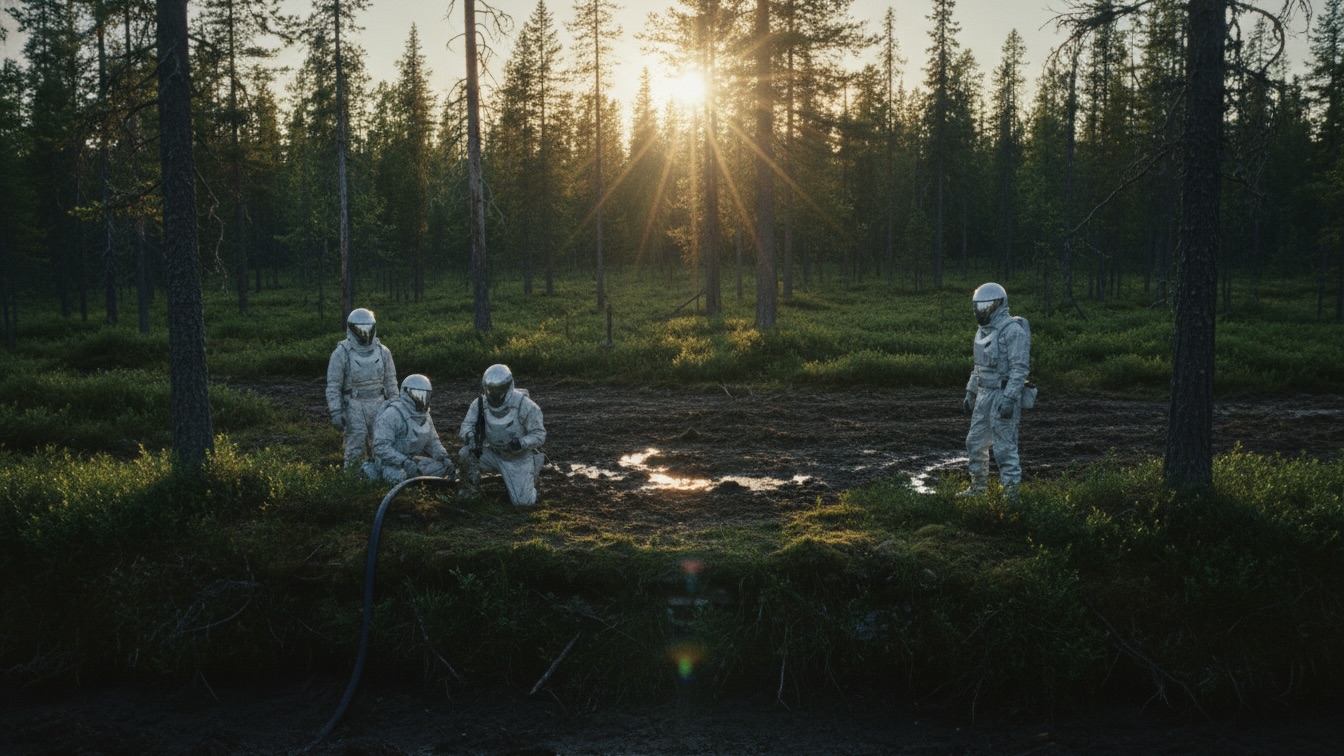
Klaus and Sarah-Jane lead the recovery team on a grueling trek through the treacherous boreal forest, intentionally choosing a path through the difficult muskeg. During the journey, Klaus exposes the illegal pipeline tap to the commander, hoping to create a distraction or a bargaining chip. The situation reaches a breaking point at the crash site when Hele discovers the data drive is missing and threatens the pair with detention. However, a massive sow bear, previously agitated by the drone, attacks the soldiers, providing Klaus and Sarah-Jane with a window to escape into the brush.
In the aftermath of the chaos, the two reach the shores of Iron Lake as the sun sets and the oppressive heat begins to lift. Sarah-Jane chooses to throw the incriminating data drive into the deep water, effectively ending the threat of military occupation and preserving the status quo of the forest. Klaus, feeling a sense of relief from the "transactional" weight of his secret, decides to close his shop and spend the following day fishing. The story concludes with a sense of weary peace as the forest returns to its natural silence, the secrets of the pipeline and the drone buried beneath the waves.
The central theme of the narrative revolves around the concept of transaction and the moral debts incurred through silence. Klaus views his entire existence through the lens of commerce, yet he discovers that his "quiet life" was bought at the price of his honesty regarding the pipeline tap. The arrival of the drone and the subsequent recovery team represents the inevitable moment when the bill for such a transaction comes due. The story suggests that every choice to remain silent is a trade that eventually demands a high-interest repayment.
Another prominent theme is the conflict between the organic world and artificial imposition. This is manifested in the contrast between the "white plastic ghosts" of the recovery team and the "mountain that walked," represented by the sow bear. The soldiers rely on stabilization technology and digital sensors, which prove inadequate against the shifting, chaotic reality of the muskeg. The forest is depicted as a living entity that actively rejects the intrusion of sterile technology, eventually using the bear as its primary instrument of expulsion.
The narrative also explores the burden of knowledge and the cost of truth. The data drive is described as a "fallen star" and a "spy’s brain," representing a weight that threatens to sink those who carry it. Sarah-Jane and Klaus eventually realize that in their world, the truth is a currency they cannot afford to spend without destroying their way of life. By disposing of the drive, they choose a "better transaction," trading the possibility of justice or technological progress for the continued survival of their community and the preservation of the forest's autonomy.
Klaus is a man defined by a profound sense of physical and existential weariness. He perceives the world as "gritty," a reflection of his own aging body which he describes as being filled with dry sand. This psychological projection suggests a man who has become cynical and detached, viewing his shop as a "museum of failed intentions." He uses the language of a merchant to distance himself from the emotional and moral consequences of his actions, framing his complicity in the pipeline theft as a simple business deal.
His primary motivation is the maintenance of a quiet, undisturbed life, even if that life is built on a foundation of hidden corruption. He possesses a sharp, theatrical intellect, which he uses as a defense mechanism when confronting the cold authority of Commander Hele. Despite his claims of being a simple outfitter, he is a keen observer of human and mechanical nature, recognizing the arrogance of the soldiers' technology. His decision to go fishing at the end of the chapter signifies a release from his self-imposed transactional prison, suggesting a return to a more authentic connection with the world.
Sarah-Jane functions as the pragmatic protector of the district, balancing her official duties with a deep, personal loyalty to the land. She is described as a shadow that becomes a person, highlighting her ability to move through the forest with a grace that the armored soldiers lack. Her theatricality mirrors that of Klaus, but it is tempered by a sharp, cynical realism about the power dynamics at play. She understands that the "vultures" in the white suits represent a systemic threat that cannot be defeated through traditional legal means.
Her decision to carry the data drive and ultimately destroy it reveals her role as the true arbiter of the forest's secrets. While she is a conservation officer, her primary allegiance is not to the government that pays her, but to the ecosystem she inhabits. She is willing to use the bear as a "shield," demonstrating a ruthless streak necessitated by the harsh environment. By the end of the story, she finds common ground with Klaus in their shared exhaustion, choosing the silence of the lake over the "sharp edges" of the truth.
Commander Hele serves as the embodiment of cold, technological detachment and the arrogance of external authority. He is a man who has been subsumed by his equipment, speaking through a chest-mounted speaker and viewing the environment through a filtered visor. To him, the forest is not a living system but a series of "suboptimal" friction coefficients and "environmental errors." He represents a world that seeks to quantify and control nature through "smart" tech and forensic analysis, failing to account for the primal unpredictability of the woods.
His psychological rigidity makes him vulnerable to the very environment he seeks to dominate. He treats the local residents as "citizens" to be commanded rather than individuals with relevant expertise, which leads him directly into the trap Klaus and Sarah-Jane set. His failure to recognize the danger of the sow bear until it is too late illustrates the blindness of a purely data-driven worldview. He is a man who values the "asset" over human or animal life, making him the ultimate antagonist in a world that Klaus believes should be governed by more human, albeit flawed, transactions.
The pacing of the chapter is masterfully controlled, beginning with a slow, atmospheric stagnation that mirrors the heat of the shop. This initial lethargy establishes a sense of dread and anticipation, which is then disrupted by the rhythmic, thudding arrival of the helicopter. The narrative speed increases during the trek through the woods, with the descriptions of the difficult terrain creating a sense of physical struggle. The climax at the cedar blind is frantic and violent, providing a sharp contrast to the quiet, reflective resolution by the lake.
Sensory details are used extensively to ground the story in a "gritty" and oppressive reality. The author emphasizes tactile sensations, such as the "sticky, protesting noise" of the vinyl seat and the "black grease" that feels like a permanent glove. The auditory landscape is equally rich, contrasting the "theatrical rasp" of Sarah-Jane’s voice with the "mechanical speed" and "digital voices" of the soldiers. These details serve to heighten the contrast between the organic, decaying forest and the sterile, unblemished technology of the recovery team.
The narrative voice is colored by Klaus’s cynical and slightly elevated perspective, giving the prose a literary, almost weary quality. The use of metaphors, such as comparing dust motes to "aimless astronauts" or the bear to a "mountain that walked," adds a layer of poetic depth to the survivalist plot. This stylistic choice elevates the story from a simple thriller to a psychological exploration of character and place. The recurring motif of the "transaction" provides a cohesive structural element, tying the various plot points together under a single thematic umbrella.


