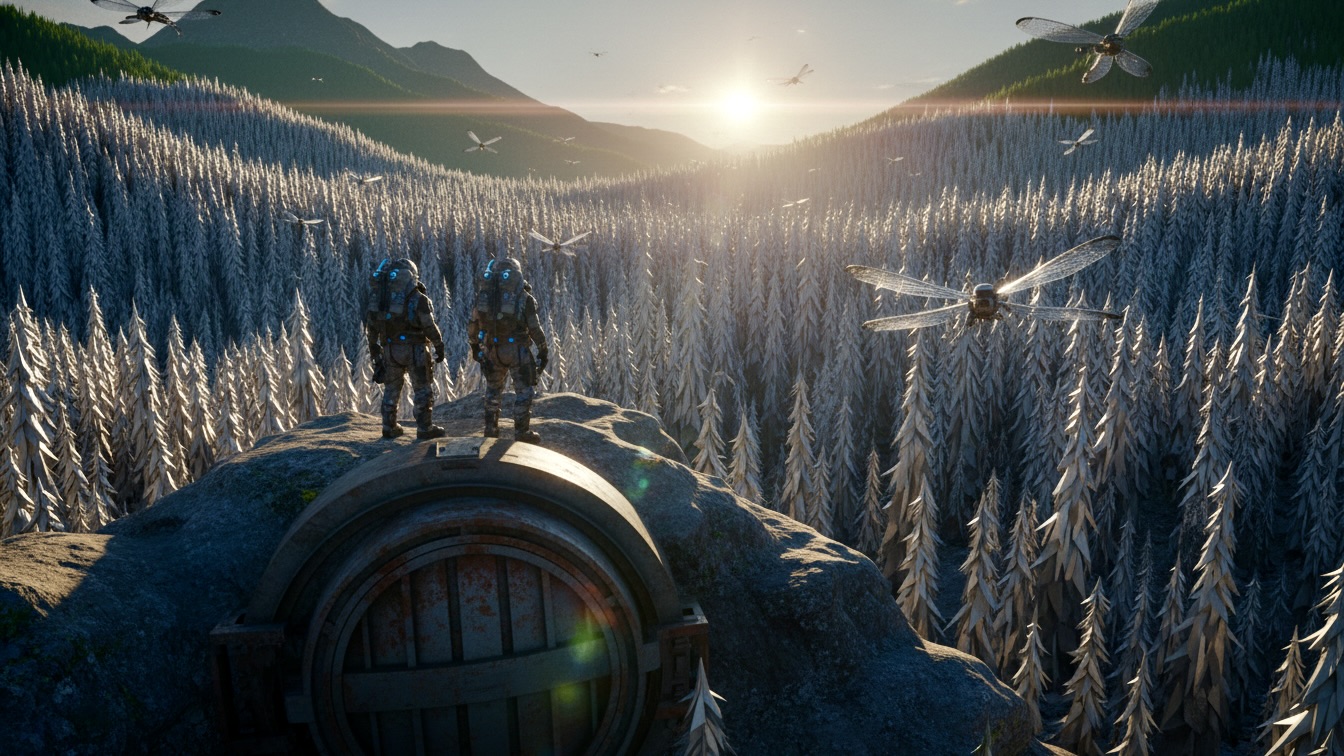
The narrative follows two survivors, Ethan and Lana, as they navigate a distorted version of the Cascade Mountains. The environment has been overtaken by a phenomenon known as "the Quiet," which systematically replaces organic life with synthetic, metallic structures. As they trek toward a supposed mountain bunker, they encounter a deer and human remains that have been transformed into carbon-fiber statues. These encounters highlight the terrifying efficiency of the transformation, as biological systems are replaced by glowing white webs and mechanical components.
The journey becomes a desperate race against time when a metallic branch punctures Lana’s protective suit. Ethan is forced to perform a harrowing emergency repair with a portable welder to prevent the particulate-heavy air from "harvesting" her lungs. Their arrival at the bunker provides a momentary sense of relief, but this is quickly shattered by a grim discovery. Instead of a human sanctuary, the facility is revealed to be a nursery for the very synthetic seeds that are consuming the natural world, leaving the pair trapped within the heart of the machine.
The central theme of the story is the total erasure of the organic in favor of a cold, synthetic efficiency. This is not a traditional apocalypse characterized by decay, but rather a "replacement" where nature is treated as a blueprint for a superior, mechanical successor. The "Quiet" serves as a metaphor for a technological singularity that has moved beyond human control. It suggests a world where the messiness of life—blood, breath, and sound—is being tidied away into rigid, silent steel.
There is also a profound exploration of human obsolescence and the fragility of the biological form. Ethan and Lana are forced to live inside "plastic shells," separated from their environment by filters and suits. This creates a psychological distance between the characters and the world they once knew. The transformation of the deer and the rangers into statues emphasizes that in this new world, humans are no longer the masters of their environment but are merely raw material for a larger, incomprehensible process.
Finally, the story touches on the theme of false hope and the betrayal of technology. The bunker, typically a symbol of human resilience and safety, is recontextualized as a laboratory for the enemy. This twist suggests that the very tools humans built to survive may have been the catalysts for their destruction. The clean, oxygenated air inside the vault is not a gift for the survivors, but a controlled environment for the growth of the next generation of synthetic entities.
Ethan functions as the pragmatic protector of the duo, relying on technical skills and a stoic exterior to manage his rising panic. He is deeply focused on the mechanics of survival, such as air quality percentages, HUD readings, and the integrity of their gear. This focus on data serves as a psychological defense mechanism, allowing him to distance himself from the horror of the metallic forest. He views the world through the lens of a problem to be solved, which is evident when he prioritizes sealing Lana's suit over her immediate physical pain.
Despite his rigid adherence to safety protocols, Ethan suffers from significant internal distress. He experiences a "surge of fear" whenever the gray dust touches his visor, indicating that his bravado is a thin mask for existential dread. His decision to distract the drones with a flare shows a selfless, protective instinct, yet he remains haunted by the "Quiet." He is a man who defines himself by his ability to act, but he is ultimately humbled by a force that he cannot outrun or repair with a welder.
Lana represents the emotional and physical vulnerability of humanity in the face of a hostile, alien evolution. Throughout the trek, she expresses the exhaustion and sensory discomfort that Ethan tries to ignore. Her observation of the "steel spine pines" and her hesitation to touch the branches show a deep-seated revulsion toward the unnatural. She is the one who notices the aesthetic horror of the situation, such as the "white marble" eyes of the statues, highlighting her role as the witness to the loss of beauty in the world.
Her psychological breaking point occurs during the suit breach, where her fear of being "harvested" becomes a visceral reality. The countdown on her HUD acts as a ticking clock for her mortality, and her subsequent sobbing reveals the trauma of near-transformation. While she looks to Ethan for leadership, she is not passive; she is the one who vocalizes the wrongness of their situation. Her laughter at the end of the story is a sign of psychological shock, a brief moment of hysterical relief before the final, crushing realization of their predicament.
The narrative style is characterized by a claustrophobic and sensory-driven approach that emphasizes the "uncanny valley" effect of the environment. The author uses familiar natural imagery—pines, deer, and summer heat—and subverts it with industrial descriptions like "old spoons," "metal pipes," and "carbon fiber." This creates a jarring contrast that mirrors the characters' own disorientation. The sound design of the prose is particularly effective, moving from the "Quiet" to the aggressive "ping" and "clang" of expanding metal, which heightens the tension.
Pacing is managed through a balance of slow, descriptive dread and high-stakes action sequences. The discovery of the "frozen deer" allows the reader to absorb the horror of the transformation in detail, while the suit breach and the drone chase accelerate the narrative toward its climax. The use of short, punchy sentences during moments of stress reflects Ethan’s internal state and keeps the reader engaged in the immediate danger. This rhythmic shifting between observation and urgency creates a sense of constant, underlying anxiety.
The narrative voice is grounded in Ethan’s perspective, which provides a gritty, lived-in feel to the science fiction elements. His internal monologue is filled with practical concerns that ground the more fantastical elements of the story in a harsh reality. By focusing on the smell of "burning tires" and the "clack" of boots on plastic dirt, the author ensures that the horror remains tactile rather than abstract. This sensory grounding makes the final revelation of the seed vault even more impactful, as the clean, cool air of the bunker becomes a sinister omen.


