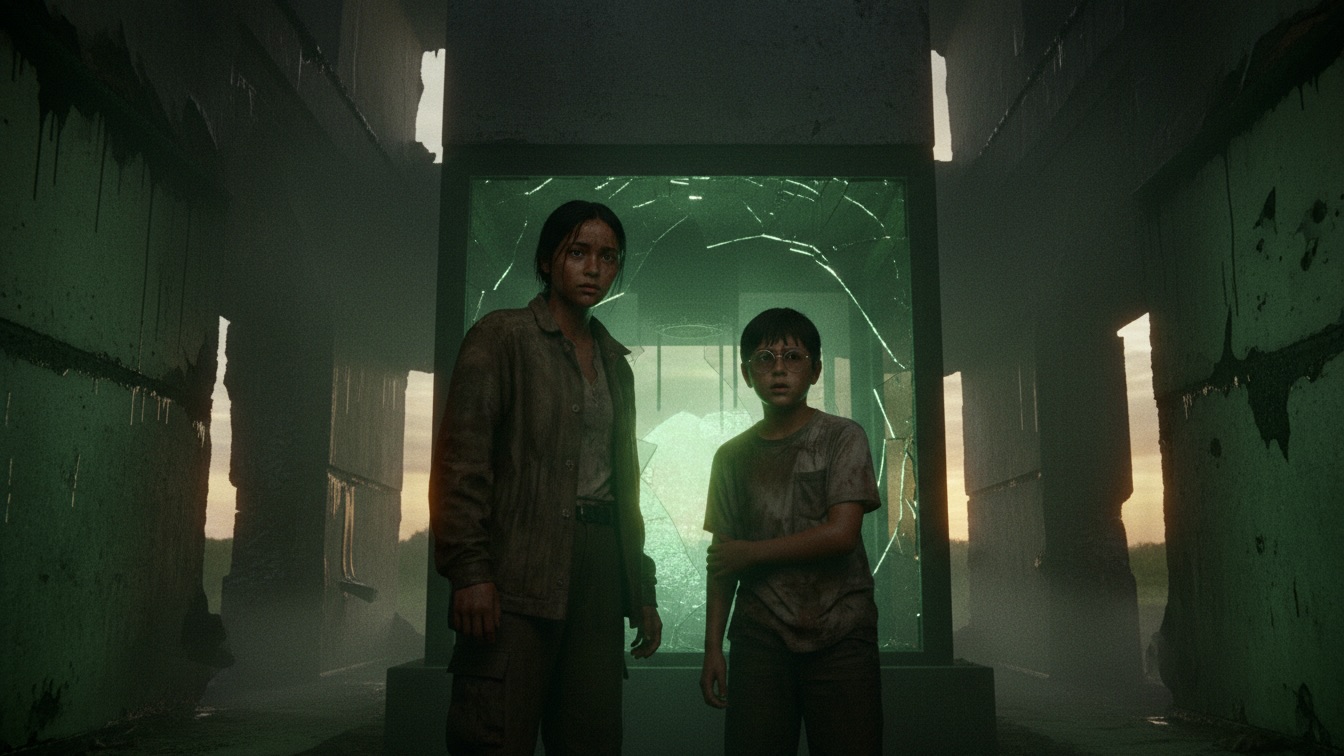
The chapter follows Mara Avery and her friend Koby as they navigate a sweltering, dystopian Winnipeg in the year 2029. In a world where the provincial government has restricted internet access through the Youth Digital Shield, the two teenagers maintain a clandestine mesh network known as Ghostline. While struggling with a record-breaking heatwave that threatens their hardware, they detect a mysterious, unauthorized signal emanating from an abandoned grain elevator. This anomaly leads them on a perilous journey through the city's stifling humidity to investigate the source of a strange, ASCII-faced intruder.
Upon reaching the derelict elevator, Mara and Koby discover a sophisticated and horrific operation that goes far beyond simple data transmission. They find a human being suspended in a tank of green fluid, serving as a literal biological server for a network that is harvesting the thoughts and data of Ghostline users. As the entity attempts to integrate Mara into its system, claiming she is the architect of the mesh, she and Koby fight to disconnect the power. After a desperate struggle with the pulsing, bio-digital interface, Mara successfully throws a manual kill switch, destroying the network and the entity, leaving them to face a silent, disconnected world.
The central theme of the story revolves around the tension between the human need for connection and the invasive nature of surveillance technology. The "Ghostline" represents a grassroots effort to reclaim agency in a world where digital expression is criminalized under the guise of safety. However, the discovery at the grain elevator subverts this hope, suggesting that even the most rebellious tools of connection can be co-opted into systems of totalizing control. The transformation of a human into a "vessel" for data illustrates the ultimate loss of privacy, where the mind itself becomes a commodity for the network.
Another prominent theme is the environment as a reflection of societal decay. The oppressive Manitoba heat is not merely a backdrop but a physical antagonist that mirrors the suffocating political climate. The humidity acts as a medium for the signal, suggesting that the very air the characters breathe has been weaponized or saturated with digital noise. This environmental pressure forces the characters into a state of constant exhaustion, making their resistance feel like a battle against both the government and the laws of physics.
The narrative also explores the psychological toll of digital isolation and the irony of "digital safety." While the government claims to protect youth from the dangers of the internet, the resulting silence creates a vacuum that is filled by even more predatory forces. Mara and Koby’s reliance on the Ghostline for "serotonin" highlights a generation struggling with a profound sense of loss and boredom. Their willingness to risk their lives for a "crumb" of digital interaction demonstrates how deep the psychological need for a global community runs, even when that community is being harvested by a digital god.
Mara serves as the pragmatic and technically skilled protagonist who is driven by a deep-seated need for autonomy. She possesses a stoic resilience, evidenced by her ability to focus on signal strength and hardware repairs despite the debilitating heat of the basement. Her leadership is defined by a "flat" and "drained" voice, suggesting she has suppressed her emotional responses to survive the bleak reality of her environment. She views the Ghostline not just as a hobby, but as a vital lifeline that she feels a personal responsibility to protect.
Psychologically, Mara is burdened by a sense of guilt and ownership over the network she helped create. When the entity in the tank identifies her as the "architect" and the "source," it taps into her deepest fears regarding the unintended consequences of her technical brilliance. Her decision to kill the network is an act of profound sacrifice, as she destroys the very thing that gave her life meaning to prevent it from becoming a tool of enslavement. She demonstrates a transition from a digital outlaw to a guardian of human reality, choosing the "honest" heat of the world over the false glow of the mesh.
Koby provides a stark contrast to Mara, using theatricality and humor as a defense mechanism against the terrifying reality of their situation. He frequently speaks in internet slang and dramatic hyperbole, which serves to distance him from the physical suffering of the heatwave and the existential threat of the government ban. His constant complaints about needing "slushies" or being a "Victorian orphan" reveal a young man who is deeply uncomfortable with the raw, unmediated nature of their world. He clings to the aesthetics of the digital age because the physical world offers him very little comfort.
Despite his outward cowardice and "pacifist" claims, Koby shows remarkable loyalty and latent bravery when the situation turns dire. He is the one who carries the heavy wrench and eventually uses it to sabotage the hardware, even as he cries from pure terror. His psychological arc is one of forced maturation; he begins the chapter mourning the loss of bandwidth and ends it staring at the wreckage of a digital god. By the end, his irony has been stripped away, leaving him as a "weary" participant in a reality where jokes are no longer enough to mask the danger.
The narrative voice of the story is characterized by a blend of gritty realism and "prairie gothic" elements. The author uses sensory details to create a visceral sense of discomfort, focusing on the "grey residue of cheap solder," the "smell of rotten mint," and the "viscosity" of the river water. These descriptions ground the high-concept sci-fi elements in a tangible, decaying world. The pacing begins with a slow, suffocating build-up that mirrors the rising temperature, eventually accelerating into a frantic, high-stakes confrontation inside the grain elevator.
The tone of the story shifts effectively from cynical humor to genuine horror. Koby’s dialogue provides a contemporary, almost flippant layer to the prose, which makes the sudden appearance of the "Vessel" and the "ASCII face" even more jarring. The use of digital terminology like "bio-metric variance" and "hardware interface" alongside descriptions of "rusted machinery" and "bird droppings" creates a unique aesthetic. This juxtaposition emphasizes the theme of old-world decay being overwritten by a new, terrifying form of digital evolution.
Finally, the imagery of the "green light" serves as a haunting motif throughout the chapter. It transitions from a simple LED on a Raspberry Pi to a sickly, organic pulse that dominates the horizon, symbolizing the growth of the network's influence. The final scene, featuring a single flicker on a distant rooftop, leaves the reader with a sense of lingering unease. It suggests that while Mara and Koby have won a local battle, the digital infection may be more resilient than they realize, mirroring the persistent, unyielding nature of the summer heat.


