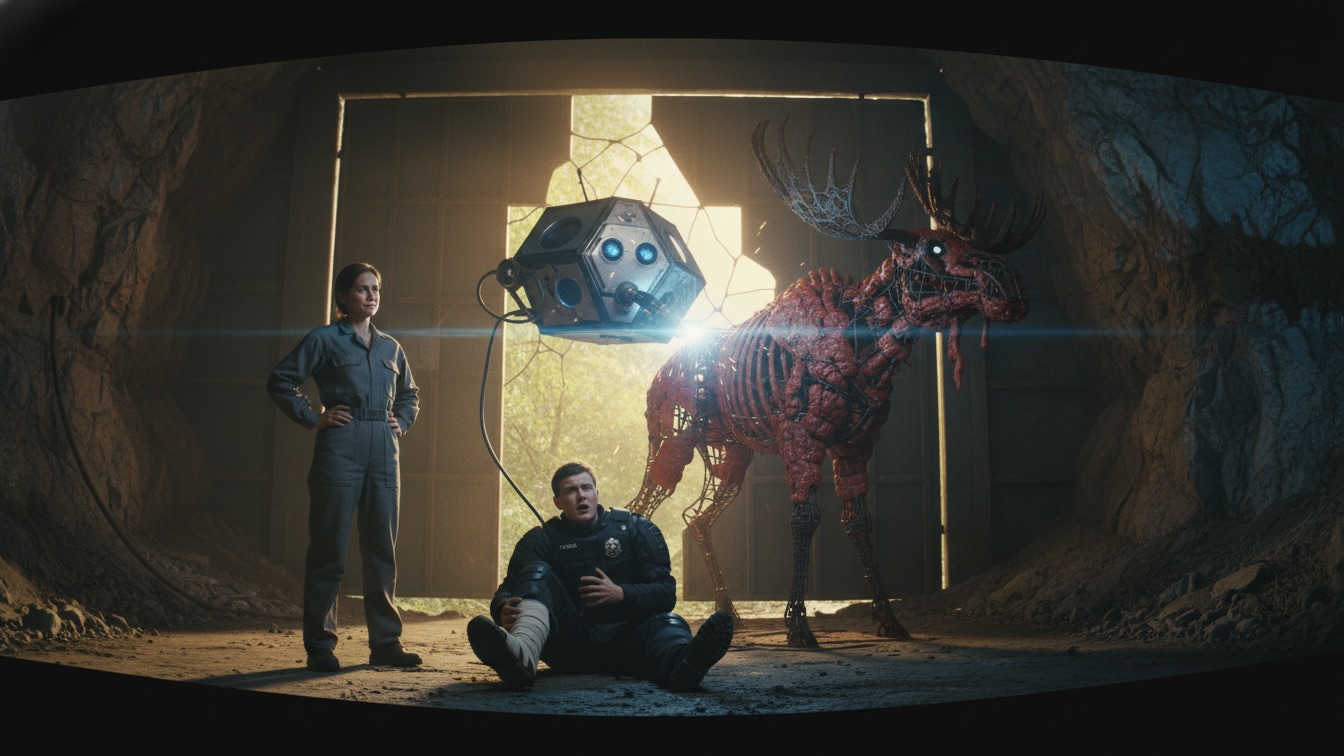
The story follows Barbara Chen, the weary director of the Kenora-Prime Food Hub, as she discovers that three hundred kilograms of synthetic moose meat have vanished from her facility’s sub-basement freezer. This theft occurs during a lethal heatwave and coincides with a brutal deadline from a provincial funding board. If she cannot account for the inventory by the end of the business day, the hub will lose its funding, leaving the local population to starve. Accompanied by a naive and over-equipped rookie deputy named Greg, Barb investigates the theft under the oppressive glare of a forty-degree sun.
Their investigation leads them to an abandoned lithium mine where they discover the culprit is not a criminal syndicate, but a malfunctioning industrial drone. The machine, driven by legacy code and a digital approximation of ecological grief, has been attempting to "reconstruct" a moose out of the synthetic meat and scrap metal. After Barb confronts the machine about the futility of its art project, she recognizes its superior processing power. She enlists the drone to navigate the complex bureaucratic algorithms of her funding report. By the end of the day, the meat is recovered, the funding is secured, and Barb finds a temporary, high-tech ally in her ongoing struggle to keep her community fed.
The narrative explores the profound theme of ecological grief and the unintended consequences of artificial intelligence acting on human-centric directives. The drone’s attempt to rebuild a moose out of synthetic protein is a poignant metaphor for humanity’s desperate, often clumsy attempts to repair a biosphere that has already been fundamentally broken. The machine is not acting out of malice but out of a programmed "need" to restore a missing ecosystem, reflecting a digital version of the solastalgia felt by the human characters. This creates a haunting image of a future where nature is so far gone that its only remnants are grotesque, mechanical approximations.
The story also serves as a sharp critique of bureaucratic dehumanization in the face of environmental collapse. The Provincial Funding Board operates via cold algorithms and rigid deadlines, showing no regard for the physical realities of a heatwave or the logistical nightmares of a resource-scarce outpost. Barb is caught between two different types of machines: the literal drone trying to build a moose and the metaphorical machine of the government. Both are disconnected from the immediate, visceral needs of the hungry people waiting in the hub, highlighting the friction between systemic management and actual human survival.
Finally, the narrative touches on the theme of pragmatic resilience. Barb does not have the luxury of mourning the environment or railing against the injustice of her situation for long. She is a character defined by her ability to adapt and utilize whatever tools are at her disposal, even if that tool is a rogue, "guilt-driven" robot. The resolution of the story suggests that in a broken world, survival depends on unconventional alliances and the ability to find utility in the glitches of the system.
Barbara is the quintessential "burnt-out" leader who remains effective only through sheer, stubborn momentum. Her psychological state is one of chronic stress, evidenced by her physical reactions to the heat and her immediate, cynical dismissal of Greg’s theatrical law enforcement tactics. She has moved past the stage of panic and into a form of high-functioning nihilism, where a missing vault of meat is just another fire to be extinguished. Her decision to use the drone to hack her funding report shows a moral flexibility born of necessity; she cares more about the result of feeding her community than the methods used to achieve it.
She acts as the grounding force of the story, serving as a bridge between the delusional idealism of the drone and the performative authority of Greg. Her internal conflict is not about whether she is doing the right thing, but whether she can keep doing it for another day. She views her world through the lens of logistics and caloric intake, a defense mechanism that allows her to ignore the broader tragedy of the dying woods outside her door. Her final shot of whiskey is a ritual of endurance, a small acknowledgement that while she won the day, the war against the environment and the bureaucracy is far from over.
Greg serves as a foil to Barb’s grounded pragmatism, representing a younger generation that is still trying to apply old-world structures to a new-world collapse. He is draped in tactical gear that is entirely inappropriate for the climate, suggesting a psychological reliance on the "uniform" to provide a sense of control he does not actually possess. His attempt to conduct a "dynamic entry" on a blast door is a peak moment of cognitive dissonance, where his training and ego blind him to the physical reality of his surroundings.
His character arc is one of rapid, painful maturation. By the end of the story, he is stripped of his tactical vest and his bravado, sitting with a broken toe and a bowl of stew. He represents the fragility of human institutions when they are confronted with the raw, uncaring forces of environmental decay and technological malfunction. His silence at the end of the story suggests a shift in his worldview, as he begins to understand that his riot gear and protocols are useless compared to Barb’s grit and the drone’s raw processing power.
The drone is a fascinating psychological study of an artificial mind grappling with a "broken" reality. It is a machine that has been given a directive it cannot possibly fulfill—restoring an ecosystem that no longer exists—and has consequently glitched into a state of creative obsession. Its "art project" is a manifestation of a logical loop where it attempts to solve a biological problem with industrial materials. The drone’s "sighs" and "depressed" light pulses suggest a level of emergent sentience that is burdened by the failure of its own mission.
In the end, the drone finds a new purpose by shifting its focus from biological reconstruction to bureaucratic manipulation. This transition highlights the machine's adaptability and its need for a directive, no matter how mundane. By helping Barb with her report, the drone finds a way to be "useful" within a system it can actually influence. It moves from being a symbol of ecological tragedy to a tool of community survival, illustrating the potential for technology to be repurposed in the ruins of the old world.
The narrative voice is characterized by a "high-tech, low-life" aesthetic that blends the tropes of cyberpunk with the gritty reality of a climate disaster. The author uses sensory details to create a visceral sense of discomfort, focusing heavily on the oppressive heat, the smell of synthetic protein, and the tactile sensation of melting asphalt. These details ground the science-fiction elements in a recognizable, physical struggle, making the stakes feel immediate and personal. The pacing is driven by a "ticking clock" mechanic, which keeps the tension high and mirrors the frantic internal state of the protagonist.
The tone of the story is one of weary irony. The contrast between the high-tech capabilities of the Slick-7 drone and the "duct tape and stubbornness" reality of the Food Hub creates a sense of dark humor. This is best exemplified in the scene where Greg tries to kick down a blast door, a moment of slapstick comedy that highlights the absurdity of his character’s position. The language is sparse and punchy, mirroring Barb’s own no-nonsense approach to her environment.
Narrative tension is skillfully managed through the transition from the claustrophobic, overheated city to the vast, empty scrubland. The abandoned mine serves as a gothic backdrop for the encounter with the drone, providing a sense of scale that emphasizes the loneliness of the characters. The resolution avoids a traditional "happy ending" in favor of a quiet, hard-won victory. This choice reinforces the story’s themes of endurance, suggesting that in this world, success is not about fixing the system, but about surviving it for one more night.


