Victor is a private investigator struggling to survive in a sweltering, decaying city. He accepts a job to find a missing young woman named Lilith, motivated primarily by a five-thousand-dollar cryptocurrency payout. His investigation leads him from a squalid apartment building filled with impossible, ice-cold peonies to a high-end restaurant called O-Toro. After a tense meeting with a cynical detective named Suzuki, Victor realizes the case is far more dangerous than a simple runaway situation.
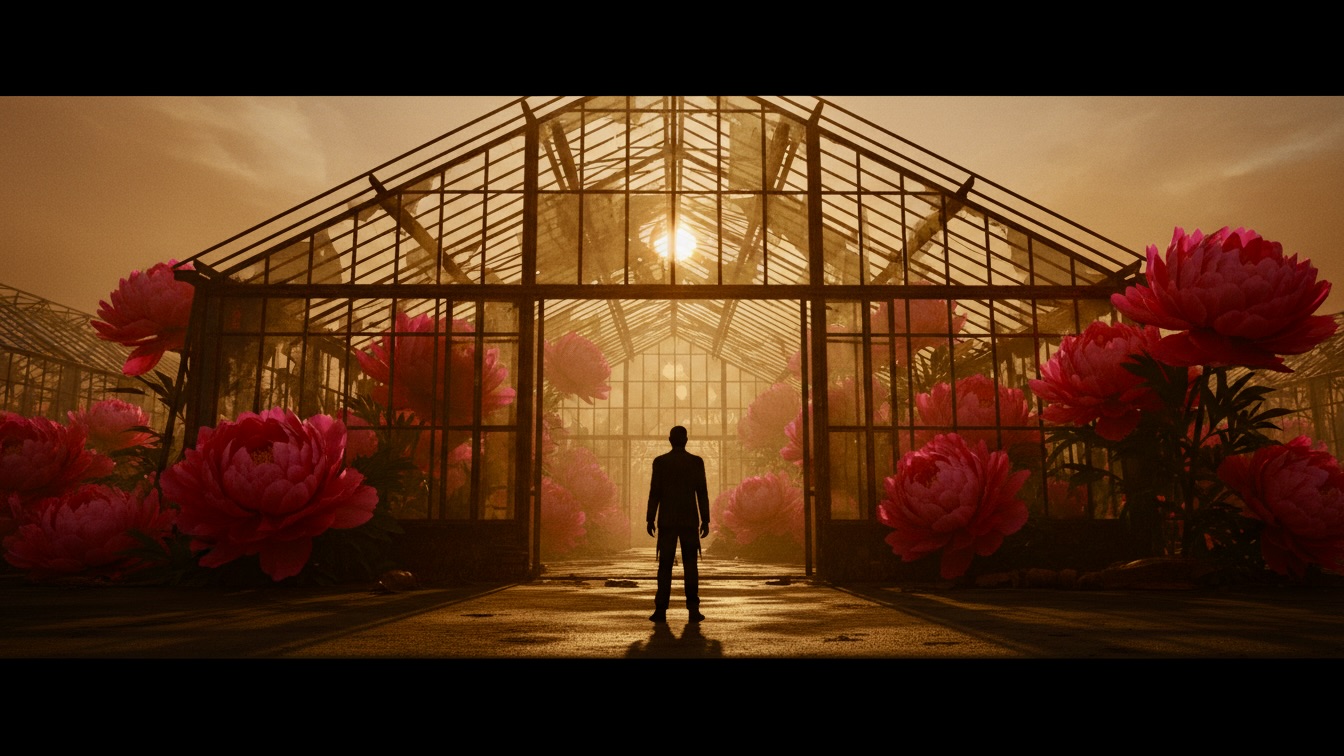
He infiltrates the Gold Coast district, sneaking into the restaurant's ventilation system to observe a private dinner. There, he witnesses the city's elite consuming a mysterious, grayish meat served alongside the same strange peonies he found in Lilith's room. Following a delivery truck, he travels to a remote, industrial greenhouse on the edge of the city. He discovers a horrific operation where human remains are used as fertilizer to grow the flowers and provide meat for the wealthy.
Inside the greenhouse, he finds Lilith, but she has been psychologically broken and now views the gruesome process as a form of beautiful recycling. Victor is attacked by guards and narrowly escapes with his life, sustaining broken ribs in the process. He returns to his office as dawn breaks, physically and spiritually battered. He lies to his client about Lilith's death to end the search and sits in silence, contemplating the rot of the city and his own fractured life.
The central theme of the story is the predatory nature of class stratification, depicted through the literal consumption of the poor by the rich. The Gold Coast elite do not merely exploit the lower classes economically; they physically harvest them to sustain their own vitality and aesthetic pleasure. This cannibalistic relationship is symbolized by the "O-Toro" sushi and the peonies, which thrive on death. The story suggests that in a late-stage capitalist dystopia, the marginalized are viewed as nothing more than raw material for the luxury of the powerful.
Decay and the "rot" serve as both a physical setting and a psychological state throughout the narrative. The city is portrayed as a dying organism, characterized by strikes, heat, and the stench of garbage. This environment creates a sense of nihilism in the characters, making the grotesque "recycling" at the greenhouse seem like a logical, albeit horrifying, conclusion. Lilith’s acceptance of her fate shows how extreme urban decay can warp a person’s mind until death becomes more attractive than survival.
The contrast between the organic and the artificial is also a significant thematic thread. The peonies are described as "impossible" and "violent" in their beauty, thriving in conditions that should kill them. Their unnatural coldness in the ninety-degree heat highlights the perversion of nature occurring at the hands of the cult. This reflects a world where even beauty is manufactured through suffering, and the most vibrant things are fueled by the most profound corruption.
Victor is a man defined by his stagnation and a stubborn, self-destructive sense of duty. He is physically and emotionally worn down, as evidenced by his damp shirt, his popping knees, and his inability to sign his divorce papers. The papers represent a threshold he is not yet ready to cross, suggesting he is clinging to a ghost of a life that no longer exists. He inhabits a world of "cheap suits" and "cheap bourbon," marking him as a man who has been discarded by the very system he tries to navigate.
Psychologically, Victor is driven by a "familiar, stubborn anger" that prevents him from following the path of least resistance. While Suzuki advises him to let the city eat who it wants to eat, Victor’s ego and moral compass force him to look into the rot. This isn't necessarily out of heroism, but rather an inability to accept the total insignificance of his own existence. By the end of the story, his spirit is further crushed as he realizes the scale of the conspiracy, leading him to lie about Lilith's fate as an act of mercy or perhaps pure defeat.
Lilith serves as the tragic focal point of the narrative, representing the ultimate victim of the city’s hunger. When Victor finds her, she is no longer the tired girl from the low-res photo but a hollowed-out vessel for the cult’s ideology. Her psychological transformation is a defense mechanism against the "ugly and mean" reality of her former life. She has traded her autonomy for a sense of belonging, even if that belonging means becoming literal fertilizer for the elite.
Her calm demeanor in the face of horror indicates a total psychological break from reality. She views the "recycling" of human bodies not as murder, but as a way to become part of something "beautiful." This suggests that she was so dehumanized by her life in the city that she finds more dignity in being a flower than being a person. Her refusal to be "saved" by Victor highlights the futility of his mission and the depth of the corruption he is fighting.
The pacing of the chapter follows a classic noir structure, beginning with a slow, atmospheric build-up before escalating into a horrific climax. The author uses the oppressive heat and the sensory details of the city to create a feeling of claustrophobia that mirrors Victor’s internal state. Every movement feels heavy and labored, from the clicking of the box fan to the "army-crawl" through the cold ductwork. This tension is released only during the violent encounter in the greenhouse, which is described with sharp, visceral movements.
Sensory imagery is the story's strongest stylistic tool, particularly the juxtaposition of foul and sweet smells. The "stagnant, ninety-degree air" and "rotting garbage" of the city are constantly at odds with the "sickly sweet" and "overpowering" scent of the peonies. This olfactory contrast serves to alert both the protagonist and the reader that something is fundamentally wrong. The coldness of the flowers and the sushi container provides a tactile shock that punctuates the sweltering environment, emphasizing the unnatural presence of the Gold Coast’s influence.
The narrative voice is grim and fatalistic, utilizing short, punchy sentences that reflect Victor’s exhaustion. Descriptions are often clinical yet evocative, such as the fire escapes looking like "rust-colored ribs." This choice of metaphor reinforces the theme of the city as a decaying carcass. By grounding the supernatural elements of the "impossible" flowers in the gritty reality of a private investigator’s life, the author creates a sense of grounded horror that feels disturbingly plausible.


