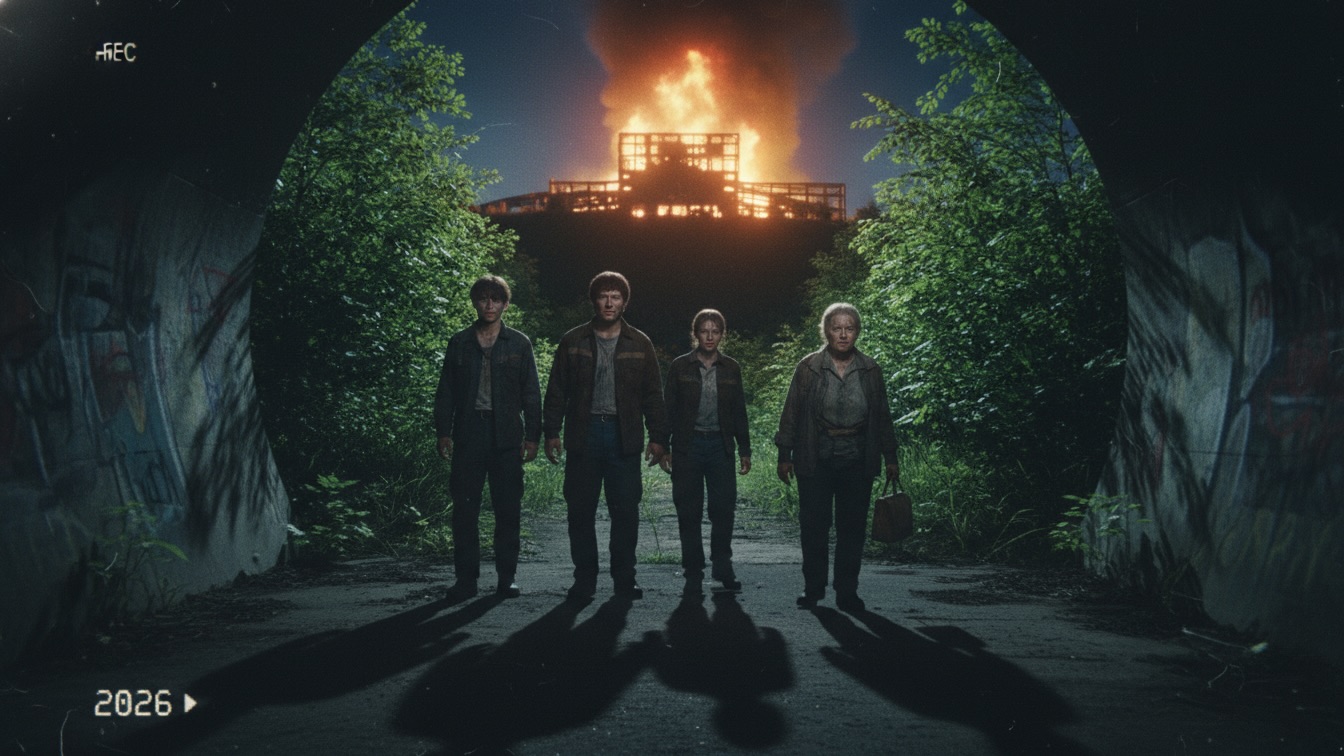
The narrative follows Moe, Andrea, and Toby as they uncover a hidden cache of legal pads belonging to their missing mother, revealing her role as a whistleblower against the NorthStar conglomerate. Realizing they are being tracked by a corporate auditor in a gray sedan, the group doubles back to a scrapyard to switch to an analog vehicle. They use their mother's detailed field notes to infiltrate the NorthStar data center through a series of subterranean cooling tunnels.
Inside the facility, they discover a secret living quarters where their mother has been hiding for years, maintaining her surveillance of the company. The auditor eventually corners them in this subterranean bunker, leading to a high-stakes confrontation. Moe initiates a thermal meltdown of the server farm to destroy the Phoenix Protocol, narrowly escaping with his family as the facility explodes. The story concludes with the family fleeing into the night, though the presence of a surveillance drone suggests their struggle against NorthStar is far from over.
The narrative explores the chilling concept of data-driven dehumanization within a modern corporate landscape. Andrea’s realization that they have become "line-items" rather than fugitives suggests a world where human life is reduced to a balance sheet entry. This theme highlights the psychological horror of being hunted not by the law, but by a corporate entity that views murder as a mere recovery of liquid assets. The "auditor" represents the faceless, emotionless nature of this system, operating with a cold efficiency that ignores human morality.
Another central theme is the tension between the digital and physical worlds. The "Phoenix Protocol" represents the ultimate digital power—the ability to rewrite history and delete people from existence. However, the story emphasizes that this power still relies on physical infrastructure like server racks and cooling tunnels. By attacking the physical "source," the characters assert their reality against a system that tries to turn them into ghosts. The destruction of the facility serves as a temporary victory of human will over digital erasure.
The legacy of trauma and the search for truth also drive the narrative forward. The discovery of the mother's notes reframes the family's entire history, transforming her from a passive victim into an active resistance fighter. This revelation forces the siblings to confront their perceptions of their parents, particularly their view of Jerry as a coward. The act of returning to the site of their trauma to find their mother demonstrates a psychological need for closure that outweighs their instinct for self-preservation.
Moe functions as the physical and emotional anchor for the group, characterized by his stoic endurance and protective instincts. His bleeding fingernails and salt-stained clothing signify a man who is physically falling apart yet remains driven by a singular purpose. Psychologically, he struggles with a deep-seated cynicism, initially dismissing Jerry as a coward and wanting to throw away the notes. This skepticism is a defense mechanism against the overwhelming complexity of the conspiracy they face.
As the narrative progresses, Moe shifts from a reactive state of flight to a proactive stance of defiance. His decision to engage the auditor in hand-to-hand combat shows a willingness to sacrifice his own life for the survival of his siblings. He rejects the auditor's offer of a peaceful exit, choosing instead to embrace the "messiness" of human conflict over corporate order. By the end of the chapter, he has fully transitioned into a leader who accepts the reality of a perpetual war.
Andrea serves as the intellectual engine of the trio, possessing the technical literacy required to navigate the NorthStar threat. She is the first to recognize the gravity of their situation, translating the abstract digital pings into a tangible threat. Her focus is often split between the immediate physical danger and the digital landscape she monitors on her tablet. This duality makes her the most vulnerable to the auditor's tracking, as her reliance on technology is both her greatest strength and their primary weakness.
Emotionally, Andrea is driven by a fierce hope that her mother is still alive, a hope that borders on desperation. She uses her technical skills as a shield against the grief of the past, focusing on "decryption keys" and "schemas" rather than her own fear. When she finally confronts her mother, she immediately snaps back into a functional role, triggering the meltdown with clinical precision. She represents the modern resistance fighter who must use the enemy's tools to dismantle their empire.
Toby is the most viscerally affected by the trauma of their situation, often described as "vibrating" with nervous energy. He represents the psychological toll of living under constant surveillance and the fear of being erased. His voice frequently cracks, and he seeks comfort in the familiarity of his hometown and friends. Despite his outward fragility, he provides crucial local knowledge and observational details that allow the group to survive.
Throughout the chapter, Toby moves from a state of whimpering terror to one of grim participation. He is the one who notices the "void" in the notes and suggests the scrapyard, showing that his mind is still functioning despite his fear. His bleak smirk near the end suggests a hardening of his character, as he accepts the reality of being an outlaw. He represents the loss of innocence that occurs when an individual is forced to fight a system far larger than themselves.
The mother is a figure of resilience who has survived fifteen years of isolation in the heart of the enemy's territory. Her pale, translucent skin and silver hair reflect the physical cost of her long-term concealment. Psychologically, she has become an extension of the surveillance system she was fighting, living among monitors and legal pads. She is no longer the woman her children remember, but a sentinel who understands the true nature of NorthStar.
Her warning that "he’s watching" indicates a state of hyper-vigilance that has likely defined her existence for over a decade. She possesses a clarity of vision that her children lack, understanding that the struggle is not just about money, but about the source code of reality. Despite her frailty, she remains the catalyst for the group's final act of defiance. Her presence validates the siblings' struggle and gives their fight a tangible purpose.
The author utilizes an oppressive, sensory-heavy style to mirror the high-stakes tension of the plot. The recurring motif of the summer heat serves as a constant, suffocating presence that heightens the characters' desperation. Descriptions like "a blast furnace of dust" and "a river of mercury" create a visceral sense of discomfort for the reader. This focus on physical sensation grounds the techno-thriller elements in a gritty, tangible reality.
The pacing of the narrative is expertly managed through the use of varied sentence structures and rhythmic transitions. During the high-speed chase and the infiltration, the sentences are short and punchy, mimicking the frantic breathing of the characters. In contrast, the scenes inside the bunker allow for longer, more contemplative paragraphs that explore the emotional weight of the reunion. This fluctuation keeps the reader engaged while allowing for necessary character development.
The narrative voice is detached yet intimate, providing a clear view of the external action while hinting at the internal psychological states of the protagonists. The use of technical jargon like "MAC address," "latency," and "NFC chip" adds an air of authenticity to the corporate espionage elements. This is balanced by poetic, evocative language, such as the description of the server farm as a "city of neon and glass." The final image of the blue drone light provides a haunting closing note, shifting the tone from one of triumph to one of lingering unease.


