Format: Short Film / Anthology Episode | Est. Length: 10-12 minutes
This story serves as a standalone entry in the anthology series The Burn Rate, a collection of psychological horror episodes exploring the dehumanizing pressures of the Silicon Valley "unicorn" culture. Each episode centers on a different founder whose internal anxieties manifest as a surreal, inescapable architectural trap designed by their own failures. The series maintains a consistent aesthetic of high-end corporate minimalism twisted into a claustrophobic nightmare, highlighting the thin line between visionary success and total psychological collapse.
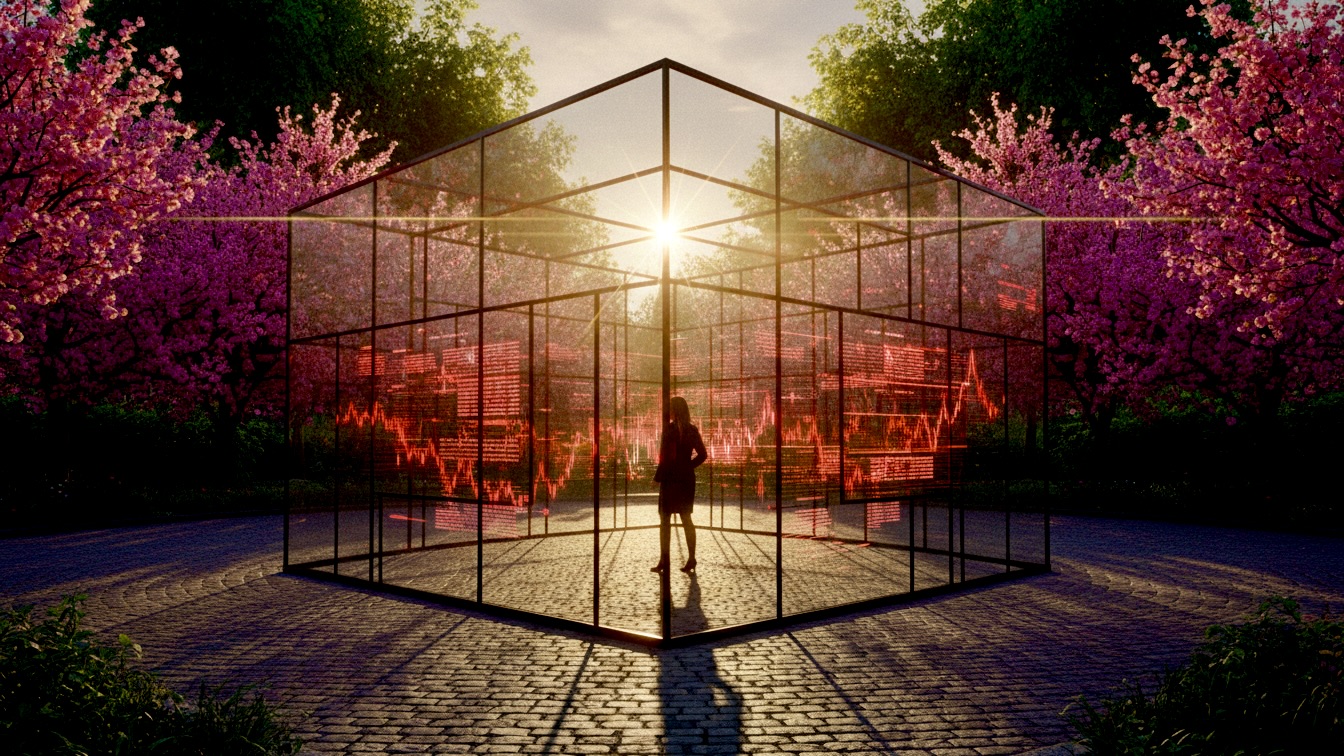
A disgraced CEO wakes up inside a seamless, soundproof glass corridor where the vibrant, blooming world outside is a silent, mocking backdrop to her internal panic.
A disgraced tech CEO must navigate a shifting glass labyrinth of her own corporate failures while being hunted by the faceless specters of her board of directors. As the maze closes in, she discovers that the nightmare of her downfall is no longer confined to her sleep.
The episode explores the fragility of the "Visionary" archetype and the dehumanizing nature of venture capital in a hyper-competitive market. It delves into the intersection of ego, debt, and the violent psychological toll of a high-stakes corporate collapse, where a human being is reduced to a set of failing metrics.
The narrative also examines the concept of the "Pivot"—traditionally a celebrated move in tech—as a metaphorical death sentence. It highlights the isolation of leadership, where the silence of the glass maze represents the soundproof bubble of the executive suite, cut off from reality until the walls begin to shatter.
Andrea faces the total annihilation of her identity, her professional reputation, and her financial future. The "grave" isn't just a metaphor for her company; it represents the death of her self-worth as she is stripped of her status by the very people who funded her rise. For the board members, the stakes are purely transactional, representing the cold, unfeeling logic of capital that demands a return even if it requires the destruction of the founder.
The primary external conflict is the "Cap Table"—a collective of faceless, predatory investors who manipulate the environment to trap and interrogate Andrea. Internally, Andrea battles her own imposter syndrome and the realization that her "vision" was a hollow sales pitch built on flawed code and deceptive "runway" projections. The maze itself acts as a secondary antagonist, a physical manifestation of her company’s complex, failing infrastructure that shifts to keep her trapped in her own mistakes.
Andrea Fevrier finds herself trapped in a surreal, shifting glass maze where the walls act as digital displays broadcasting her company’s terminal metrics and public disgrace. As she attempts to escape, she is cornered by a group of faceless, impeccably dressed figures representing her board of directors, who subject her to a psychological trial regarding her failures and "lies." The lead figure mocks her desperate "pivot," revealing that her shares are worthless and her control over the company has been severed.
In a final act of desperate defiance, Andrea shatters the digital glass with her bare knuckles, breaking the cycle of corporate mockery. She reaches a central desk to answer a ringing phone, hoping for a reprieve, only to find a dead dial tone that signals her final disconnection from power. She wakes in her dark apartment to find the "dream" was a premonition; her real-world investors have already moved to seize control of her life's work, leaving her to face the grey morning of her professional death.
Andrea Fevrier (Protagonist): A manic, sleep-deprived executive who has spent years performing the role of a "visionary" in a black turtleneck. She starts the episode in a state of high-functioning denial, clinging to the remnants of her authority, but ends as a hollowed-out shell facing the cold reality of her obsolescence. Her psychological arc is one of violent deconstruction, moving from corporate arrogance to raw, bloodied desperation.
The Cap Table (Antagonists): A collective of faceless, suited entities that move with predatory grace, representing the unfeeling logic of venture capital. They do not possess individual identities, speaking instead with a unified, theatrical voice that echoes through the glass maze. They serve as the ultimate judge and jury, stripping Andrea of her "shares" and her dignity with clinical efficiency.
Andrea awakens in a seamless glass corridor, blinded by a harsh sun that illuminates a vibrant spring world she can see but cannot hear. She discovers the soundproof nature of her prison, where the only noise is her own shallow breathing and the rhythmic, involuntary clicking of her jaw. The sensory disconnect between the beautiful blossoms outside and the sterile glass within establishes an immediate sense of psychological isolation and impending dread.
The glass walls flicker to life as transparent displays, projecting a violent red line graph that tracks the terminal velocity of her company’s burn rate in real-time. Andrea is forced to watch as her public reputation disintegrates, with vitriolic tweets and investor complaints scrolling across the panes in a digital blur that follows her every movement. She attempts to run, but every turn in the maze reveals new screens broadcasting her most humiliating professional failures and the "vaporware" nature of her product.
A deep mechanical hum vibrates through the floor as the glass panels slide into new configurations, cutting off her escape and herding her toward a dead end. The maze begins to loop footage of her last board meeting, distorting her own face into a sweating, desperate mask of corporate jargon and empty promises. The air grows stale and hot as the screens generate an oppressive heat, turning the corridor into a high-tech kiln that mirrors her rising internal temperature.
The "Cap Table" appears as a group of faceless, impeccably suited figures who step through the glass as if it were liquid, surrounding Andrea in the narrow hallway. The lead figure delivers a cold, theatrical monologue regarding her lies and the "grave" of her failed pivot, stripping away her remaining sense of control. Driven to a breaking point by their mockery, Andrea lashes out and shatters a digital pane with her bare hands, smearing the glass with her own blood in a moment of visceral, grounding pain.
The walls retract into the floor to reveal a central clearing where a battered wooden desk sits alone under the harsh, unblinking glare of the sun. A black rotary phone rings with a jarring, physical intensity, compelling Andrea to cross the glass floor to answer the final summons of her career. She picks up the receiver with trembling, bloodied fingers, only to be met with a flat, endless dial tone that signifies her total erasure from the world she built.
Andrea bolts upright in her dark bedroom, the transition from the glass maze to her sweat-soaked sheets feeling like a violent decompression. She checks her real phone to find the "dream" was merely a reflection of her reality, as emails from her lead investor confirm the board has already moved to oust her. The episode ends with Andrea sitting in the grey morning light, her foot tapping the same frantic rhythm against the floorboard as she waits for the inevitable knock on the door.
The episode begins with high-frequency anxiety and disorientation, escalating into a fever pitch of corporate horror and claustrophobia. The middle act is defined by a sense of mounting persecution, as the protagonist is literally hunted by her own failures. By the climax, the audience feels the catharsis of Andrea’s violent outburst, only to be plunged into a cold, lingering dread as the final scene reveals that the nightmare is not a dream, but an inescapable reality.
If expanded into a full season, The Burn Rate would follow different founders within the same "accelerator" program, each facing a unique psychological manifestation of their business failures. The overarching narrative would reveal a sinister experimental technology used by a shadowy venture capital firm to "harvest" the intellectual property and cognitive patterns of failing CEOs before discarding them.
As the season progresses, the connections between the characters would be revealed, showing how their "mazes" are interconnected in a massive, digital purgatory. The finale would involve a group of "discarded" founders attempting to hack the system from within their respective nightmares to expose the firm’s practices to the real world.
The visual style is defined by high-contrast cinematography with a clinical, "Apple Store" aesthetic that feels increasingly hostile and distorted. The use of wide-angle lenses in the glass maze will create a sense of unnatural depth, making the corridors feel infinite yet suffocating. Tonal influences include the sterile tension of Ex Machina and the surreal, bureaucratic dread of The Trial, utilizing a palette of bright whites, transparent glass, and "warning" reds.
The tone is one of "prestige horror," where the scares are derived from psychological erosion rather than jump-scares. The contrast between the hyper-saturated, beautiful spring world outside the glass and the cold, digital interior emphasizes Andrea’s disconnection from humanity. The camera work will be steady and mechanical, mimicking the unblinking gaze of an investor or a surveillance system.
The target audience consists of adults aged 25-45, particularly fans of psychological thrillers, tech-industry satire, and prestige anthology series like Black Mirror. It appeals to viewers interested in the darker side of the "hustle culture" and the modern anxieties associated with digital identity and professional failure.
The pacing is a relentless, "ticking clock" tempo that mimics the physiological experience of a panic attack. The first half of the 10-12 minute runtime is a rapid descent into the maze, while the second half slows down for the theatrical confrontation with the Cap Table, allowing the tension to thicken. The final transition to reality is abrupt and quiet, leaving the audience in a state of stunned, cold reflection.
The glass maze requires a sophisticated mix of practical sets with high-gloss, reinforced floors and CGI for the shifting walls and transparent OLED displays. Lighting must be carefully managed to avoid unwanted reflections while maintaining the "too bright" aesthetic described in the source text.
Sound design is a critical production element, contrasting the muffled, pressurized silence of the glass corridor with the sharp, aggressive mechanical noises of the maze’s movement. The "click" of Andrea’s jaw and the "crack" of her heels should be hyper-real and jarring, grounding the surreal visuals in a painful, physical reality.


