Format: Short Film / Anthology Episode | Est. Length: 10-12 minutes
Imagine a series where the internal rot of the human psyche manifests as a physical, inescapable landscape that consumes those who refuse to change. The Heavy Seasons is an anthology series exploring characters trapped in "liminal landscapes" that mirror their mental health struggles, where mundane objects become anchors and the weather reflects the weight of the soul. "The Rusty Trowel" serves as a foundational episode, introducing the "Grey Weight"—a recurring atmospheric force—and the concept of "Keepers" who are physically reclaimed by the earth when they lose their agency.
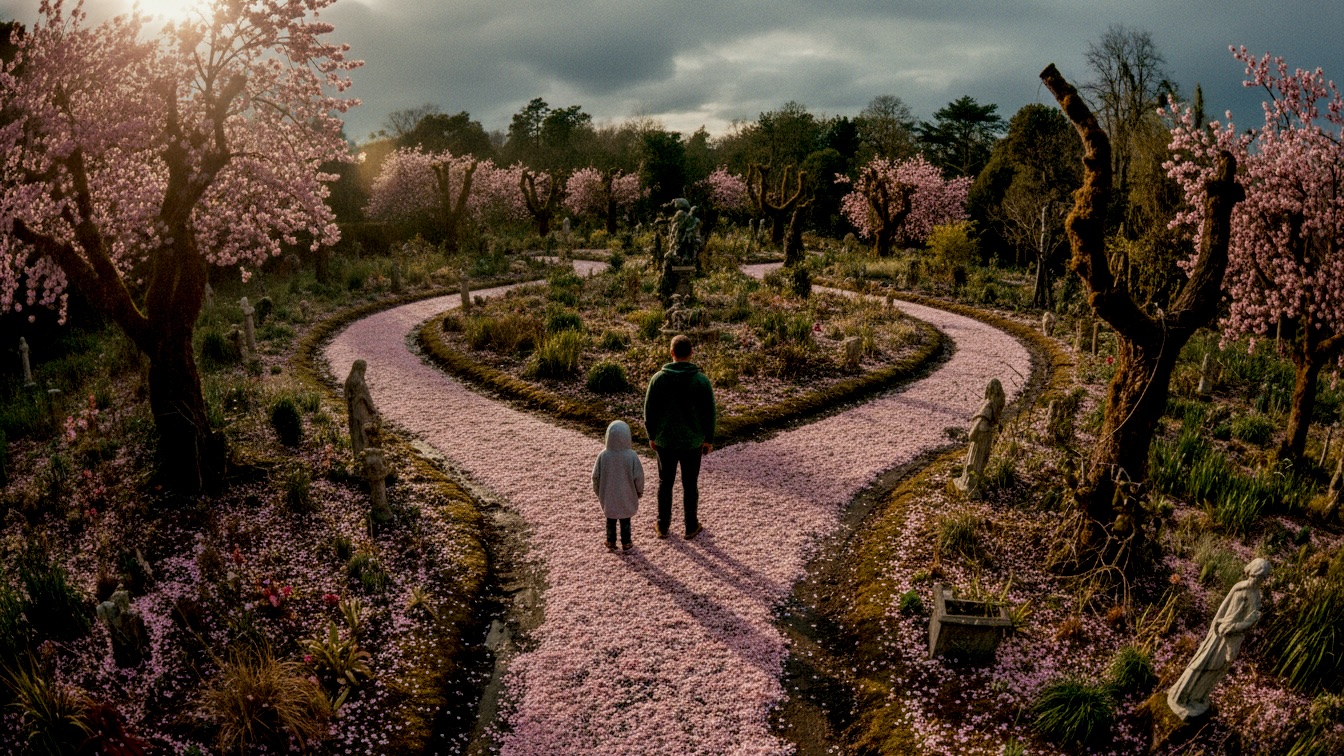
A man stands paralyzed in a mud-caked garden, his boots sinking into the earth as the air itself takes on the physical weight of wet rocks. The simple choice between a path to his house and a path into the woods becomes a life-or-death struggle against a sentient, suffocating atmosphere.
Paralyzed by a life of indecision, a man must navigate a surreal, encroaching garden that physically manifests his psychological stagnation. To save his niece and himself, he must decide whether to remain an anchor in the mud or sacrifice his identity to step into the unknown.
The primary theme is the "Paralysis of Choice," illustrating how the fear of making the wrong decision can lead to a total cessation of life and growth. It explores the concept of "The Grey Weight," a metaphor for clinical depression and the crushing humidity of a life lived without purpose or direction, where the environment becomes as stagnant as the protagonist's mind.
The secondary theme is "Generational Inertia," symbolized by the rusted trowel and the water-damaged photograph. It suggests that stagnation is an inherited trait, passed down through tools and memories, and that breaking the cycle requires a violent, physical detachment from the comforts of one's own misery.
The immediate stake is the physical survival of Leo and Maya, who risk being permanently absorbed by the garden’s "velvet soil" and turned into literal lawn ornaments. On a deeper level, Leo’s soul is at risk; if he fails to move, he will be consumed by the "Grey Weight," becoming a frozen monument to his own inability to choose a future while his niece remains trapped in the dark with him.
The external conflict is the sentient garden, which actively rearranges itself to prevent escape and uses "The Grey Weight" to physically crush the protagonists under the guise of an eternal, wet Spring. Internally, Leo battles a profound psychological fog that makes the simplest actions feel like moving through oatmeal, a conflict exacerbated by the realization that his inheritance—the trowel—is actually his shackle. Maya provides a secondary source of friction, her youthful impatience clashing with Leo’s paralysis until the environment forces them into a desperate, shared survival struggle.
Leo is trapped in a state of total inertia in his backyard, where the mud feels like hands holding his boots and the air feels like a backpack of wet rocks. His ten-year-old niece, Maya, interrupts his trance and goads him into choosing the "secret" path toward the overgrown lilacs rather than the safe path back to his stagnant life. As they venture deeper, they discover a buried tin containing an ancient iron key and a photograph of a man—holding Leo’s exact trowel—standing in a version of the garden that looks alien and vibrant.
The discovery triggers a violent shift in the environment; the path home vanishes, replaced by a wall of carnivorous thorns, and the "Grey Weight" intensifies until the sky turns a bruised purple. Leo realizes the rust on his trowel is spreading onto his skin, fusing his body to the tool and the earth itself. In a desperate climax, he forces Maya to take the key and open a massive iron gate at the edge of the woods. As Maya disappears into a blinding white light, Leo must use his rusted limb to dig himself out of the living soil, ultimately ending up suspended between the crushing weight of his past and the terrifying lightness of the unknown.
Leo (Protagonist): At the start, Leo is a man defeated by routine and depression, physically and mentally "stuck" in the mud of his own life. His psychological arc moves from total paralysis to a harrowing acceptance of his "rust," as he eventually finds the strength to dig himself out of the earth. By the end, he is no longer a passive observer but a man who has chosen a path, even if that path leaves him physically transformed and suspended between worlds.
Maya (Supporting): Maya begins as a cynical, snarky ten-year-old who views her uncle’s paralysis with youthful boredom and modern detachment. Her arc moves from mockery to genuine terror as the garden turns hostile, eventually forcing her to step into the role of the "Key-bearer." She represents the catalyst for change, the only character capable of seeing the "vibes" of the secret path and ultimately leading the way into the light.
Leo stands paralyzed in the mud of his garden, feeling the air take on the physical weight of wet rocks as he struggles to choose between his mundane life and the dark woods. His boots sink deeper into the black earth with every passing minute, illustrating a psychological stagnation that has become a physical trap. The world around him is desaturated and heavy, mirroring the "Grey Weight" that has defined his existence for months.
His ten-year-old niece Maya breaks his trance with sharp, cynical commentary, mocking his transformation into a "lawn ornament" and pushing him toward the overgrown lilac bushes. She dismisses the safe, straight path to the house as a boring sidewalk and insists that the dark, messy path holds the "vibes" of a secret treasure. Her youthful decisiveness forces Leo to take his first agonizing step forward, breaking the suction of the mud with a wet, heavy groan.
Deep within the shadows of the lilacs, they discover a rusted tin box fused to the roots of a dying tree, containing an ancient iron key and a disturbing photograph. The image reveals a man holding Leo’s exact trowel in a vibrant, alien version of the same garden, suggesting a generational cycle of entrapment. As Leo grips the trowel, he realizes the orange rust is no longer just on the metal but is beginning to spread across his own skin, staining his fingers a deep, dull orange.
The discovery triggers a violent environmental shift as the path back to the house vanishes behind a wall of carnivorous thorns and the sky turns a bruised, pulsing purple. The "Grey Weight" becomes a crushing physical force, and the garden begins to rearrange itself into a labyrinth of sentient vines that smell of old metal and rotting meat. Leo’s arm becomes increasingly stiff as the rust fuses his bone to the wooden handle of the trowel, turning him into a permanent fixture of the landscape.
They reach a massive wrought-iron gate at the edge of the woods, where the velvet soil begins to swallow Leo’s legs in a warm, relentless grip. Realizing he is too anchored by the rust to use the key himself, Leo passes the artifact to Maya and commands her to open the way to salvation. Maya unlocks the gate, revealing a blinding white light that shivers the air and momentarily lifts the oppressive weight of the garden.
Maya steps into the light and disappears, but the gate closes on Leo’s rusted arm, leaving him suspended between the suffocating garden and the weightless void. Instead of pulling away, Leo uses his remaining strength to dig around his own trapped limb with the trowel, fighting the earth with the very tool that once symbolized his paralysis. He eventually finds a moment of absolute silence, waiting in the threshold as the scent of a thousand Springs finally begins to feel light.
The episode begins with a sense of "Leaden Stagnation," characterized by slow movements and muffled sound design to mimic Leo’s internal fog. As Maya enters, the mood shifts to "Unsettling Whimsy," before plunging into "Gothic Terror" once the house disappears and the garden turns predatory. The finale offers a "Bittersweet Catharsis," where the relief of the white light is tempered by the physical cost of Leo’s escape and the uncertainty of his final state.
If expanded, the season would follow Maya on the "other side" of the gate, using the black key to navigate a series of interconnected psychological landscapes that mirror different human failings. Each episode would introduce a new "Keeper" like Leo, individuals who have become fused with objects of their own stagnation—such as a broken clock, a silent radio, or a locked diary—within the Overgrowth.
The season finale would reveal that the "Grey Weight" is a sentient force harvesting human regret to grow the garden, and Maya must decide whether to close the gates forever or find a way to prune the Overgrowth. Leo’s fate would remain a recurring mystery, as Maya catches glimpses of him in the "white light," slowly shedding his rusted skin as he helps other lost souls find their way to the threshold.
The visual style utilizes "Tactile Surrealism," focusing on extreme close-ups of wet earth, orange rust, and the texture of the "bruised plum" leaves to create a sense of sensory overload. The lighting transitions from a flat, high-key "Overcast Grey" in the first act to a saturated, neon-gothic "Deep Purple" in the woods, ending in a "High-Exposure White" that bleeds out all detail.
Tonal influences include the environmental dread of Annihilation and the domestic surrealism of Twin Peaks. The tone is somber and heavy, yet punctuated by the sharp, modern dialogue of Maya, creating a jarring contrast between the ancient, organic horror of the garden and the contemporary world she represents.
This episode targets fans of "Elevated Horror" and "Psychological Thrillers," specifically those aged 25-45 who resonate with themes of mid-life stagnation and mental health. It is designed for an anthology format similar to Black Mirror or Guillermo del Toro's Cabinet of Curiosities, appealing to viewers who enjoy metaphorical storytelling and high-concept visual world-building.
The pacing is intentionally "Glacial" in the first three minutes to immerse the audience in Leo’s paralysis, before accelerating into a "Frantic Crawl" during the escape sequence. The 10-12 minute runtime follows a strict three-act structure: Act I (The Stagnation), Act II (The Discovery and Environmental Shift), and Act III (The Gate and the Dig).
The "Rust" effect on Leo’s arm should be achieved through a combination of high-detail prosthetic makeup and subtle CGI to show the orange flakes "pulsing" or moving under the skin. The transition of the garden from a normal backyard to a wall of thorns requires a modular set design where the background greenery can be mechanically shifted or replaced with "carnivorous" variants to minimize post-production costs.
Sound design is critical; the "Grey Weight" should be represented by a low-frequency hum (infrasound) that increases in volume as the episode progresses. The "wet leather" sound of the vines and the "bone-breaking" click of the lock should be hyper-realized to emphasize the physical stakes of the environment and the violent nature of Leo's eventual liberation.


