Format: Short Film / Anthology Episode | Est. Length: 10-12 minutes
Imagine a near-future anthology series titled The Quantified Soul, where every human emotion and biological impulse has been turned into a corporate Key Performance Indicator (KPI). In this world, wellness is not a state of being but a mandatory metric tracked by wearable tech, and "Growth Week" is the high-stakes annual ritual where employees must prove their biological alignment with company goals. The series explores the friction between messy human reality and the sterile, algorithmic demands of late-stage corporate capitalism, with each episode focusing on a different "optimization" protocol that pushes a protagonist to their breaking point.
Ben stares in horror at his wristband, which is pulsing a violent, failing red, while his colleague’s device glows a serene, smug green—signaling that his "Inner Spring Potential" is bottoming out before the retreat has even begun.
In a corporate retreat where career success is measured by the growth of a bio-linked seedling, a cynical employee discovers the "nature" around him is a high-tech fraud. His genuine laughter at the absurdity triggers a systemic biometric overload that puts him in the crosshairs of the company’s security algorithm.
The primary theme is the commodification of wellness and the "theatre of productivity," exploring how modern corporate culture attempts to colonize the internal emotional lives of its workers. It examines the conflict between authentic human experience—even "negative" emotions like irony or frustration—and the forced, artificial positivity required by high-performance environments.
The episode functions as a satirical techno-thriller, blending the clinical aesthetic of a high-end tech launch with the creeping dread of a surveillance state. It highlights the absurdity of quantifying the unquantifiable, suggesting that true "growth" only occurs when one stops performing for the sensors and acknowledges the reality of their environment.
For Ben, the stakes are initially professional: failing to "manifest" growth means a Performance Improvement Plan and the potential loss of his livelihood. However, as the episode progresses, the stakes shift to his psychological autonomy; he must choose between maintaining the lie to survive or embracing a "toxic" truth that makes him an enemy of the system. For Dr. Jones and the firm, the stakes involve the integrity of their control mechanism, as Ben’s authentic reaction threatens to crash the very infrastructure used to domesticate the workforce.
The primary conflict is Man vs. System, personified by Dr. Jones, the polished and plastic face of the Bloom Lab who views human emotion as a variable to be managed. Ben faces an internal conflict between his natural cynicism and the survival instinct to "lean in" to the corporate delusion. The antagonistic force is the "Inner Spring" algorithm itself—an unfeeling, data-driven judge that interprets Ben’s genuine joy as a systemic threat because it does not fit into its pre-defined categories of "Verdant" or "Stagnant."
Ben and his ambitious colleague Sarah arrive at The Bloom Lab, a massive glass dome designed for "Growth Week," where their career futures are tied to the health of a seedling linked to their biometric wristbands. While Sarah thrives by mimicking the "botanical harmony" demanded by the firm, Ben’s "Inner Spring" score plummets due to his inability to suppress his irony and discomfort. Dr. Jones, the retreat’s guru, reprimands Ben for his "stagnant mindset" as his seedling literally withers and dies under the weight of his "emotional inefficiency," leading to Ben being sent to the "Silent Awakening" hall for corrective meditation.
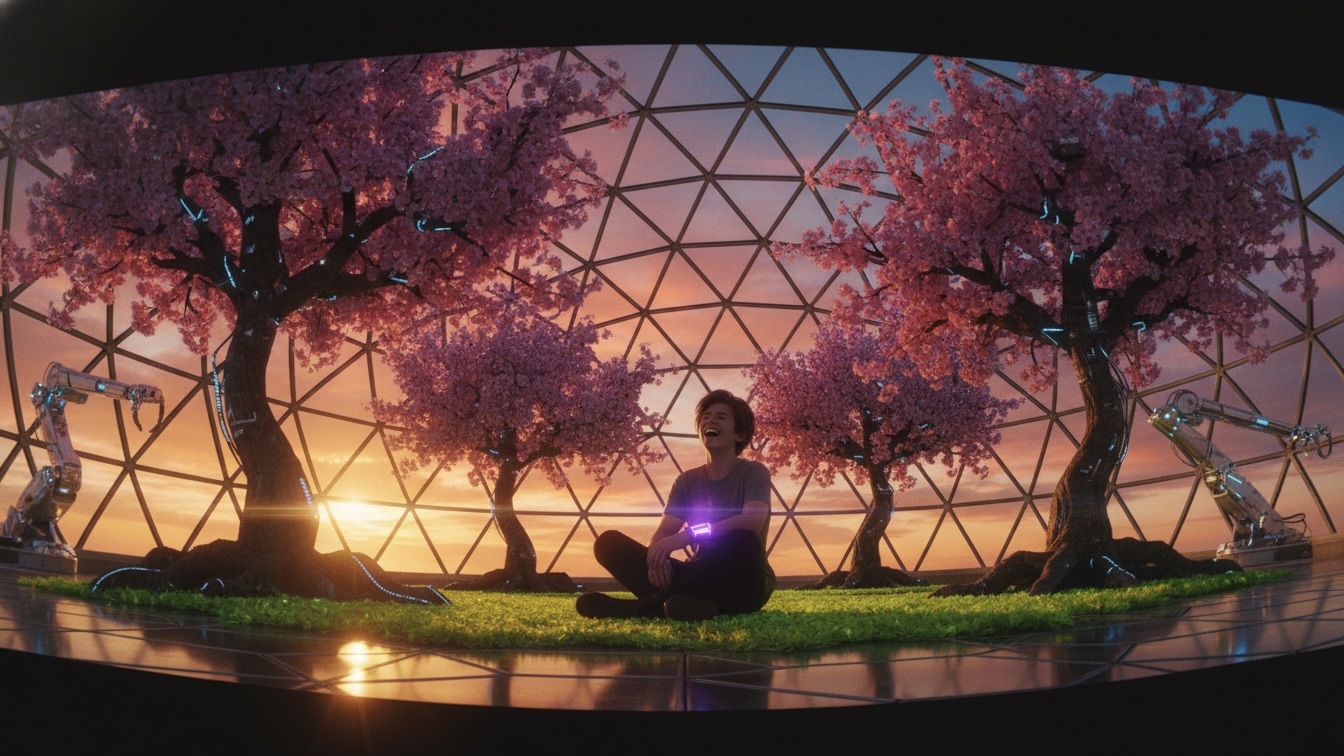
While in the hall, Ben accidentally discovers that the ancient trees and lush moss are high-tech props—plastic trunks, hidden misting nozzles, and fiber-optic cables disguised as nature. The realization that the entire "spiritual" experience is a scripted lie triggers a fit of genuine, uncontrollable laughter, which the biometric system misinterprets as a massive surge in growth potential. His "Inner Spring" score skyrockets, overloading the facility's grid and causing a localized system failure. As the episode ends, Ben stands liberated by the truth, but the facility’s security cameras swivel toward him, signaling that the algorithm has transitioned from nurturing him to identifying him as a critical malfunction.
Ben (Protagonist): A weary, cynical mid-level employee who has reached his limit with corporate jargon. He begins the episode in a state of anxious non-compliance, trying and failing to "perform" the required emotions, but ends in a state of defiant liberation after discovering the facility's fraud. His psychological arc moves from the fear of being "stagnant" to the realization that his "toxicity" is actually his most authentic and powerful trait.
Sarah (Supporting): Ben’s high-achieving, hyper-competitive colleague who has fully internalized the firm’s "growth" ideology. She functions as a foil to Ben, starting the episode in a state of smug "alignment" and ending it in a trance-like state of total corporate assimilation, unable to see the artificiality around her even as the system glitches.
Dr. Jones (Antagonist): The architect of the Bloom Lab, wearing recycled plastic suits and speaking in filtered, premium-subscription tones. He is the personification of the algorithm, lacking genuine human empathy and viewing employees as biological batteries for the firm's KPIs. He begins as a calm, condescending mentor and ends in a state of unscripted panic when Ben’s authentic joy breaks his controlled environment.
The episode opens in the blindingly bright lobby of the Bloom Lab, establishing the biometric disparity between Ben’s failing red wristband and Sarah’s green glow. Dr. Jones enters with a rehearsed, smooth-as-silk speech about "spring as a KPI," setting the clinical and high-stakes tone of the retreat. Ben’s physical discomfort and the oppressive heat of the glass dome emphasize his disconnect from the "botanical harmony" he is supposed to feel.
In the Manifestation Suite, the tension rises as Ben is forced to link his vitals to a pathetic, yellowing sprout while Sarah’s plant unfurls new leaves in real-time. Dr. Jones looms over Ben, diagnosing his "irony" as a growth-inhibitor, creating a claustrophobic atmosphere of psychological surveillance. The beat culminates in the "Critical Vitality Drop" as Ben’s seedling turns black and dies, leading to his humiliating exile to the Silent Awakening hall.
The climax occurs in the hall, where the silence is broken when Ben discovers a seam in an "oak" tree and realizes the forest is a mechanical stage. His transition from shock to belly-aching laughter serves as the narrative pivot, causing his wristband to flash a chaotic purple as it fails to categorize his authentic joy. The episode ends with the metallic clank of the speakers cutting out and the security cameras locking onto Ben, shifting the mood from absurdist comedy to a chilling, "man against the machine" cliffhanger.
The episode begins with a sense of Anxiety and Alienation, mirroring Ben’s feeling of being a "bug under a magnifying glass." As he enters the Manifestation Suite, the mood shifts to Oppressive Absurdity, where the ridiculousness of the corporate demands creates a high-pressure environment. Upon entering the Silent Awakening hall, the tone briefly touches on Eerie Serenity before exploding into Cathartic Liberation during Ben’s laughter. The final moments pivot sharply into Paranoid Suspense, leaving the audience with the realization that Ben’s moment of truth has made him a target.
If expanded, the season would follow Ben as he becomes an accidental revolutionary within the firm, using his "un-optimizable" emotions to disrupt other biometric protocols. He would eventually discover that the "Inner Spring" data isn't just for performance reviews, but is being harvested to train a new AI that can predict and suppress employee dissent before it happens. Sarah would serve as his primary antagonist, rising through the ranks by becoming more "plant-like" and less human, eventually leading to a confrontation where Ben must decide whether to save her or burn the entire Bloom Lab down.
The thematic escalation would move from individual wellness to societal control, exploring how the "Optimized Equinox" is just one part of a global "Eternal Spring" initiative. Each episode would introduce a new "Agent of Stagnation"—other employees who have found ways to "glitch" the system through grief, anger, or love. The season finale would see Ben facing the ultimate choice: accepting a high-level position where he can "fake" his metrics perfectly, or triggering a total system reset that would destroy the firm but leave the employees "un-quantified" and vulnerable in the real world.
The visual style is "Clinical Organic"—a mix of hyper-modern, minimalist architecture and unnaturally perfect greenery. The lighting should be high-key and slightly overexposed in the dome to create a sense of discomfort, transitioning to a moody, "forest-floor" green in the Awakening Hall. The camera work should be steady and symmetrical during Dr. Jones’s scenes to reflect his control, becoming handheld and erratic during Ben’s laughter to mirror the system’s breakdown.
Tonal influences include the dry, corporate satire of Severance and the colorful, high-tech dystopia of Black Mirror (specifically the episode "Nosedive"). The sound design is crucial, featuring a "premium" layer of filtered voices and bird loops that suddenly cut to reveal the mechanical whirring and metallic echoes of the true environment. The contrast between the "Optimized" bird chirps and Ben’s jagged, human laughter should be jarring and visceral.
The target audience consists of adults aged 22-45 who are familiar with the pressures of modern "hustle culture," corporate wellness trends, and the ubiquity of wearable health tech. It appeals to viewers who enjoy dark satire, speculative fiction, and "social thriller" narratives that reflect contemporary anxieties about privacy and the workplace. The episode is designed for a streaming context, where its short, punchy runtime and high-concept premise can spark immediate social media discussion.
The pacing is "Accelerated Dread," starting with a slow, clinical introduction that builds speed as the biometric feedback loops tighten. The first 4 minutes establish the world and the conflict, the next 4 minutes focus on the "Manifestation" failure, and the final 4 minutes cover the discovery in the hall and the subsequent system overload. The 10-12 minute runtime ensures that the satirical point is made sharply without overstaying the "absurdist" welcome, maintaining a high-tension tempo until the final frame.
The primary production challenge is the "Manifestation Suite," requiring practical "dying" plant effects and high-quality prop seedlings that can unfurl on cue. The Silent Awakening hall requires a sophisticated set design that looks like a lush forest at first glance but reveals its mechanical nature through "breakaway" sections of moss and hollow, textured plastic tree trunks.
The Bio-Spring 3.0 wristbands should be functional props with programmable LED arrays to reflect the changing "Inner Spring" scores in real-time. Sound design will be a major post-production factor, specifically the transition from the "Optimized Forest Noises" to the raw, mechanical sounds of the facility. The use of a real glass dome or a high-quality "Volume" stage would be ideal to capture the specific way sunlight interacts with the environment, enhancing the "bug under a magnifying glass" aesthetic.


