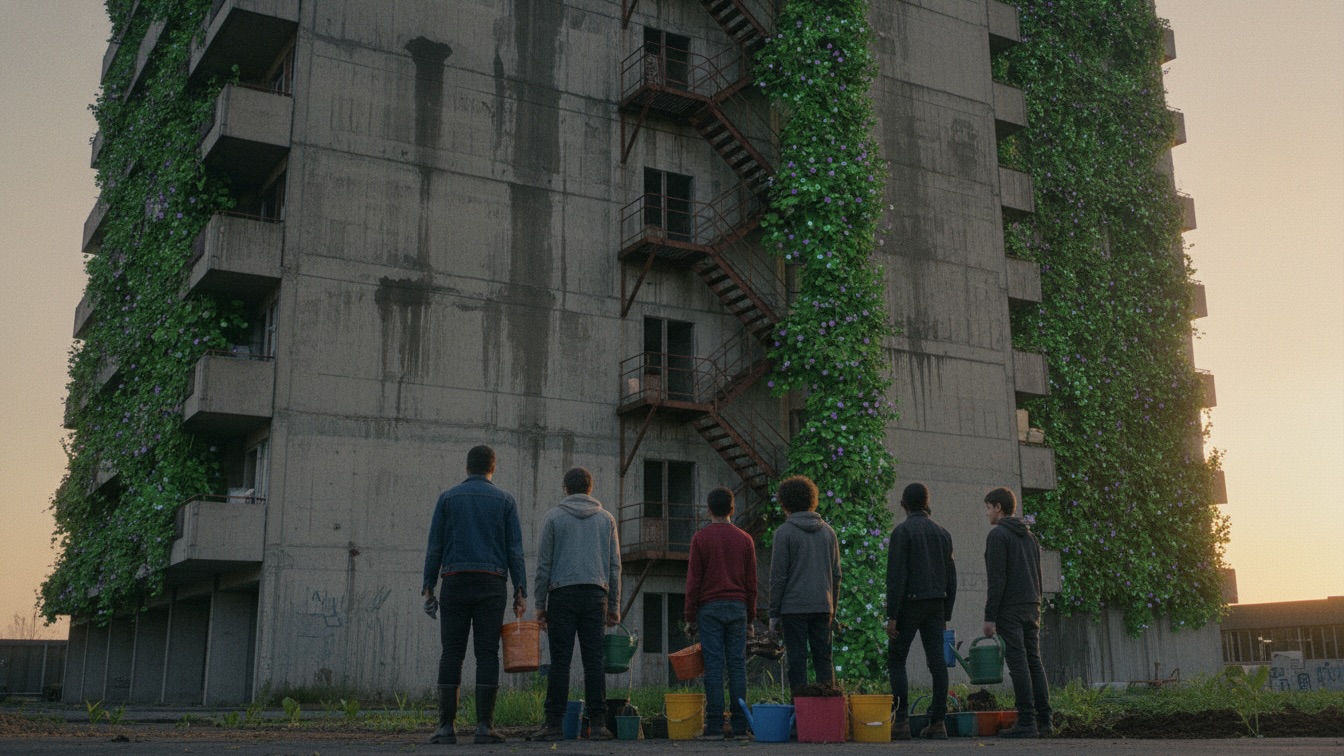
Format: Short Film / Anthology Episode | Est. Length: 10-12 minutes
Imagine a near-future anthology series titled The Concrete Pulse, where each episode explores a different "guerrilla" intervention in a decaying megacity. This series follows the intersection of high-tech survival and low-life resilience, focusing on the "solarpunk" rebels who fight to reclaim their environment from corporate neglect. Each installment highlights a specific sector of the city, building toward a larger narrative of collective uprising against the Council’s sterile, suffocating control through decentralized technology and organic defiance.
Wendy hangs thirty feet up a rotting concrete wall, her haptic gloves humming as she grafts "bio-scaffolding" onto a building that looks like a burning dumpster. From his balcony, her cynical neighbor Matt watches with a lukewarm protein shake, convinced she’s just putting stickers on a corpse.
In a sweltering urban slum, a rogue architect attempts to install a living, bio-engineered forest on the side of a decaying housing block. When the city’s infrastructure fails and the heat spikes, she must rally her cynical neighbors to save the plants—and their own air—before the authorities arrive to tear it down.
The primary theme is the tension between "solarpunk" hope and "cyberpunk" despair, illustrating how community action can bridge the gap between high-tech solutions and grassroots needs. It explores the concept of "biophilia" in an artificial environment, suggesting that human connection to nature is not a luxury but a fundamental right that can catalyze social cohesion in an atomized society.
The secondary theme focuses on the democratization of technology through decentralized funding and "gray-market" engineering. It critiques the bureaucratic weaponization of "aesthetics" and "city codes" to maintain class divides, ultimately arguing that survival in a dying climate requires breaking the rules established by those who are already safe.
For Wendy, the stakes are both professional and existential; failure means being blacklisted from the architecture guild and losing her only chance to prove that green-tech can save the poor. For the residents of Sector 4, the stakes are literal survival, as the "Urban Heat Island" effect threatens to turn their homes into unlivable ovens. If the project fails, the City Council will use it as a precedent to permanently deny environmental resources to "low-priority zones," dooming the sector to slow suffocation.
The primary external antagonist is Councilman Barnes, who represents the cold, bureaucratic indifference of the North District and views the project as a violation of the "crushing poverty" aesthetic. Environmental forces act as a secondary antagonist, with the extreme heat spike and the building's crumbling, clogged plumbing creating a race against time. Internal conflict stems from Matt’s deep-seated cynicism and the residents' initial apathy, which Wendy must overcome to form the "bucket brigade" necessary for the plants' survival.
Wendy, a rogue architect, scales the Sector 4 housing block to install a bio-scaffolding system funded by micro-donations, despite the cynical jeers of her neighbor, Matt. As she grafts the self-repairing moss onto the soot-stained walls, a sudden, lethal heat spike hits the city, causing the building's ancient plumbing to fail and threatening to wither the seedlings before they can take root. With the city’s automated patrol drones closing in and the Councilman preparing to shut her down, Wendy realizes her high-tech solution cannot survive without a low-tech human intervention.
Desperate, Wendy convinces Matt to drop his mask of indifference and mobilize the building’s residents into a manual bucket brigade to feed the irrigation nodes. The community, previously isolated by poverty and digital lag, unites to haul greywater from the basement, successfully reviving the bio-scaffold just as Councilman Barnes arrives to condemn the "violation." Faced with a glowing, living landmark and a unified voting block, Barnes is forced to pivot, declaring the project a "pilot program," though a final, mysterious hacking attempt on Wendy’s ledger suggests a deeper conspiracy is already working to erase their victory.
Wendy: A visionary architect turned digital ghost who has traded her professional standing for a chance to save the slums. At the start, she is a frantic idealist who believes technology alone can fix the world, but by the end, she realizes that community mobilization is the essential "prime" for any system. Her psychological arc moves from isolated engineering to collaborative leadership, though the final alert on her comm leaves her in a state of high-alert paranoia.
Matt: A twenty-something "watchdog" of Sector 4 whose cynicism is a defense mechanism against a lifetime of failed urban renewal projects. He begins the episode as a detached observer, mocking Wendy’s efforts to "put stickers on a dumpster fire," but ends as the primary catalyst for the bucket brigade. His arc is one of rediscovered agency, moving from passive nihilism to active participation in his community's survival.
Councilman Barnes: The polished, suit-wearing face of the North District elite who views the city through the lens of codes and PR wins. He is static in his arrogance, only shifting his stance when the political cost of destroying the "landmark" outweighs the benefit of enforcing the code.
The Ascent: Wendy scales the crumbling Sector 4 wall while Matt heckles her from his balcony, establishing the contrast between her bio-scaffolding and the surrounding urban decay. The haptic gloves provide a sensory link to the building's structural rot, emphasizing the precariousness of her mission as she explains the "surface stabilization" loophole. This beat establishes the high-tech/low-life setting and the immediate physical danger Wendy faces.
The Heat Spike: Just as the first five floors are covered in the green ribcage, the temperature HUD spikes to ninety-two degrees, and the building's ancient irrigation system fails due to a blockage. Wendy frantically tries to override the manual valves, but rust and neglect have fused the machinery, leaving the seedlings to turn yellow under the copper sun. The tension shifts from legal risk to an immediate environmental crisis that threatens to destroy the project in minutes.
The Bucket Brigade: Matt vaults over his railing to join Wendy, leading a ragtag group of residents who pass containers of greywater hand-to-hand up the fire escape. This midpoint climax transforms the solitary engineering project into a collective act of defiance, showing residents who never spoke to each other working in a rhythmic, chaotic harmony. The bio-scaffold reacts to the hydration, expanding its mesh and beginning to glow as the nutrients kick in.
The Council’s Arrival: As the sun sets and the building begins to phosphoresce with a purple glow, Councilman Barnes arrives in a sleek hover-car to cite code violations and order the project's destruction. Wendy and Matt stand their ground, using the public ledger's live data and the presence of the unified residents to trap Barnes into a PR corner. The beat concludes with Barnes begrudgingly validating the "pilot program" to save face before his upcoming election.
The Digital Breach: The residents celebrate their "salad on a skyscraper" and the cooling air, but the victory is undercut by a red alert on Wendy’s wrist-comm. An unknown, high-level encryption begins pinging the decentralized ledger, attempting to wipe the project's data from existence. The episode ends on a cliffhanger, revealing that while they won the physical battle, the digital war for Sector 4 has only just begun.
The episode begins with a sense of gritty, high-altitude tension and cynical humor, mirroring the friction between Wendy’s idealism and Matt’s realism. As the heat spike occurs, the mood shifts into a claustrophobic, frantic survival thriller, peaking with the cathartic, sweat-soaked unity of the bucket brigade. The finale offers a brief, glowing moment of "solarpunk" wonder and triumph, which is immediately sharpened into a cold, technological dread by the final cliffhanger, leaving the audience feeling both inspired and unsettled.
In a full season, the "Green Initiative" would expand to other blocks, with Wendy and Matt acting as consultants for other neighborhoods trying to replicate the bio-scaffold. Each episode would introduce a new environmental or social hurdle—such as corporate sabotage of the seed supply or the "North District" attempting to gentrify the newly cooled sectors. The overarching mystery would center on the source of the data breach, eventually revealing that the City Council is using the green-tech to mask a more sinister surveillance network embedded in the bio-mesh.
The season would culminate in a city-wide "Blackout vs. Bloom" event, where the Council attempts to shut down the decentralized ledger entirely. Wendy must choose between keeping the plants alive and exposing the surveillance data she’s discovered, while Matt organizes a city-wide network of bucket brigades to keep the "Concrete Pulse" beating. The finale would see the transformation of the entire Sector 4 into a self-sustaining fortress, setting the stage for a full-scale revolution against the North District’s monopoly on resources.
The visual style is "Industrial Solarpunk," blending the rusted, grimy textures of Children of Men with the vibrant, bioluminescent aesthetics of Avatar. The camera work should be handheld and kinetic during the climb and the bucket brigade to emphasize the heat and physical labor, contrasting with the smooth, stabilized, and cold shots used for Councilman Barnes and his hover-car. The color palette transitions from soot-grays and copper-oranges to deep emeralds and phosphorescent purples as the garden comes to life.
Tonal influences include the grounded sci-fi of The Expanse and the community-driven grit of Shameless. The sound design is crucial, featuring the constant hum of haptic sensors, the rhythmic clanging of metal buckets, and the transition from the dull roar of traffic to the soft, organic rustle of the bio-mesh. The music should be a hybrid of lo-fi industrial beats and swelling orchestral swells that trigger when the plants begin to thrive.
This project targets the "New Adult" demographic (ages 18-35) who are engaged with themes of climate anxiety, decentralized technology, and social justice. It appeals to fans of speculative fiction who prefer "used future" settings and stories where the hero’s power comes from engineering and community organizing rather than superpowers. The short, high-intensity format makes it ideal for anthology platforms or as a standalone digital pilot.
The 10-12 minute runtime follows a compressed three-act structure: Act I (The Setup/Climb) takes 3 minutes, Act II (The Heat Spike/Brigade) takes 6 minutes, and Act III (The Confrontation/Cliffhanger) takes 3 minutes. The pacing is relentless, using the rising heat as a literal and metaphorical ticking clock to ensure there are no lulls in the narrative. The transition from the frantic labor of the brigade to the silent arrival of the hover-car provides a necessary "breath" before the final confrontation.
The bio-scaffolding should be a mix of practical "green wall" elements and CGI enhancements to handle the rapid growth and phosphorescence. The "haptic glove" interface and Wendy’s HUD should be rendered as diegetic AR elements, keeping the audience grounded in her perspective without cluttering the frame.
Filming requires a location with significant verticality and weathered textures—an abandoned industrial site or a brutalist housing project would serve as the ideal base. The "heat" effect can be achieved through color grading and the use of practical haze, while the bucket brigade sequence requires a large cast of extras to create the sense of a populated, living building.


