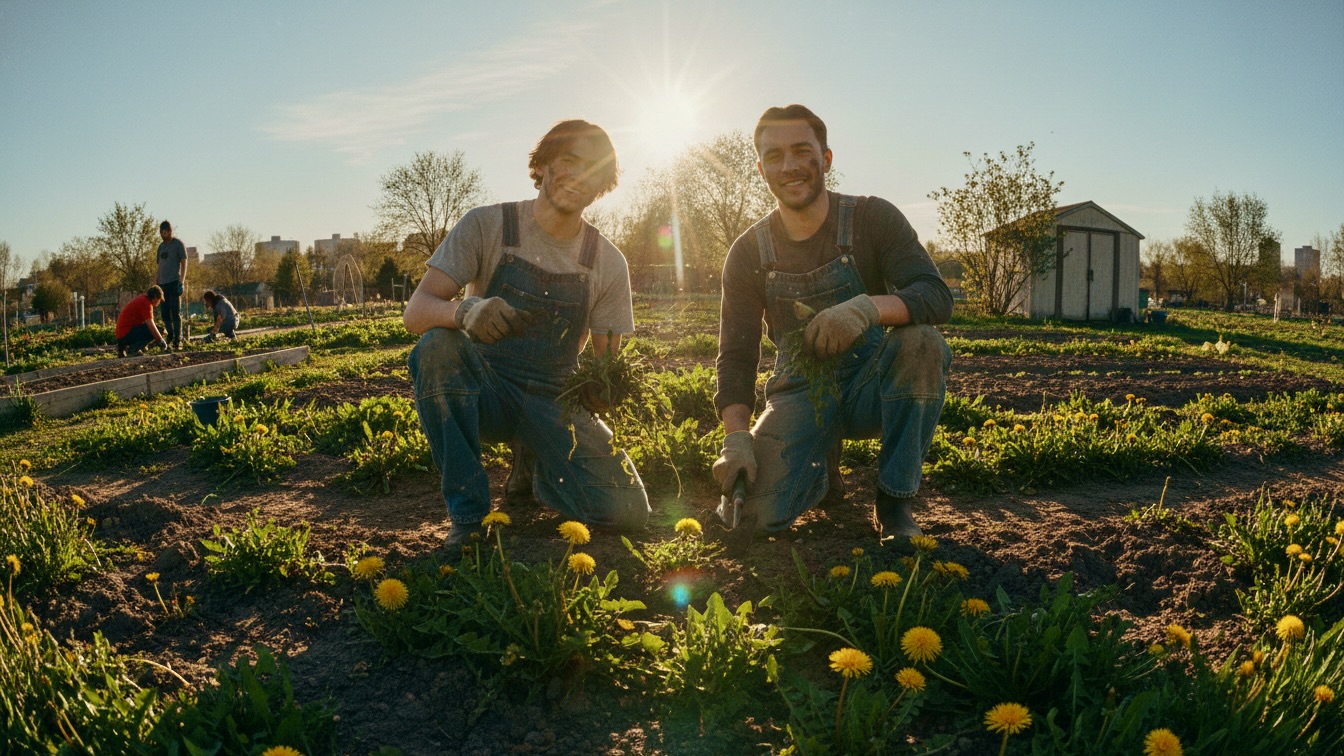
Format: Short Film / Anthology Episode | Est. Length: 10-12 minutes
Imagine this story as a cornerstone episode of The Common Lot, an anthology series that explores the surreal existential crises of urban dwellers through the lens of a shared community garden. Each episode centers on a different plot, where the mundane act of gardening becomes a catalyst for deep-seated personal revelations, bizarre suburban mysteries, and the messy intersection of nature and human neurosis. The series follows a seasonal arc where the garden itself acts as a silent witness to the evolving lives of its disparate members, culminating in a neighborhood-wide event that forces every character to confront what they have buried.
Under a blistering, unseasonable spring sun, two sleep-deprived siblings struggle to unlock a rusted community garden gate, unaware that their simple chore is about to unearth a life-altering secret.
Two exhausted siblings attempt to save their grandmother’s garden plot while grappling with a secret academic failure. Their clumsy efforts lead to an accidental act of agricultural sabotage that threatens to expose their deepest insecurities.
The primary theme explores the "Root of Failure," contrasting the physical difficulty of gardening with the psychological weight of life’s expectations. It examines how people often "snap the stem" of their problems rather than digging deep enough to address the source of their anxiety, suggesting that true growth requires a willingness to confront the messiest parts of one's identity.
The second theme focuses on "The Illusion of Perfection," represented by the contrast between the siblings' chaotic Plot 18 and the pristine Plot 42. It highlights the hidden pressures of maintaining appearances and the gritty, often "cheap" reality of trying to grow something meaningful in a hostile environment where the sun and the soil seem to conspire against human effort.
For Pete and Tess, the immediate stake is the loss of their grandmother’s garden plot to the city, a tangible link to their family heritage that they feel obligated to protect. However, the deeper emotional stake is Tess’s identity; having secretly dropped out of her master’s program, she faces the total collapse of her self-worth and her relationship with her family if she cannot successfully complete even this simple, manual task.
The primary external conflict is the environment itself—the oppressive heat, the concrete-hard soil, and the aggressive weeds of Plot 18 that act as physical barriers to their progress. Internally, Tess battles her own paralyzing fear of inadequacy and the shame of her secret academic withdrawal, while Pete struggles with his frustration toward his sister’s instability. The looming "antagonist" is the unseen Mrs. Wilson, whose perfect garden represents an unattainable standard of success that the siblings have accidentally desecrated.
Pete and Tess arrive at a community garden on a punishingly hot spring day to plant tulip bulbs for their grandmother. They are both physically and mentally exhausted, with Tess vibrating from a lack of sleep and a secret she is struggling to keep from her family. As they battle the sun, rusted tools, and impenetrable dirt, Tess’s frustration boils over, leading her to accidentally pull a prize-winning, baseball-bat-sized carrot from their neighbor’s perfect plot.
Panicked and convinced they have ruined a stranger's life, they attempt to bury the evidence using a bag of cheap potting soil, creating an obvious, grave-like mound on the neighbor's property. This act of "agricultural sabotage" triggers a breakdown for Tess, who confesses she has dropped out of her master’s program because she feels like a fraud. Pete helps her find the strength to finish their own task properly, but as they leave the garden, they witness the "buried" evidence beginning to resurface in a way that suggests their problems cannot be so easily hidden.
Pete: A pragmatic, weary young man who acts as the anchor for his sister’s volatility. At the start, he is dismissive and focused solely on the physical task to satisfy his grandmother, but by the end, he adopts a role of unexpected emotional depth, using the metaphor of the soil to help Tess process her failure. He ends the episode exhausted but more connected to his sister, having moved from irritation to a protective, grounded empathy.
Tess: A high-strung, dramatic academic who is currently spiraling after secretly quitting her master's program. She begins the episode in a state of performative exhaustion and frantic denial, but through the physical struggle of the garden, she reaches a place of raw, muddy honesty. By the end, she accepts that she is "a mess," finding a small measure of peace in the literal act of touching the earth and admitting her defeat.
Mrs. Wilson (Supporting/Off-screen): The unseen owner of Plot 42, whose presence is felt through the intimidating perfection of her garden. She represents the societal pressure of success and the "blue ribbon" standards that Tess feels she has failed to meet, serving as a silent judge of the siblings' incompetence.
Pete and Tess struggle against a rusted padlock under a glaring, aggressive sun that feels more like summer than spring. Pete eventually forces the lock open with a sound like a breaking bone, symbolizing the violent start to their chore. They enter the grid of dirt rectangles, feeling like intruders in a space that smells of wet decay and ancient earth.
Upon reaching their grandmother’s neglected plot, they find a hostile landscape of thorny weeds and stagnant water that contrasts sharply with the neighboring, perfect gardens. Pete retrieves dull, rusted tools and a heavy bag of cheap soil from a dilapidated shed, setting a tone of struggle and low-quality materials. They begin the grueling process of scraping at the concrete-hard earth, their physical pain mirroring their internal exhaustion.
Tess, fueled by a sudden burst of "farmer" aggression, attempts to pull a weed on the border of Plot 42 but instead uproots a massive, baseball-bat-sized carrot. The siblings realize they have destroyed Mrs. Wilson’s prize-winning vegetable, leading to a frantic, botched attempt to re-bury the evidence under a mound of dark, smelly potting soil. This moment serves as the midpoint, shifting the tone from a chore to a desperate cover-up.
While trying to remove a stubborn dandelion root, Tess snaps the stem and suffers a total emotional breakdown, revealing she has dropped out of her master’s program. Pete stops his work to listen, eventually using the physical act of digging out the deep dandelion root to explain that life’s problems require "digging wider" rather than just snapping off the tops. This is the emotional climax, where the sibling bond is reinforced through shared failure and dirt.
With a newfound, quiet focus, the siblings work together to plant the tulip bulbs "pointy side up" in a neat, professional trench. They cover the bulbs with the cheap soil and smooth the earth, achieving a small but significant victory over the hostile plot. As the sun sets and the light turns golden, they lock the gate, feeling a temporary sense of closure and physical accomplishment.
Just as they prepare to walk away, they look back at the "grave" in Plot 42 and see the dark soil shifting. The neon orange tip of the stolen carrot begins to poke through the surface, suggesting that their secrets and mistakes cannot stay buried forever. The episode ends on this unsettling, surreal image of the earth rejecting their cover-up.
The episode begins with a sense of "Abrasive Exhaustion," characterized by the oppressive heat and the physical resistance of the gate. It transitions into "Frantic Absurdity" during the carrot incident, before dipping into "Raw Vulnerability" during Tess’s confession. The final movement is one of "Quiet Resignation," ending on a "Surreal Cliffhanger" that leaves the audience feeling both a sense of relief for the siblings' bond and an anxious anticipation of the consequences to come.
In a full season, Plot 18 would serve as the home base for Pete and Tess as they return weekly to tend to the growing tulips, with each episode focusing on a different "infestation" or "growth" that mirrors their personal lives. The mystery of the resurfacing carrot would escalate as Mrs. Wilson begins to investigate the "sabotage," leading to a neighborhood-wide conflict that forces the siblings to confront the community they tried to hide from.
The season would explore the gradual transformation of the garden from a place of chore and shame into a sanctuary of honesty. As the tulips eventually bloom (or fail to), Tess must decide whether to re-enroll or find a new "root" for her life, while Pete deals with his own hidden burdens that he has been suppressing to care for his sister, ultimately proving that even "cheap soil" can produce something beautiful if tended with enough patience.
The visual style should utilize high-contrast, "sweaty" cinematography with a shallow depth of field to emphasize the claustrophobia of the heat and the intensity of the siblings' focus. Colors should be desaturated and dusty, emphasizing the grittiness of the environment, except for the jarring, "aggressive" neon orange of the carrot and the deep, wet black of the cheap potting soil, which should pop with unnatural vibrance.
The tone is "Existential Dramedy," blending the mundane frustrations of manual labor with the heightened drama of a quarter-life crisis. It should feel like a cross between the gritty realism of a kitchen drama and the suburban surrealism of a modern anthology, where a simple vegetable can carry the weight of a Greek tragedy and the dirt under one's fingernails feels like a permanent mark of character.
This content is aimed at "Zillennial" viewers (ages 22-35) who resonate with themes of academic burnout, the struggle for adult identity, and the dark humor found in everyday failures. It is designed for anthology platforms or prestige cable networks, appealing to audiences who enjoy character-driven stories that find profound meaning in small, messy, and slightly surreal human moments.
The pacing is "Deliberately Strenuous," mimicking the slow, rhythmic effort of digging in hard earth. The first half moves slowly to build the tension of the heat and the siblings' fatigue, while the middle section (the carrot incident) accelerates into a frantic, high-energy tempo. The final minutes slow down significantly to allow the emotional weight of the confession to land before the quick, sharp final visual beat of the resurfacing carrot.
The "Monster Carrot" must be a high-quality practical prop—heavy, vibrant, and slightly larger than life—to ensure the visual impact of its "resurfacing" feels visceral and unsettling rather than purely comedic. The dirt itself should be treated as a character; different textures (hard-packed brown earth, dusty surface dirt, and the "sour" wet black potting soil) should be clearly distinguishable on camera to emphasize the siblings' progress and their mistakes.
The community garden location requires a "grid-like" layout to emphasize the feeling of being watched by neighbors, even if they are off-screen, creating a sense of surveillance. Sound design is critical, specifically the "shhh-pop" of the carrot being pulled and the "screaming" hinges of the gate, to heighten the sensory experience of the siblings' physical struggle and the aggressive nature of the environment.


