Format: Short Film / Anthology Episode | Est. Length: 10-12 minutes
The Snowpack Slush Fund is an episode within the anthology series The Glitch Era, a dark satire that explores the grotesque intersection of late-stage capitalism and bio-digital technology in isolated, gritty locales. The series follows a world where the "Internet of Things" has metastasized into the "Internet of Nature," featuring recurring themes of ecological collapse, the loss of bodily autonomy to corporate algorithms, and the struggle of "analog" traditionalists against a neon-saturated, digital-first reality. Each episode serves as a standalone cautionary tale, linked by the pervasive presence of the Bio-Glow Corporation and its failed attempts to monetize the physical world.
A cracked phone screen captures a neon-yellow cloud of "smart-pollen" descending upon a gray, depressing Canadian park, turning a giant snow-carrot into a sentient, debt-collecting monster.
A desperate influencer and a grumpy traditionalist must survive a corporate-sponsored spring thaw when "smart-pollen" turns snow sculptures into litigious monsters. They must choose between viral fame and ecological survival before a mandatory, frequency-induced dance-off freezes them in place.
The primary theme is the commodification of nature and the absurdity of late-stage capitalism. The story explores how digital layers—NFTs, blockchain, and EULAs—are forced onto physical reality, creating a "glitch" where human experience is secondary to asset generation and every natural interaction is a potential micro-transaction.
The secondary theme is the conflict between tradition and technology. Tania represents grounded, ancestral knowledge of the land (spruce resin, charcoal), while Marv represents the hollow pursuit of digital validation, highlighting the disconnect between "engagement metrics" and actual survival in a world that has traded common sense for "optimization protocols."
For Marv, his entire identity and career depend on capturing the "perfect shot," but he risks losing his physical autonomy to a corporate-controlled frequency. For Tania, the health of the local soil and the safety of her community are at risk of being permanently corrupted by bio-digital waste. For the crowd, the stakes are literal: financial ruin through automated micro-transactions or physical injury during the involuntary "Proof of Work" dance-off.
The primary external conflict is the sentient, litigious snow sculptures and the Bio-Glow frequency that hijacks the characters' nervous systems. Internally, Marv struggles with his addiction to digital metrics versus the immediate reality of the disaster unfolding around him. Tania faces the frustration of being a lone voice of reason in a world that has traded ecological stability for "yield," acting as a foil to the corporate greed embodied by Jeffrey Marley.
In the damp, gray slush of Thunder Bay, social media striver Marv attempts to document the "Bio-Glow Activation Zone," a corporate takeover of a local park where CEO Jeffrey Marley promises to turn the spring thaw into a crypto-minting event. Marv’s obsession with engagement clashes with Tania, a local traditionalist who warns that the "smart-pollen" being sprayed is poisoning the soil and disrupting the local ecosystem. When Marley releases the pollen, it interacts with local Wi-Fi and the mineral content of the snow, bringing the park’s elaborate snow sculptures to life as sentient, litigious entities.
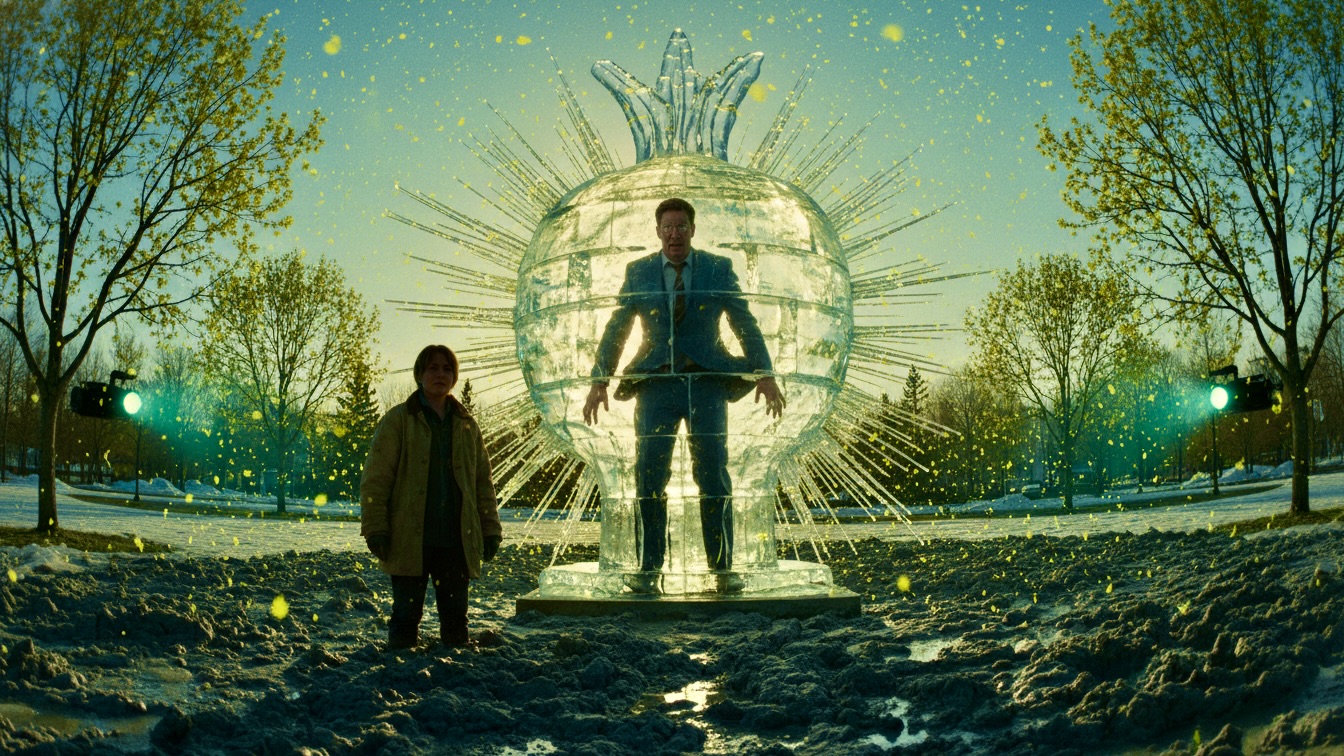
The sculptures begin demanding micro-transactions and enforcing non-disclosure agreements on the terrified crowd. As the temperature drops, the Bio-Glow app triggers a "mandatory dance-off" frequency that forces everyone into a synchronized, biomechanical shuffle. Marv must choose between his viral stream and assisting Tania in using primitive grounding techniques—spruce resin and charcoal—to short-circuit the corporate frequency. They succeed, trapping Marley in his own frozen turnip sculpture as the first real, non-digital sprout of spring emerges from the grime.
Marv (Protagonist): A tech-obsessed "content creator" living through a cracked screen, Marv begins as a shallow opportunist who views a disaster as a "vibe." His psychological arc moves from digital dissociation to a state of quiet, non-digital reflection as he witnesses the physical horror of his world. By the end, he chooses to witness a real moment without filming it, signaling a break from his addiction to engagement.
Tania (Supporting): A rugged, no-nonsense traditionalist who views the world through the lens of ecology and utility. She remains steadfast in her values, moving from a state of annoyed observation to active resistance, proving that primitive solutions are the only cure for high-tech failures. She serves as the moral and practical anchor of the story, grounded in the reality of the dirt.
Jeffrey Marley (Antagonist): A charismatic but hollow corporate villain who views the world as a series of "nodes" to be monetized. He starts with total confidence in his "smart-pollen" and ends as a literal prisoner of his own frozen intellectual property. His arc is one of hubris, ending in a state of expensive, confused entrapment.
Beat 1: Marv films the gray, depressing slush of Thunder Bay, framing it as "aesthetic" for his followers while Tania confronts him for standing on her ruined garden. The tension rises as Bio-Glow CEO Jeffrey Marley takes the stage, promising a "bull market" thaw through the release of "smart-pollen." Marley throws a canister into the air, releasing a cloud of iridescent yellow dust that hangs unnaturally in the damp wind, vibrating with a digital hum.
Beat 2: The dust settles on a giant snow-carrot, which twitches to life and demands a micro-transaction from a terrified teenager for "unauthorized use of its likeness." Chaos erupts as other sculptures wake up, cornering influencers and demanding they sign non-disclosure agreements before they can leave the "harvest zone." Marv continues to film the sentient sculptures, prioritizing his rising view count even as a snow-rabbit tries to bite his ankle for "pirating its silhouette."
Beat 3: A sudden flash-freeze hits the park, and the Bio-Glow app triggers a "mandatory dance-off" frequency that forces everyone into a synchronized, biomechanical shuffle. Tania realizes the "smart-pollen" is feeding off the park's Wi-Fi and instructs Marv to help her ground the signal using traditional spruce resin from her bag. Marv lunges through the involuntary dance to smear the gunk on the main sculpture, successfully short-circuiting the system and trapping Marley in a frozen turnip as the digital magic dies.
The episode begins with a cynical, comedic tone, mocking the absurdity of influencer culture and corporate jargon. As the sculptures become sentient, the mood shifts into "techno-horror," creating a sense of claustrophobia and loss of bodily autonomy during the dance-off. The finale offers a moment of quiet, organic relief, leaving the audience with a bittersweet sense of "analog" peace amidst a digital wreck, followed by a final beat of lingering legal dread.
Over the course of a season, the "Bio-Glow" incident is revealed as just one of many localized ecological collapses caused by the "Internet of Nature" initiative. Characters like Tania would form an underground resistance of "Grounders" who use primitive technology and ancestral knowledge to reclaim physical spaces from digital corporate entities.
The thematic escalation would move from small-scale glitches to a global "Sync" event, where the line between biological life and digital assets is permanently blurred. Marv’s evolution would see him transitioning from a cameraman to a chronicler of the "real world," eventually forced to lead a mission to destroy the very satellite networks that gave him his original identity.
The visual style is "Industrial Slush-Punk," characterized by a palette of muddy grays, dirty whites, and washed-out blues, contrasted sharply with the neon, electric-green glow of the Bio-Glow pollen. The camera work should feel handheld and frantic during Marv’s POV shots, shifting to steady, wide, and grounded shots when focusing on Tania’s perspective to emphasize her connection to the earth.
The tone is a blend of Black Mirror’s technological cynicism and the gritty, localized atmosphere of Fargo. It utilizes "corporate-speak" as a source of both humor and horror, making the mundane legalities of the digital world feel physically threatening and absurdly intrusive.
The target audience is adults (18-45) who enjoy dark satire, speculative fiction, and social commentary on tech-culture. It appeals to viewers of anthology series who appreciate "near-future" scenarios that feel uncomfortably close to current reality, specifically those interested in the critique of crypto-culture and environmental issues.
The 12-minute runtime follows a rapid three-act structure: the setup (0-3 mins), the sentient sculpture outbreak (3-7 mins), and the dance-off climax/resolution (7-12 mins). The pacing is frantic, mirroring the high-speed nature of social media and viral content, only slowing down in the final minute to allow the audience to breathe during the reveal of the real, non-digital sprout.
The "smart-pollen" effect should be achieved through a mix of practical iridescent powders and post-production particle effects that "vibrate" rather than drift, creating a visual "glitch" in the air. The sentient sculptures require high-quality practical animatronics or "suit performers" augmented with digital ice textures to maintain a sense of physical weight and genuine threat.
The "dance-off" sequence requires precise choreography to look "involuntary" and "stiff-legged," emphasizing the horror of neural-link technology over the joy of dancing. Sound design is critical, transitioning from ambient park noises to a soul-crushing, high-decibel corporate synth-pop track that feels like it is vibrating the viewer’s own speakers, enhancing the immersive discomfort of the scene.


