Format: Short Film / Anthology Episode | Est. Length: 10-12 minutes
This episode serves as a standalone entry in a psychological horror anthology titled The Liminal Mile, where characters trapped in moments of profound personal trauma find themselves physically manifested in surreal, purgatorial landscapes. Each episode explores a different "road" or "space" that reflects the protagonist's unresolved guilt, suggesting that these environments are not just dreams, but fractures in reality where the past refuses to stay buried.
Carl awakens in a desolate, blindingly white desert composed entirely of shattered windshield glass and twisted car wreckage, where the silence is a physical weight pressing against his chest. He discovers his phone is dead, his surroundings are eerily familiar, and the air carries the suffocating, metallic scent of a fatal accident he has spent months trying to forget.
A guilt-ridden teenager finds himself trapped in a purgatorial desert made of car wrecks after a fatal accident. He must confront the manifestation of his deceased brother before the landscape consumes his sanity.
The narrative centers on the corrosive nature of survivor's guilt and the psychological impossibility of compartmentalizing trauma. It explores the fragility of memory, where the mind constructs elaborate, punishing environments to force a confrontation with the truth that the conscious self is desperate to ignore.
The secondary theme is the "dead road"—the idea that once a life-altering mistake is made, the path forward is irrevocably broken. The story examines the tension between the desire for forgiveness and the reality that some scars are permanent, suggesting that true resolution requires total, agonizing acceptance.
Carl is fighting for his psychological survival; if he fails to admit his culpability in the crash, he risks being permanently erased by the encroaching storm of rust and oil. The stakes are both internal and existential, as the "loop" threatens to keep him in a state of eternal, unresolved agony where he is forced to relive the moment of his brother’s death indefinitely.
The primary conflict is internal, as Carl battles his own denial and the crushing weight of his responsibility for the accident. Externally, he is pitted against the "Shadow Mass"—a sentient, oppressive environment that uses his own memories as weapons—and the Coyote, a manifestation of his brother Leo that serves as a cruel, indifferent judge of his character.
Carl wanders a glass-strewn wasteland, desperately searching for his brother, Leo, while struggling to suppress the memory of the black ice that caused their car to crash. His journey is interrupted by a grotesque, oil-soaked coyote that speaks with Leo’s voice, mocking Carl’s attempts to find comfort or absolution in this surreal hellscape.
As the environment begins to decay into a storm of rust and toxic fumes, Carl is forced to confess his distraction—his phone usage—at the moment of the crash. The episode concludes with Carl waking up in his own bed, only to find the taste of motor oil in his mouth and the realization that his bedroom is beginning to fracture into the same glass shards he encountered in the desert.
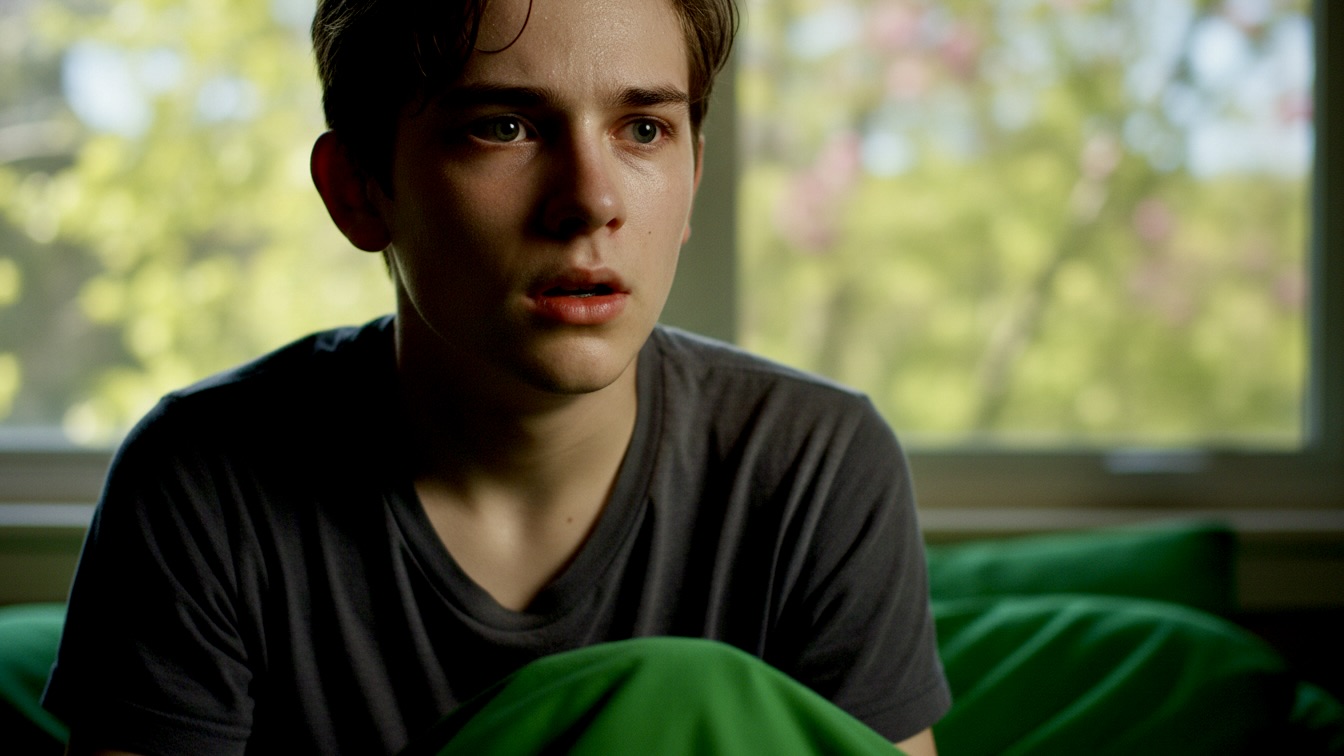
Carl is a seventeen-year-old struggling with severe PTSD and deep-seated survivor's guilt. He begins the story in a state of active denial, attempting to rationalize his surroundings as a hallucination, but ends in a state of terrifying realization, unable to escape the physical evidence of his trauma.
Leo (The Coyote) acts as the manifestation of Carl's subconscious guilt and the brother he lost. He is cold, mocking, and entirely devoid of the warmth Carl remembers, serving as a mirror that reflects the harsh, unforgiving truth of the accident back at the protagonist.
Carl navigates the glass desert, his confusion mounting as he realizes the wreckage is composed of parts identical to his brother's car. He encounters the Coyote, who shatters his delusions and forces him to acknowledge the specific circumstances of the crash. The climax occurs as a storm of rust and oil descends, forcing Carl to scream his confession of guilt while the landscape physically tears him apart.
The episode begins with a sterile, isolating dread, shifting into a frantic, high-tension panic during the confrontation with the Coyote. The emotional trajectory bottoms out in a moment of raw, sobbing vulnerability, before transitioning into a lingering, cold sense of hopelessness as the reality of his situation bleeds into his waking life.
If expanded, the series would reveal that these "Liminal Miles" are interconnected, with different characters crossing paths in these purgatorial states. The overarching narrative would track a mysterious "Architect" or force behind these landscapes, suggesting that these individuals are being tested or harvested for their emotional energy.
As the season progresses, characters who successfully confront their trauma might find a way out, while those who fail remain as permanent fixtures of the landscape. The season finale would culminate in a character discovering that the "real world" is just another layer of the same trap, leading to a desperate attempt to break the cycle of the entire series.
The visual style is defined by high-contrast, clinical lighting that feels artificial and oppressive, utilizing a palette of blinding whites, gunmetal grays, and bruised, sickly oranges. The aesthetic is surreal and tactile, emphasizing the sharp, dangerous textures of the glass and the viscous, oily nature of the decay, comparable to the nightmarish logic of Jacob’s Ladder or the bleak, atmospheric isolation of Silent Hill.
The target audience is fans of psychological horror and surrealist dramas, specifically adults and older teens (16+) who enjoy character-driven narratives that prioritize atmosphere and thematic depth over jump scares. It is intended for viewers who appreciate slow-burn tension and ambiguous, haunting endings.
The pacing is deliberate and suffocating, mirroring Carl’s own feeling of being trapped in a loop. The first act establishes the isolation, the second act builds the psychological pressure through dialogue, and the third act accelerates into a chaotic, sensory-heavy climax before a sudden, jarring cut to black.
The production relies heavily on practical effects to render the glass desert, using crushed safety glass and matte-painted wreckage to create a convincing, dangerous environment. The Coyote requires a blend of high-quality animatronics and subtle CGI for the mouth movements to ensure the uncanny, "glitching" effect of Leo’s voice is unsettling rather than cartoonish.
The sound design is critical, specifically the contrast between the "vacuum" silence of the desert and the harsh, abrasive sounds of crunching glass and mechanical screeching. The transition between the desert and the bedroom should be seamless, using a match-cut on the sound of the glass to disorient the audience and blur the line between reality and the nightmare.


