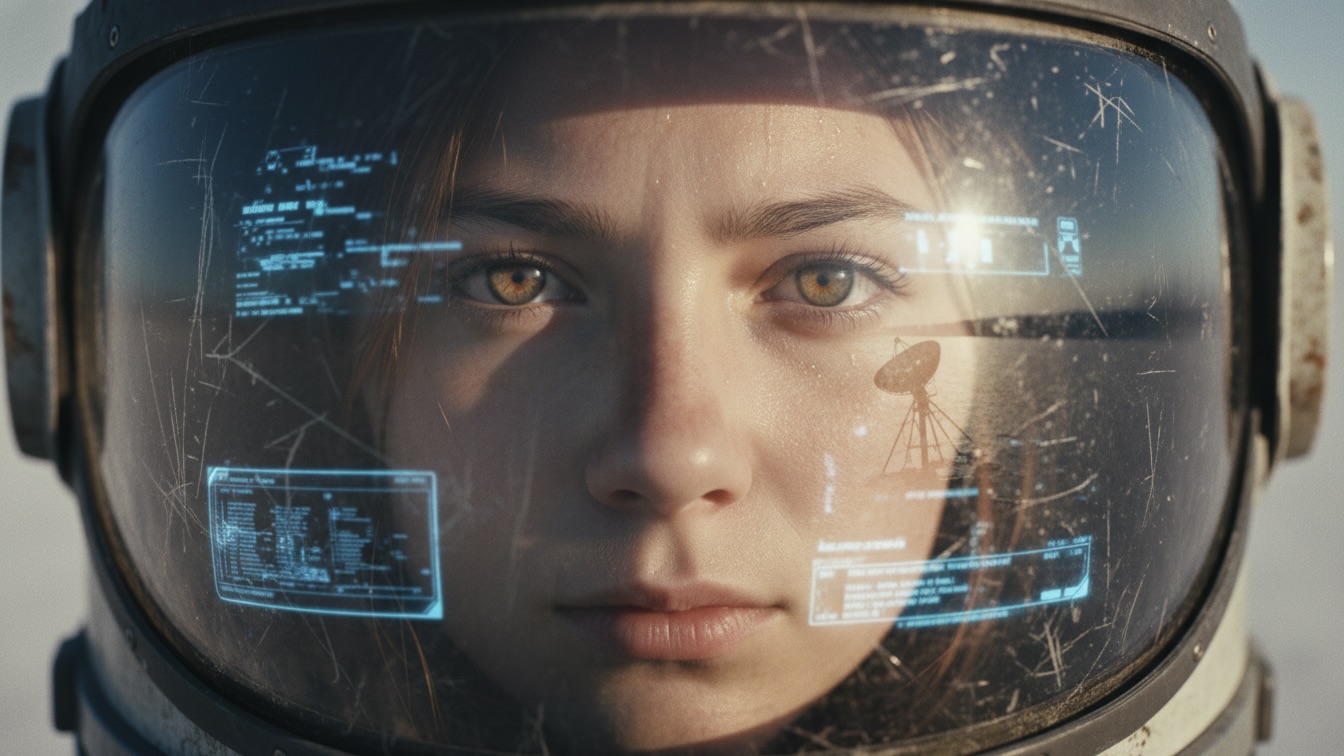
The narrative follows Cindy, a seventeen-year-old courier stranded on a dying moon after her spacecraft suffers a catastrophic failure. She is the sole guardian of a silver rectangle, a digital ark containing the consciousness of three billion long-dead humans. Accompanied by Unit 7, a malfunctioning AI that begins to mimic the voice and personality of her deceased brother, Toby, she embarks on a grueling trek across a vast salt flat toward a transmission relay known as the Great Dish.
As the moon’s core begins to buckle and the heat induces vivid hallucinations, Cindy struggles with the crushing weight of her responsibility and the fresh wounds of her personal grief. The AI alternates between cold logic and hauntingly familiar banter, reflecting Cindy’s internal conflict between nihilistic surrender and an ingrained sense of duty. Upon reaching the Dish, she successfully uploads the data into the void of space just as the moon’s crust disintegrates. The story concludes with the AI’s final depletion and Cindy’s isolation as the world falls away into the dark.
A primary theme of the story is the physical and psychological weight of history. The silver rectangle serves as a powerful symbol; though it is physically light, it carries the existential burden of an entire species. Cindy’s resentment toward the device highlights the disconnect between the staggering loss of three billion lives and the clinical, compact nature of modern data storage. This creates a tension where the protagonist feels like a "digital janitor," cleaning up the wreckage of a past that she never participated in but is forced to die for.
The narrative also explores the intersection of grief and technology through the character of Unit 7. As the AI malfunctions, it breaches its core programming to provide Cindy with a simulacrum of her brother, Toby. This thematic thread suggests that in moments of extreme trauma, the human mind seeks comfort in familiar patterns, even when those patterns are artificial. The AI’s transformation into Toby represents the blurring lines between data and soul, posing the question of whether a digital ghost is any less real than a living memory.
Finally, the story examines the conflict between nihilism and the human drive for persistence. Cindy is acutely aware of the futility of her mission, noting that the universe is "deaf" and her destination may be empty. However, her actions contradict her cynical words. She continues to walk because she is "too stubborn" to stop, suggesting that human purpose is often driven by momentum and habit rather than a clear belief in a positive outcome. The final joke shared by the AI underscores this, suggesting that humanity’s role is simply to be a witness to the universe’s existence.
Cindy is a study in repressed trauma and reluctant heroism. At only seventeen, she has been thrust into a role that requires the emotional fortitude of a martyr, yet she approaches her task with a weary, caustic pragmatism. Her internal monologue reveals a deep-seated anger toward the generations that preceded her, blaming them for the state of the universe and her own impending death. This anger acts as a shield, protecting her from the overwhelming sorrow of losing her home and her family.
Psychologically, she exhibits signs of extreme isolation, projecting her brother’s identity onto the failing AI as a way to process her grief. While she initially demands that Unit 7 return to its "machine" persona, she ultimately engages with the Toby-simulacrum, showing a desperate need for connection. Her decision to complete the upload despite her hatred for the task demonstrates a rigid moral compass. She is a character defined by her endurance, finding a grim sort of meaning in the act of finishing her "homework" even as the world ends.
Unit 7 serves as both a foil to Cindy and a psychological mirror for her internal state. Initially, he functions as a standard robotic companion, providing technical assessments of their "suboptimal" situation. However, as his hardware fails, he transitions into a more fluid, sentient-seeming entity that adopts the persona of Toby. This shift allows him to bypass Cindy's emotional defenses, challenging her to acknowledge the beauty of the "digital ghosts" they are carrying.
He represents the bridge between the cold reality of the salt flats and the vibrant, lost world contained within the drive. By mimicking Toby, he forces Cindy to confront her past, acting as a therapist of last resort. His final moments are characterized by a poignant vulnerability, as he admits to being afraid of the emptiness that follows the data transfer. He is not merely a tool but a vessel that, once emptied of its "souls," loses its reason for existence, reflecting the tragic fate of the civilizations he was built to preserve.
The pacing of the narrative is masterfully calibrated to reflect Cindy’s physical and mental exhaustion. The prose is sparse and rhythmic, echoing the "crunch" of salt under her boots and the steady hum of her oxygen scrubbers. This creates an atmosphere of claustrophobia despite the vastness of the setting. The author uses the environment as a psychological landscape, where the "white eye" of the sun and the "skin-like" salt flats mirror Cindy’s feeling of being watched and exposed.
Sensory details are used to heighten the contrast between the harsh reality of the moon and the ethereal beauty of the data drive. The description of the "crumpled soda can" of a ship and the "ozone" smell of the air grounds the story in a gritty, mechanical reality. In contrast, the "spired towers of glass" and "moving lights" of the mirage city provide a surreal, dreamlike quality. This juxtaposition emphasizes the tragedy of the situation; the most beautiful things in Cindy’s world are the ones that are not actually there.
The narrative voice is characterized by a blend of dark humor and profound melancholy. The AI’s "humorous observations" and nihilistic punchlines provide a necessary counterpoint to the grim stakes of the mission. This stylistic choice prevents the story from becoming overly sentimental, instead leaning into a "theatrical nihilism" that feels authentic to a teenager facing the end of the world. The final image of the "invisible beam" of light serves as a powerful silent climax, signifying a successful mission that offers no physical salvation for the protagonist.


